In a Nutshell
- Offshore casino websites and live dealer software providers are often separate businesses.
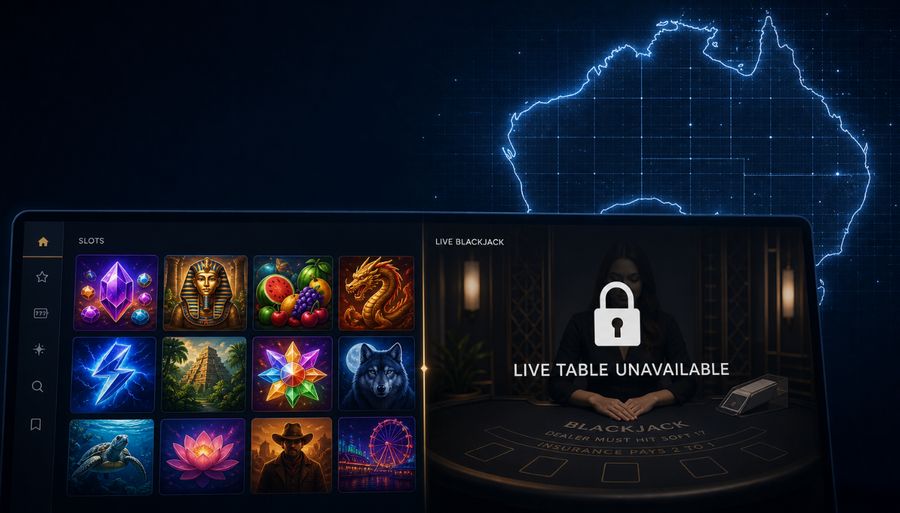
- A casino can display thousands of pokies in its lobby while its Live Blackjack, Roulette and Baccarat tables remain blocked.
- Live casino suppliers use geo-fencing to detect where a player is located.
- Geo-fencing can use an IP address, account country, device signals, identity checks and payment information.
- When a live dealer provider detects an Australian location, it may refuse to launch the live stream.
- The player may see a blank screen, an endless loading icon, a technical error or an “unavailable in your region” message.
- Successful registration, a visible game tile or a completed deposit does not mean that live casino games are available or permitted.
- Live dealer providers often apply stricter geo-blocking because their streamed Blackjack, Roulette and Baccarat products require separate licensing and compliance controls.
- Online casino services, including live dealer games, are prohibited from being provided to people in Australia.
- Do not attempt to bypass geo-blocks with VPNs or false account details, as this can create account, verification and withdrawal problems.



Why Are Live Dealer Tables Unavailable at Some Offshore Casinos in Australia?
Live dealer tables may appear unavailable at offshore casino websites because the casino lobby and the live-stream supplier operate under separate compliance rules. A site may show thousands of slot-style games in its catalogue, yet the live Blackjack, Roulette or Baccarat stream can be blocked automatically when the player’s location is detected as Australia.
Why This Happens
The short explanation is that a casino website is often not the company actually running the live dealer game.
An offshore casino can operate as a front-end platform. It manages registration, payments, promotions, the player account and the game lobby. However, its live casino section may be supplied by a specialist studio provider. That provider owns or operates the physical tables, cameras, streaming infrastructure, game software and dealer-management systems.
A typical setup may involve three separate parties:
- The casino website, which hosts the player account and displays games in its lobby.
- The live dealer software provider, which supplies the streamed Blackjack, Roulette, Baccarat or game-show table.
- The licensing or compliance framework that defines where the provider is permitted to make its stream available.
This separation explains a common Australian experience. A player opens an offshore casino website, sees a huge collection of pokies, registers successfully, logs in, and can browse the entire casino lobby. But when they click a live dealer game, they may see a blank screen, a loading loop, an “unavailable in your region” message or a game tile that disappears after the page refreshes.
The casino may accept the account, but the live dealer provider can independently refuse to deliver its stream to an Australian IP address.
The Legal Context in Australia
Australia’s Interactive Gambling Act 2001 prohibits online casino-style gambling services from being provided to people in Australia. The prohibition covers online casino games, including slots or pokies, poker, roulette, blackjack and comparable games of chance offered over the internet. The rules apply to offshore operators as well as businesses located in Australia when they provide prohibited services to people physically present in Australia.
Live dealer products sit squarely within the online casino category. A streamed Blackjack table may look different from a digital table game because it features a human dealer, real cards, a studio environment and a live video feed. However, it still enables remote betting on a casino game through the internet.
That makes live dealer access a significant compliance issue for suppliers, studios, software developers, payment partners and casino operators. The Australian Communications and Media Authority, or ACMA, enforces the Interactive Gambling Act and has powers that include investigating suspected breaches and seeking the blocking of illegal gambling and related affiliate websites.
For this reason, the question is not only whether a casino website lets an Australian user create an account. The key issue is whether each individual product supplier is willing and permitted to make a particular game available to a person located in Australia.
Casino Lobby vs Game Provider
A casino lobby can be misleading because it often displays a global game catalogue rather than the final catalogue available to each individual player.
When a visitor opens an offshore casino homepage, the site may show categories such as:
- Pokies or slots.
- Jackpot games.
- Table games.
- Live casino.
- Blackjack.
- Roulette.
- Baccarat.
- Game shows.
- Crash games.
- Instant-win games.
- Tournaments.
- New releases.
The presence of a game tile does not confirm that the game will load for every user. It may simply indicate that the casino holds a commercial agreement with the provider or has integrated the provider’s catalogue into its lobby.
The final availability check can take place only after a player clicks the game.
In many cases, the casino sends a request to the supplier’s game-launch server. That request may include technical and account-level data, such as:
- The player’s country or registered jurisdiction.
- The detected IP address and approximate physical location.
- Device information.
- Browser settings.
- Account currency.
- Casino brand identifier.
- Whether the account has passed identity checks.
- Whether the game is being opened in real-money or demo mode.
- Whether the player is subject to any self-exclusion or restriction.
- The operator licence associated with the request.
The live provider’s system then decides whether to issue a game session. If Australia is on the provider’s restricted-territory list, the stream will not launch, even if the main casino website appears fully accessible.
This is why a user can sometimes play or view certain game categories while live dealer tables remain unavailable.
Why Live Casino Is Often Blocked First
Live casino streams are often subject to stricter geographic controls than standard slot-style games. There are several practical reasons for this.
Live studios are closely regulated
A live dealer product is a broadcast operation as well as a gambling product. It involves real dealers, studio facilities, equipment, game supervisors, physical cards, roulette wheels, cameras and video-streaming systems.
The supplier may operate under licences issued by particular gambling jurisdictions. Those licences can define the markets where the supplier may provide games. A studio provider may be expected to prevent access from countries where its product is not authorised.
The supplier therefore has a direct reason to enforce country restrictions rather than relying entirely on the casino brand to do so.
Live games need continuous verification
A video slot or RNG table game can often be delivered through a software package. A live dealer table requires an active real-time session.
The provider must verify not only that the player has opened the game, but also that the stream, betting interface, dealer table and account connection work together in real time. This makes location control easier to enforce at the moment the game session is created.
A live provider can simply refuse to generate the stream token required for the table to load.
Supplier risk is concentrated
A casino may offer content from dozens or hundreds of suppliers. If one live-stream provider is found to be supplying a restricted market, that provider could face regulatory, licensing, commercial and reputational consequences.
The supplier may therefore adopt a more conservative approach than the casino operator. It may block a country based on IP location even where the casino itself has not stopped registrations from that country.
Live dealer products attract closer scrutiny
Live Blackjack, Roulette and Baccarat are highly recognisable casino products. A real dealer and a studio feed make the product easier for regulators, rights holders and compliance teams to identify than a generic game tile in a large slot catalogue.
This does not mean slot-style games are permitted in Australia. Online casino services are prohibited from being provided to Australians, including online slots and table games. It simply explains why a live dealer supplier may enforce its location block more visibly or more reliably than some other parts of an offshore casino lobby.
How Geo-Fencing Works
Geo-fencing is the process of restricting access to a digital service based on a user’s geographic location. In live casino software, it is usually a layered system rather than a single country check.
A provider may use several signals at once.
IP address detection
An IP address can indicate the country and approximate region from which a user is connecting. If a player’s internet connection is identified as Australian, the live dealer launch request may be blocked.
This is one of the most common reasons a table fails to load.
A player can create an account using an email address, select a different account currency and browse an offshore casino lobby, yet still be blocked when the provider detects an Australian IP address at game launch.
Account country
The registration form may ask for a country of residence. If the account is marked as Australian, the casino or provider can remove live games before the player attempts to open them.
Some offshore sites may still display the games because their lobby is not fully filtered. The restriction can then occur at the supplier level instead.
GPS, device and network signals
Mobile devices, apps and browser environments can reveal more than a basic IP address. Depending on the platform and permissions, a service may use network data, device location settings, mobile carrier information, time zone indicators or other location signals.
The purpose is to identify whether the person is physically located in a restricted territory.
KYC information
KYC means “Know Your Customer.” It refers to identity and verification processes used by financial and gambling services.
If a player submits an Australian passport, driver licence, proof of address or Australian bank information during verification, the operator may restrict, suspend or close access to products that cannot legally be offered to that person in Australia.
A player may be able to open an account initially because the casino has not completed verification. That does not mean they will remain eligible to use all services or withdraw funds.
Payment data
Deposit and withdrawal methods can create another location signal. Bank accounts, card issuers, mobile-payment details and other financial information may indicate an Australian connection.
Payment review may occur later than sign-up. This is one reason a player should never interpret a successful deposit as proof that a casino product is lawful, available or eligible for withdrawal in Australia.
Provider-side game tokens
Live dealer games often launch through a secure session token. The casino requests a token from the supplier, and the supplier verifies the conditions for access.
If the provider’s system finds a location restriction, it may decline to issue a valid token. The casino may then show a blank page, error message, spinning loader or generic “game unavailable” notice.
The player is not necessarily seeing a technical fault. They may be seeing a compliance decision expressed through a software error.
Why Pokies May Still Appear Available
A player may ask a reasonable question: if live dealer software can block Australia, why do thousands of pokies remain visible?
The answer is that visibility is not the same as legal availability, and not every supplier applies restrictions in the same way.
An offshore casino can integrate a large number of slot providers. Each provider may have its own licence arrangements, technical systems, restricted-territory list and approach to compliance. Some game tiles may be visible in a universal lobby because the casino uses a broad catalogue feed. Others may load only after a location check. Some may disappear after login. Others may appear available until a verification or withdrawal stage.
There are also differences in how products are delivered.
Standard digital games may use a different launch system
Some slots and RNG table games are delivered through remote game servers or software modules that may not use the same real-time streaming and session-control processes as live dealer products.
This does not make the games legal for Australians. It only means the provider’s enforcement mechanisms may be different, less visible or activated at a different point in the customer journey.
Casino catalogues can be poorly filtered
Offshore casino websites are not always carefully localised. A lobby might show games that are unavailable in dozens of countries. The site may be designed to attract broad search traffic first and apply restrictions later.
A game thumbnail in the lobby may therefore be nothing more than a catalogue listing.
Providers maintain separate country lists
One provider may block Australia immediately. Another may block access only after account verification. A third may not have fully implemented country filtering. These inconsistencies can create the impression that certain products are allowed while others are not.
That impression is incorrect. Under Australian law, the central issue is whether prohibited online casino services are being provided to people in Australia, not whether a particular game happens to load from a particular website on a particular day.
Restrictions can change without warning
A game that launched yesterday may be unavailable today. A provider can update its restricted territories, revise a commercial agreement, respond to a compliance review or alter its geo-location controls.
For players, this means access is unstable by design. It is not a dependable service, and it is not a basis for assuming that a casino is safe or compliant.
Common “Unavailable” Messages Explained
Different error messages can point to different causes. The wording may be vague because providers often do not disclose the exact compliance reason.
None of these messages should be treated as an invitation to find a workaround. They indicate that the product is unavailable or restricted from the user’s location.
Why Registration Does Not Mean Approval
A successful account registration can create a false sense of security.
Many offshore websites use automated sign-up systems. A customer may enter an email address, mobile number and password, accept the terms and immediately enter the casino lobby. At that early stage, the operator may have collected very little reliable information about the person’s identity or physical location.
Registration is not the same as:
- Identity verification.
- Residence verification.
- Payment verification.
- Eligibility confirmation.
- Legal availability of a specific product.
- Approval to use live dealer tables.
- Approval to withdraw a balance.
- Protection under Australian gambling regulation.
A casino can allow an Australian email address to create an account while the live dealer provider later blocks gameplay through IP checks. The casino may also apply restrictions once it receives identity documents or detects an Australian payment method.
This mismatch is particularly common with offshore websites because their customer onboarding can be designed for broad international traffic, while game suppliers operate under stricter market-by-market controls.
The Risks of Trying to Bypass Geo-Blocks
Some websites, forums or social-media posts may suggest using a VPN, changing device settings, selecting a different country during registration or using an alternative payment method. These are not reliable or responsible solutions.
Attempting to bypass geographic restrictions can create serious problems:
- It may breach the casino’s terms and conditions.
- It may lead to account suspension or closure.
- It may result in a withheld or cancelled withdrawal request.
- It can create inconsistencies between account details, IP information and identity documents.
- It may expose the user to scams, malware, account theft or unregulated payment services.
- It can make it harder to access help if there is a dispute.
- It does not change the Australian legal position on prohibited online casino services.
A player who accesses a casino through a concealed location may later face verification checks. If the casino finds a mismatch between the account country, IP history and submitted documents, it may argue that the account breached its rules.
This creates an obvious risk: a person may deposit funds, play games and then discover that the provider will not process a withdrawal because the account was not eligible for use in the first place.
The safest response to a geo-block is to treat it as a stop sign, not a technical obstacle.
What Australian Players Can Do Instead
People in Australia who enjoy the social and entertainment side of casino games have safer options than trying to access offshore live casino platforms.
Use free-to-play games carefully
Free-play slot-style games and social casino apps can provide virtual entertainment without real-money wagering or cash withdrawals. They may include simulated Blackjack, Roulette, slots and other games, but the credits should have no cash value.
Before using any app, check that:
- The game clearly identifies credits as virtual.
- There is no real-money betting or cash withdrawal function.
- Purchases of virtual items are optional and clearly priced.
- The app’s privacy policy is easy to find.
- You understand how daily rewards and notifications work.
- You can set personal time and spending limits.
Consider legal gambling formats
Australia permits some gambling products under state and territory regulation, such as licensed wagering on approved events placed before the event begins, lotteries and land-based gambling venues. However, availability and rules vary by location, and gambling always carries financial risk.
The distinction matters. A licensed wagering service is not the same as an online casino, and an online casino product should not be assumed lawful simply because sports betting advertisements are visible in Australia.
Focus on entertainment, not a payout
Casino-style games should never be treated as a way to generate income, recover losses or solve financial pressure. Free games are best viewed as entertainment products, while real-money gambling should be approached with strict limits and an awareness that outcomes are unpredictable.
Seek support if needed
If gambling or casino-style gaming is becoming stressful, difficult to control or financially harmful, confidential support is available through Gambling Help Online. It provides advice, self-help resources and pathways to counselling and support services in Australia.
Frequently Asked Questions
Why can I see live casino games but not open them?
The casino lobby may display a global catalogue, but the live dealer provider can block the game during launch. This often happens when the provider detects that the player is located in Australia.
Why do slots load but Live Blackjack does not?
Different suppliers use different systems and country restrictions. A live dealer studio often has tighter provider-level geo-fencing because it operates a real-time streamed casino product. This does not mean online slots are permitted for Australians.
Does an offshore casino accepting Australian registrations mean it is legal?
No. Registration access is not proof that a service is lawful, regulated for Australian customers or permitted to offer a particular product. Australian law prohibits online casino services from being provided to people in Australia.legislation.gov+1
Is a blank live dealer screen always a technical problem?
No. It may be caused by an ordinary technical issue, but it can also be the visible result of a geo-location or compliance block. If the problem repeats across multiple live tables, location restriction is a likely explanation.
Can a casino block a game after I have already deposited?
Yes. Deposits, account registration, game access and withdrawals can involve different systems. A casino or game provider may apply location restrictions at any stage, including after a deposit or during verification.
Can I use a VPN to make live casino games work?
Trying to bypass geo-blocks can breach terms and create account, verification and withdrawal problems. It also does not change the fact that online casino services are prohibited from being provided to people in Australia.
Why do providers have stricter rules than the casino itself?
The live dealer provider may have its own licences, regulatory obligations, studio partners and restricted-country list. It may choose or be required to block Australian access even if the casino’s general website remains visible.
Final Thoughts
The strange situation where thousands of pokies appear available but Live Blackjack shows a blank screen is usually not random. It reflects the way offshore casino platforms and live dealer providers operate as separate businesses with separate compliance systems.
The casino website may accept an account and display a broad catalogue. The live dealer casino then performs its own checks at the point where a player attempts to enter a table. If the provider detects Australia, it can refuse to create the live game session, leaving the player with an unavailable screen, loading error or regional restriction notice.
For Australian players, that restriction should be understood in its proper context. Online casino products, including live dealer Blackjack, Roulette and Baccarat, are prohibited from being provided to people in Australia under the Interactive Gambling Act 2001. Offshore sign-up access, a visible game tile or a successful deposit does not change that position.
The most sensible approach is to avoid sites that offer or market real-money online casino products to Australians, avoid attempts to bypass geographic restrictions and choose free-to-play entertainment or regulated alternatives where appropriate.
Sources
- Australian Government — Interactive Gambling Act 2001
- Australian Communications and Media Authority — Action on Interactive Gambling
- Australian Communications and Media Authority — Interactive Gambling Safeguards Compliance Priority Report
- Gambling Help Online Australia
Last Updated on September 11, 2026 by Pokie-Player