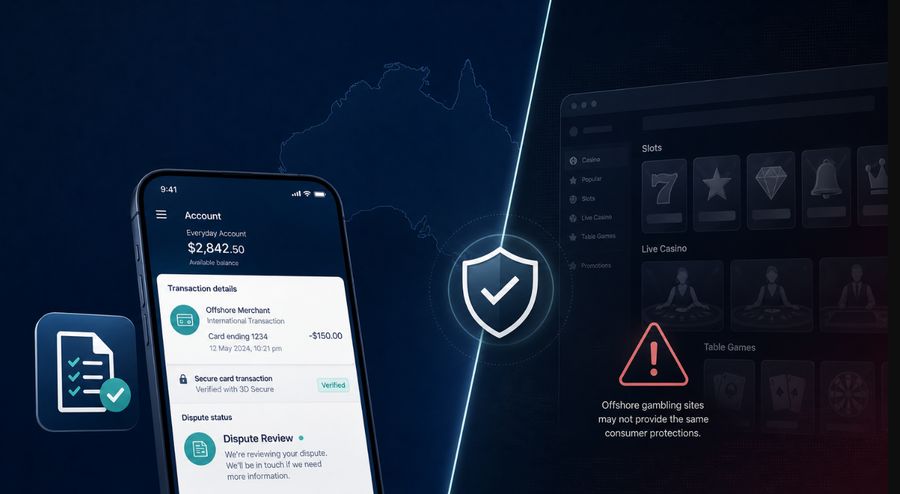
In a Nutshell
- You may be able to lodge a bank chargeback for an offshore casino deposit if the transaction was genuinely unauthorised, duplicated, charged for the wrong amount or linked to a clear scam.
- A chargeback is not a standard way to recover money lost after you knowingly deposited funds, received casino credit and used it to gamble.
- Visa and Mastercard disputes focus on the payment itself. Banks consider whether you authorised the charge, whether the merchant supplied the credited value and whether there is evidence of fraud or a processing error.
- Regretting a deposit, losing a gambling session or discovering that a casino is offshore does not automatically make the transaction eligible for a refund.
- If you did not make a casino payment, contact your bank immediately through its official app, website or phone number. Ask about securing or replacing the card and disputing the unauthorised transaction.
- Keep evidence such as bank statements, transaction dates, screenshots of account deposits, payment confirmations and written messages with casino support.
- Do not falsely claim that an authorised casino deposit was fraud. Casinos and payment providers can use account, IP address, login, payment and gameplay records to challenge a dispute.
- A dishonest chargeback can lead to casino account closure, cancelled withdrawals, confiscated bonuses and blacklisting across related white-label casino brands.
- Online casino services are prohibited from being provided to people in Australia. However, this does not automatically mean every voluntary offshore casino deposit can be reversed through a bank chargeback.
- If gambling losses are causing financial stress, stop further deposits, ask your bank about available card controls and contact Gambling Help Online for confidential support.



Australian Guide to Chargebacks for Offshore Casino Deposits
A bank chargeback may be available when a casino deposit was genuinely unauthorised, duplicated, processed incorrectly or connected to clear fraud. It is not a legitimate way to recover ordinary gambling losses after willingly making a deposit and using the funds to play.
This distinction matters for Australians who have used offshore casino websites. A common myth suggests that a player can deposit money, gamble, lose, then ask Visa, Mastercard or their bank to reverse the payment because the casino is offshore or because online casino services are prohibited from being provided to people in Australia. That is not how card disputes are designed to work.
A chargeback is a payment-dispute process. It is not an insurance policy for losses, a refund mechanism for a bad betting session or a shortcut around a casino’s withdrawal rules. Making a false claim can create serious consequences, including account closure, loss of any remaining balance, card disputes being rejected and blacklisting across connected casino brands.
What a Chargeback Actually Is
A chargeback is a process where a cardholder asks their card issuer or bank to dispute a specific transaction. The bank reviews the claim, may request evidence and, if the dispute meets the relevant scheme rules, can attempt to reverse the transaction through the card network.
In Australia, card transactions may be processed through Visa, Mastercard, debit-card networks or other payment methods. The exact dispute process depends on the bank, card type, payment method and facts of the transaction.
A chargeback is not automatic. It is not a guaranteed refund. It is also not the same as a bank deciding that a customer should receive money back because they are unhappy with a purchase.
The bank normally examines questions such as:
- Did the cardholder authorise the transaction?
- Was the charge duplicated?
- Was the merchant correctly identified?
- Did the customer receive the service they paid for?
- Was the payment processed for the correct amount?
- Was the card used fraudulently?
- Is there evidence of misleading conduct or a failure to provide an agreed service?
- Did the customer first try to resolve the issue with the merchant?
- Is the claim within the applicable time limit?
- Does the transaction fit a valid card-scheme dispute category?
The key principle is simple: a card dispute must be truthful and supported by evidence.
For gambling-related payments, the distinction between an unauthorised transaction and an authorised gambling loss is particularly important.
The Difference Between Fraud and Gambling Losses
A person may feel that they “lost money unfairly” after a poor gambling experience. That feeling does not automatically turn an authorised payment into an unauthorised transaction.
There is a major difference between these situations.
The most important point is that a player cannot accurately describe a transaction as “unauthorised” if they personally entered card details, confirmed the payment, received casino credit and used that credit to gamble.
That type of claim can be treated as a false dispute, sometimes called friendly fraud or first-party misuse. It can lead to significant problems with both the bank and the merchant.
Why Losing a Deposit Is Not a Chargeback Reason
When a person makes a casino deposit, the transaction normally purchases a balance or gambling value in the casino account. The player then chooses how to use that value.
For example, a player might deposit $100, receive $100 in their account and use it to place blackjack, roulette or pokie-style bets. If the account balance later falls to zero because of game outcomes, the original card payment was still authorised and the deposited value was supplied.
The player may be unhappy with the result, but the payment itself was not necessarily invalid.
Mastercard’s published chargeback guidance specifically addresses gambling, investment and similar purchases. It distinguishes between a failure to provide the purchased gambling value and disputes relating to the later use of that value, such as bets, withdrawals, gains or losses. In practical terms, a gambling loss after the player received and used the deposited balance is not ordinarily a standard chargeback claim.mastercard+1
This is also why the wording used when speaking to a bank matters. A truthful description would explain what happened:
- You made the deposit.
- You used or did not use the account balance.
- You believe a particular charge was duplicated, unauthorised or incorrectly processed.
- You have documents that support the concern.
A false description, such as claiming that a known and personally authorised deposit was card theft, can undermine the entire claim.
Visa and Mastercard: How Dispute Rules Apply
Visa and Mastercard operate card networks. Your bank or card issuer handles the dispute with you, then uses the network process to raise the claim with the merchant’s payment provider if there is a valid basis.
Although the card schemes have different terminology and detailed rules, the broad concepts are similar:
- Unauthorised card use may be disputed.
- Duplicate transactions may be disputed.
- Incorrect amounts may be disputed.
- Certain processing errors may be disputed.
- Goods or services not provided may sometimes be disputed.
- Gambling losses are not simply refundable because the player lost.
- A dispute needs a legitimate reason code, evidence and compliance with time limits.
- The merchant can respond with evidence that the transaction was authorised and the service was supplied.
A cardholder may receive a provisional credit while a bank investigates. That is not a final decision. The merchant or its payment processor can challenge the dispute and submit evidence.
In an online casino context, evidence may include:
- The account registration details.
- IP address records.
- Device and browser information.
- Deposit timestamps.
- Confirmation emails.
- 3-D Secure authentication records.
- Login history.
- Gameplay history.
- The account balance before and after the deposit.
- Bonus acceptance records.
- Chat messages and customer-support correspondence.
- Identity-verification documents.
- Withdrawal attempts.
- Screenshots of accepted terms and conditions.
If a casino can show that the account holder made the deposit, passed security checks, received the funds and used them for gambling, a claim based only on later losses is likely to be difficult to sustain.
When a Chargeback May Be Legitimate
There are situations where a player should contact their bank promptly. The important factor is whether there is a genuine payment problem, not whether the gambling experience was disappointing.
Unauthorised card transactions
If you find casino deposits on your statement that you did not make, act quickly.
You should:
- Contact your bank using the official number on the back of your card or through the bank’s secure app.
- Tell the bank that you believe the transaction is unauthorised.
- Ask the bank to block or replace the card if necessary.
- Review recent transactions for other suspicious activity.
- Change passwords for your bank, email and payment accounts.
- Keep a record of dates, transaction amounts and merchant names.
- Report the matter to Scamwatch if you believe you have been targeted by a scam.
- Consider reporting identity theft or serious fraud to the appropriate authorities.
Do not contact a phone number shown in an unexpected text message, email or pop-up. Use your bank’s official website, app or the number printed on the card.
An unauthorised transaction is different from a deposit that you made but later regretted. Be accurate when describing what happened.
Duplicate charges
A duplicate charge can occur when a payment is processed twice, a transaction is repeated after an error message or an account is charged more than once for a single deposit.
Before raising a dispute, check whether one transaction is pending. Sometimes a pending authorisation may disappear or settle correctly after a short period. If both charges have settled and you only intended one payment, gather evidence and contact the casino first if it is safe and practical to do so. If the issue remains unresolved, contact your bank.
Keep:
- A screenshot of the casino deposit history.
- Bank transaction records.
- The date and time of each charge.
- Any payment confirmation emails.
- Copies of messages sent to casino support.
Incorrect transaction amount
If you authorised a $20 deposit but the statement shows $200, that is a specific payment dispute. The question is not whether the player lost money gambling. The question is whether the merchant processed an amount that was different from the amount the customer authorised.
Save screenshots of the payment page, confirmation messages and account transaction history. Report the issue quickly through your bank’s official dispute channel.
Merchant misrepresentation or non-delivery
These cases can be more complex. A player may claim that a website misrepresented its identity, presented itself as a legitimate service but was actually a scam, or took a deposit without providing the promised account credit.
A bank will usually want evidence. The stronger the documentation, the better:
- Screenshots of the website and offer.
- Deposit receipts.
- The casino account history.
- Correspondence with customer support.
- Evidence that no funds were credited.
- Evidence that the merchant name on the statement differs from what was disclosed.
- Details of any suspicious redirections or impersonation.
Do not assume that every withdrawal dispute qualifies as non-delivery. If a casino credits a deposit, allows gameplay and later applies its verification or bonus rules, the matter may be treated differently from a situation where the site never provided any account value at all.
The Offshore Casino Myth
A particularly risky myth is that a player can automatically charge back any offshore casino deposit because the casino is not licensed in Australia or because online casino services are prohibited from being offered to people in Australia.
The fact that a service may be prohibited does not automatically convert every voluntary payment into a successful card dispute.
Australia’s Interactive Gambling Act 2001 prohibits certain online gambling services, including online casino-style services, from being provided to people in Australia. The legal focus is primarily on the provider and whether it offers a prohibited service to Australian customers.
A card issuer still assesses a chargeback based on the payment facts and the applicable card-scheme rules. If the cardholder knowingly made a deposit and used the casino balance, the bank may find that the transaction was authorised even if the operator was offshore or the service should not have been made available to Australians.
This is why “the casino was illegal” should not be used as a blanket chargeback strategy. It is not a substitute for proving fraud, unauthorised use, a duplicate payment or a genuine processing failure.
A customer who believes they have been scammed should report the actual facts. A person who made an informed deposit and lost should not try to rewrite the transaction history afterward.
The White-Label Casino Network Risk
Many offshore casino brands are not standalone businesses. They operate through white-label networks, platform providers, shared payment systems, common game suppliers or connected marketing groups.
A white-label arrangement allows multiple casino brands to use shared infrastructure while presenting different names, logos, designs and promotions. From the player’s perspective, they may look like unrelated websites. Behind the scenes, they can share systems for:
- Account management.
- Fraud prevention.
- Identity verification.
- Payment processing.
- Bonus administration.
- Customer service.
- Game-provider access.
- Risk management.
- Responsible gambling controls.
- Chargeback monitoring.
- Terms enforcement.
If a player lodges a chargeback after making an authorised deposit and the operator determines that the claim was false, the account can be flagged. The consequences may extend beyond one website.
Possible outcomes include:
- Immediate account suspension.
- Closure of the casino account.
- Cancellation of outstanding withdrawals.
- Confiscation of promotional balances.
- Removal from loyalty or VIP programmes.
- Refusal of future deposits or withdrawals.
- Requests for enhanced identity verification.
- A fraud or chargeback risk marker in a shared operator system.
- Closure or review of accounts at related brands.
- Restricted access to promotions across the network.
This does not mean every bank dispute will create a network blacklist. A genuine fraud report should be made when it is justified. The risk arises when a player files a dishonest chargeback after authorising a deposit and using the funds for gambling.
A truthful dispute is consumer protection. A false dispute can be treated as attempted fraud.
Why “Friendly Fraud” Is a Serious Problem
Friendly fraud is an informal term for a dispute made by someone who authorised a transaction but later tells the bank that it was unauthorised or invalid.
The phrase can sound harmless. It is not.
In a casino setting, friendly fraud may involve a player who:
- Deposits with their own card.
- Completes a security verification step.
- Uses the deposited funds to gamble.
- Loses money.
- Files a chargeback claiming the payment was not authorised.
- Claims they never received casino credit despite a complete gameplay record.
- Claims a family member used the card even though they personally controlled the account.
- Files disputes after a withdrawal fails because they broke terms or used false account details.
Merchants and payment processors take these disputes seriously because chargebacks create costs, administrative work and risk for them. A casino can challenge a dispute with transaction records, account logs and security evidence.
A bank may also look at the broader pattern. Multiple disputes, conflicting explanations or a mismatch between the claim and the evidence can affect how a bank handles future claims.
Always tell the truth. If a casino transaction was yours, say that it was yours. If it was not yours, report it immediately and give the bank all relevant information.
What to Do Before Contacting Your Bank
If you have an issue with an offshore casino deposit, avoid acting in panic. Take a structured approach.
Check your statement carefully
Identify the exact transaction:
- Date.
- Amount.
- Merchant descriptor.
- Card used.
- Whether the payment is pending or settled.
- Whether the charge appears once or multiple times.
Merchant names on bank statements may differ from the casino brand name. A payment may be processed by a third-party merchant, payment gateway or digital-services company. This does not automatically prove fraud, but it is worth documenting.
Review your account activity
If you can safely access the casino account, check:
- Deposit history.
- Game history.
- Current and past balances.
- Bonus activity.
- Withdrawal history.
- Messages from customer support.
- Account verification status.
Take screenshots before the account is changed, closed or made inaccessible.
Contact the merchant in writing
For a duplicate charge, incorrect amount or missing account credit, write to customer support and keep the correspondence. State the facts clearly and ask for a written response.
Avoid threatening language. Do not make false accusations. Do not say that a payment was unauthorised if you made it.
A simple message can be enough:
“On 12 August, my card was charged twice for one intended deposit of $50. My account shows one deposit only. Please review the duplicate charge and confirm whether a refund will be issued.”
If the merchant does not respond, provides an unsatisfactory answer or appears to be a scam, this written record can help when you speak to your bank.
Contact your bank through official channels
Use your bank’s secure app, official website, branch or the number on the back of your card. Explain the issue accurately and ask how to lodge a card transaction dispute.
Your bank may ask for:
- Transaction details.
- Screenshots.
- Emails.
- A description of what happened.
- Evidence that you contacted the merchant.
- A police report number in some fraud cases.
- Confirmation that you have not received the goods, service or refund.
Respond promptly and retain copies of anything you send.
A Practical Evidence Checklist
If you believe a casino transaction is genuinely unauthorised or incorrectly processed, prepare your evidence before lodging a dispute.
- Bank statement showing the disputed transaction.
- Screenshot of the casino account deposit history.
- Screenshot showing missing, duplicate or incorrect account credit.
- Payment confirmation emails or text messages.
- Chat transcripts and emails with casino support.
- Screenshots of the offer or payment page, if relevant.
- A timeline of events.
- Proof that the card was lost, stolen or compromised, if applicable.
- A record of all related suspicious transactions.
- Any confirmation from the merchant that a refund was promised.
- Details of the official report made to your bank.
Keep the explanation factual. Banks need clarity, not speculation.
Avoiding Offshore Casino Payment Problems
The best way to avoid a difficult chargeback dispute is to avoid making deposits to offshore casino sites targeting Australians.
Online casino services, including online pokies, roulette, blackjack, poker and live dealer tables, are prohibited from being provided to people in Australia. ACMA investigates suspected breaches and can take enforcement action, including requesting that illegal gambling and affiliate websites be blocked.
Before entering card details anywhere online, consider these questions:
- Does the service appear to be offering online casino games to Australians?
- Is the website using aggressive “no deposit” or “instant withdrawal” claims?
- Is the merchant’s identity clear?
- Are the terms and conditions easy to find and understand?
- Does the payment page use a different company name without explanation?
- Is there a clear privacy policy and support channel?
- Is the site pressuring you to deposit immediately?
- Does it promote workarounds for regional restrictions?
- Are you depositing money you cannot afford to lose?
- Would you still make the deposit if no bonus were offered?
If the answer raises concern, do not deposit. A card dispute after the fact can be slow, uncertain and stressful.
Gambling Harm and Financial Pressure
Chargeback questions often arise after a person has lost more than they intended. If that is what has happened, it is worth pausing before making another deposit or attempting to recover losses through risky actions.
Trying to win back losses is a common danger sign. So is using credit, borrowed money, rent money, bill money or emergency savings to gamble.
Useful immediate steps can include:
- Stop making further deposits.
- Remove saved card details from gambling-related accounts.
- Ask your bank about gambling transaction blocks or card controls, where available.
- Review automatic payments and subscriptions.
- Tell someone you trust about the situation.
- Seek confidential support before the problem becomes larger.
Gambling Help Online provides Australian support, self-help resources and access to counselling for people affected by gambling harm. If you are experiencing financial hardship, a financial counsellor may also help you understand your options without judgment.
Frequently Asked Questions
Can I charge back an offshore casino deposit after losing?
Usually not if you personally authorised the deposit, received casino credit and used it to gamble. Losing a gambling session is not normally a valid chargeback reason.
What if the offshore casino is not legal in Australia?
Online casino services are prohibited from being provided to people in Australia, but that does not automatically make every voluntary card deposit refundable through Visa, Mastercard or your bank. The bank still assesses the specific payment dispute facts.
Can I dispute a casino charge I did not make?
Yes. If a transaction was genuinely unauthorised, contact your bank immediately using its official channels. Secure or replace the card if required, review all transactions and provide accurate information.
What if I was charged twice?
A duplicate charge may be a valid dispute. Check whether one payment is only pending, contact the merchant in writing and keep records. If it is not resolved, ask your bank about a transaction dispute.
Can I file a chargeback because the casino will not pay my withdrawal?
Not automatically. A withdrawal dispute is different from an unauthorised card transaction. The bank will consider the specific evidence and card-scheme rules. Keep records of the deposit, account history, withdrawal request and all communications.
Will a chargeback close my casino account?
It may. Casinos commonly suspend or close accounts after a chargeback, especially where they believe the dispute concerns an authorised payment. A player may also be flagged across related brands that share white-label or risk-management systems.
Can I use a VPN or false details to avoid problems?
No. Using false information or trying to bypass geographic restrictions can breach casino terms and can create verification, withdrawal and account-closure problems. It does not change the Australian legal position.
What should I do if gambling is affecting my finances?
Stop depositing, speak with your bank about available controls and contact Gambling Help Online for confidential support. Reaching out early can make a meaningful difference.
Final Thoughts
A bank chargeback is for genuine payment problems, not for reversing gambling losses. If an offshore casino deposit was unauthorised, duplicated, processed for the wrong amount or linked to a genuine scam, contact your bank quickly and provide honest, well-organised evidence.
If you knowingly made the deposit, used the casino balance and lost, a chargeback is unlikely to be an appropriate solution. Calling an authorised payment “fraud” can harm your credibility, lead to account closure and potentially result in blacklisting across connected casino brands.
For Australians, the safest option is not to deposit with offshore casino websites in the first place. Online casino services are prohibited from being provided to people in Australia, and offshore sites can leave customers with limited protections, unclear dispute processes and significant financial risk. If gambling has become difficult to manage, focus on support and financial stability rather than trying to recover losses through another risky decision.
Sources
- Mastercard — Chargeback Guide
- Visa — Core Rules and Visa Product and Service Rules
- Australian Government — Interactive Gambling Act 2001
- Australian Communications and Media Authority — Action on Interactive Gambling
- Gambling Help Online Australia
Last Updated on September 11, 2026 by Pokie-Player