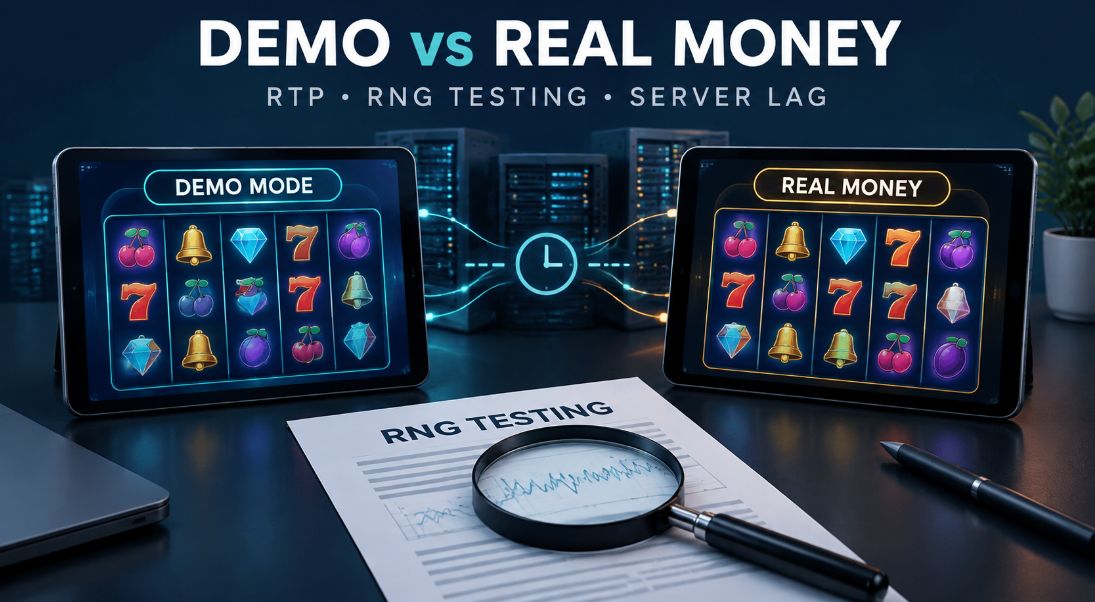
Key Points
- Different results do not automatically mean different mathematics. A winning demo session and a losing paid session can occur with identical probabilities.
- Representative demos should accurately reflect the corresponding paid game. UK standards require matching rules and representative winning chances within their regulatory scope—not across every offshore website.
- Check the exact configuration. Matching titles and artwork do not establish matching RTP, paytables, jackpot participation or bonus settings.
- Promotional showcases can differ from ordinary demos. Clearly labelled demonstrations may highlight features rather than represent typical play.
- Server lag affects timing, not necessarily odds. A slow response or frozen animation does not prove that the game lowered its RTP or changed a result.
- RNG certification has limits. eCOGRA and iTech Labs assessments cover specified products and testing scopes—not automatically every game, configuration, server or withdrawal.
- Verify the certificate, not just the logo. Look for the tested company, product, version, scope and assessment date.
- Round IDs, timestamps and balance records can help investigate a disputed spin. They cannot give players access to hidden server mathematics or replace a laboratory audit.
- HTTPS, low latency and familiar branding do not establish fairness. Avoid tools claiming to predict conventional RNG outcomes.
- For Australians, tested software does not make an offshore casino authorised or guarantee payment. Do not deposit more to investigate a suspected problem.



Demo vs Real-Money Pokies: What Explains Differences in Performance?
A pokie produces several bonuses in demo mode. You switch to real money, the features disappear, and every spin suddenly feels slower.
The obvious suspicion is that the free version was designed to look generous.
That possibility deserves scrutiny, but the experience alone does not prove different mathematics. Short sessions can produce radically different results even when the underlying probabilities are identical. Demo and paid versions may also use different configurations, while payment checks and network delays can change how quickly the game responds.
Those are separate issues. A slower server response is not evidence of a lower return to player. A testing logo does not prove that every version of a game uses the same settings. A promotional demonstration is not necessarily equivalent to an ordinary free-play session.
The strongest investigation starts by identifying exactly what differs: rules, theoretical return, observed results, interface speed or account settlement.
This guide examines those distinctions, explains what eCOGRA and iTech Labs certification can establish, and outlines the limits of player-side verification.
For Australian readers, one point remains separate from the technical debate: overseas certification does not authorise an offshore operator to provide prohibited online casino services to people located in Australia.
Demo vs Real Money: What Should Match?
A representative demo should help users understand the corresponding game—not create an inflated impression of its chances.
The UK Gambling Commission provides a useful regulatory benchmark.
Its RTS 6 standard requires play-for-free games to implement the same rules as corresponding real-money games offered on the same website. Operators must take reasonable steps to ensure that the likelihood of winning and prize distribution are represented accurately.
That requirement does not necessarily mean both modes must call the identical random number generator.
The implementation guidance permits the same RNG, another compliant RNG or a suitable publicly available generator without systematic bias.
The important requirement is representative behaviour, not identical technical infrastructure.
These are British requirements within their regulatory scope. They should not be presented as automatically applying to every website accessible from Australia.
Nevertheless, they establish a sound question for any demo: does it accurately represent the paid version it claims to demonstrate?
Five Differences Players Commonly Mix Together
| Observed difference | What it might mean | What it does not establish |
|---|---|---|
| More bonuses in a demo session | Random variation, a different configuration or a feature demonstration | Deliberate manipulation by itself |
| Slower paid spins | Additional processing, network delay or presentation differences | Lower theoretical RTP |
| Different displayed RTP | A configuration mismatch requiring explanation | The precise cause of short-term losses |
| A frozen result or missing credit | An interrupted round or accounting issue | That the RNG selected a losing result because of lag |
| A testing logo in the footer | A claim about a particular testing scope | Certification of every game, server and transaction |
Start with the category of difference before deciding what caused it.
Otherwise, a timing issue becomes a fairness allegation, or a mathematical mismatch is dismissed as “just lag”.
Both mistakes obstruct a useful investigation.
Why Identical Mathematics Can Produce Different Sessions
Random does not mean evenly distributed across each visit.
A demo session can produce several valuable features while a paid session produces none. Neither result, considered alone, establishes whether the versions differ.
RTP describes a theoretical long-run relationship between stakes and prizes. It is not a refund promise for a particular session.
A fictional 96% game does not owe A$96 back for every A$100 wagered. The distribution of prizes matters, especially where substantial return comes from uncommon events.
Two sessions can therefore finish far apart while following the same rules.
Volatility describes that unevenness, but a label such as “high volatility” is not a complete probability model.
To investigate a difference properly, you need more than two ending balances. You need matching versions, settings and rules—and an analysis that accounts for the game’s prize distribution.
Playing until the results “prove” something is not a sound testing plan. It can simply produce additional losses.
Why a Small Sample Can Be Misleading
Consider a simplified fictional feature with a fixed 1% chance on each independent spin.
Over 100 spins, the average expected number of triggers is one. That does not mean exactly one trigger must occur.
The chance of no trigger is approximately 37%.
That example is not a description of a particular pokie. Real features may use different probabilities or state-dependent rules.
Its purpose is to show why an apparently disappointing sequence can be compatible with the stated chance.
A session with three triggers and another with none would not, on its own, establish different models.
A credible comparison also needs a defined question. Are you testing bonus frequency, total return, a particular prize or something else?
Selecting whichever difference looks most suspicious after the session can create a misleading conclusion.
There is no universal number of personal spins that certifies a game’s fairness. Laboratory assessment has access to evidence that ordinary play cannot provide.
The Same Title Does Not Establish the Same Configuration
Matching artwork is not enough.
Before comparing two versions, record the provider, exact title, displayed rules and any available version or configuration information.
Compare:
-
Theoretical RTP where disclosed.
-
Paytable values.
-
Stake and denomination.
-
Available bonus options.
-
Feature-purchase settings.
-
Jackpot participation.
-
Special betting modes.
A fictional demo displaying 96% and a paid version displaying 94% are not an equivalent comparison, even if their graphics match.
That does not establish how frequently such mismatches occur. It establishes why version information matters.
Likewise, a player using an ordinary spin in one mode and an enhanced feature option in another is not necessarily comparing the same wager.
If material information is unavailable, say so. An unverified configuration should remain unverified rather than being assumed identical—or accused of being different without evidence.
Promotional Demonstrations Are a Separate Category
Some demonstrations exist to show features rather than reproduce a normal session.
The UK Gambling Commission’s guidance explicitly recognises supplier-site demonstrations with higher-than-normal returns, provided they are clearly identified as demonstrations designed to show bonus features.
It also says edited or accelerated promotional footage should be identified appropriately.
That is different from a corresponding free-play game on the operator’s gambling website.
A showcase may move rapidly through special events because its purpose is to display them. A recorded video may omit long stretches of ordinary play.
Neither should be treated as evidence of typical bonus frequency.
Look for labels explaining whether you are viewing:
-
An ordinary playable demo.
-
A feature showcase.
-
An edited video.
-
A demonstration on a supplier website.
Context matters. A transparent showcase and an ordinary demo presented misleadingly are not the same thing.
Server Lag Changes Timing, Not Necessarily Mathematics
A remote game involves several stages.
The interface sends a request, the system processes it, and a response returns to the device. The interface then displays the result.
A delay can occur before the request arrives, during processing, on the return journey or during rendering.
That means a slow animation does not identify the location of the delay.
Nor does it establish that the outcome probabilities changed.
A paid session may involve account and balance operations absent from a simple demonstration. However, the architecture varies, so it would be inaccurate to claim that every demo runs locally or every paid spin uses a wholly separate server.
The important distinction is between response time and result determination.
An extra second of waiting is a performance observation. A different RTP or incorrect settlement is a mathematical or accounting issue.
One can occur without the other.
Does Lag Allow a Casino to Change a Losing Result?
The evidence reviewed does not support that general claim.
The UK Gambling Commission’s RTS 7 requires acceptably random outcomes and prohibits adaptive behaviour that changes outcome probabilities during play.
It also addresses how random inputs are mapped to game results.
Those requirements are incompatible with a system that quietly adjusts a player’s chances because they are winning or because the connection is slow.
But a rule is not proof that every offshore site follows it.
A suspicious delay should therefore be investigated through records, not explained by speculation about an invisible “loss switch”.
Also distinguish ordinary latency from a software fault. Incorrect credits or unresolved rounds are concrete issues worth reporting.
The useful question is: what result was recorded, and how was it settled?
Watching the reels hesitate cannot answer that by itself.
What Should Happen After an Interrupted Spin?
An interrupted round is not necessarily an uncompleted round.
The system may have accepted the wager and generated a result even though the player never saw the animation finish.
The UK regulator’s RTS 10 provides a benchmark: results should stand where the operator has received the gamble and the customer can no longer influence the outcome.
For a single-stage event interrupted before an outcome is generated, the guidance calls for the deducted stake to be returned. For multi-stage games, reasonable steps should restore the last known state.
These are jurisdiction-specific standards, not a promise about every offshore service.
For an actual incident, the important evidence includes the round identifier, wager, balance changes and recorded outcome.
Refreshing the browser is not a way to reroll an accepted wager.
Do not repeatedly place new bets while an earlier debit remains unexplained.
RNG Certification: What eCOGRA Actually Tests
An RNG supplies random values. Game logic uses those values to determine outcomes under the rules.
Testing the generator is important, but it is not identical to testing every aspect of a game.
eCOGRA describes an RNG assessment that can include:
-
Source-code review.
-
Statistical analysis of generated output.
-
Evaluation of seed generation.
-
Resistance to prediction or interference.
-
Assessment of the operating environment.
It also describes possible periodic testing and monitoring.
That is substantially stronger evidence than a player watching a few hundred spins.
However, the certificate’s scope still matters.
An RNG assessment does not automatically establish the RTP of every game using that generator, the equivalence of demo and paid configurations, or the reliability of withdrawals.
Random inputs and correct game implementation are related but distinct requirements.
A logo without a relevant report or identifiable scope leaves important questions unanswered.
iTech Labs: Different Certificates Mean Different Things
iTech Labs makes the distinction particularly clear.
Its published information separates:
-
RNG certification.
-
RNG and game certification.
-
RTP/RNG audits using server logs.
-
Platform certification.
-
Integration certification.
These categories should not be treated as interchangeable.
An RNG certificate concerns the generator and its tested handling. A game certificate adds a different scope. A server-log audit examines actual recorded activity under the agreed assessment.
The laboratory also explains that system testing normally involves a working site, test accounts and back-end access.
That access is crucial. It allows assessors to examine evidence unavailable to an ordinary browser user.
A footer statement saying “tested by iTech Labs” therefore needs context.
Which product was tested? Which version? Under which standards? Was it the RNG, game, platform or an audit covering a defined period?
The name of the laboratory is meaningful only when connected to the actual claim.
How to Check a Testing Claim Without Overstating It
Begin with the linked certificate, not the badge image.
Where information is available, compare:
-
The named company or software supplier.
-
The tested product.
-
The version or build.
-
The assessment scope.
-
The date or audit period.
-
The relevant standards or jurisdiction.
Confirm that the document comes from an identifiable laboratory source rather than an unexplained image hosted by the operator.
If something remains unclear, ask the laboratory about authenticity or scope using independently obtained contact details.
An older certificate is not automatically invalid. Conversely, a recent-looking date does not establish that the certificate covers the current deployment.
Not every technical detail will be public.
The correct conclusion may be “the available document does not verify this claim”, rather than “the game is rigged”.
That distinction preserves accuracy while keeping the burden of explanation on the business making the claim.
Server Verification: What Players Can Actually Establish
The phrase “server verification” often promises too much.
Players can collect useful evidence, but they generally cannot inspect the full server-side implementation.
Round Records
A round identifier, timestamp, wager and recorded payout can help trace an individual event.
These records are stronger evidence than a description of what the animation appeared to show.
Balance Reconciliation
Compare the balance before the wager, stake deducted, payout credited and balance afterwards.
This can identify a specific accounting discrepancy without claiming to audit the RNG.
Technical Timing
A network record may help show that a request stalled or returned an error. It does not expose the hidden game mathematics or prove that an outcome was fairly selected.
Version Information
Visible build details can help establish which client was loaded. They do not, alone, prove which server configuration processed every wager.
Player-side checks support an investigation. They are not equivalent to laboratory access, source-code review or audited server logs.
Why HTTPS, Ping and a Familiar Domain Are Not Proof
An encrypted connection protects data in transit. It does not certify the game’s probability model.
A low network latency does not establish correct payout calculations.
A familiar provider name in the interface does not independently verify every part of the integration.
Likewise, an unfamiliar hosting address is not proof of counterfeit software. Systems can use intermediaries, content delivery services and different hosting arrangements.
The meaningful question is whether the provider and operator can substantiate the actual deployment.
Do not paste browser session tokens or complete network recordings into public forums. Technical exports can contain sensitive account information.
Avoid tools claiming to reveal future RNG results or “inspect winning seeds” in conventional games. A prediction claim is not a substitute for verified technical evidence.
Inspection should remain passive and limited to your own records—not attempts to alter requests or access systems without permission.
A Practical Investigation Checklist
| Question | Useful evidence | Limitation |
|---|---|---|
| Are the modes equivalent? | Matching rules, RTP information and configuration details | Artwork alone proves little |
| Was the round settled? | Round ID, history and balance reconciliation | A frozen animation may omit the final result |
| Was there a delay? | Timestamps and error records | Timing does not establish changed odds |
| Is certification relevant? | Authentic document matching product and scope | A logo does not cover everything |
| Do results suggest a discrepancy? | Controlled comparison using appropriate statistical methods | Personal sessions are highly variable |
| Is the operator accountable? | Verified identity, formal complaint route and applicable oversight | Technical testing does not guarantee payment |
Do not spend money to fill gaps in this checklist.
Ask for the relevant information and preserve what already exists. An operator’s inability to explain a discrepancy is worth recording, but it does not automatically identify the technical cause.
What Australian Readers Need to Know
Technical certification and Australian authorisation are separate.
An offshore game can use tested software while its operator remains prohibited from supplying online casino-style services to people located in Australia.
ACMA warns about illegal operators withholding winnings, disappearing with balances and making unauthorised withdrawals.
An RNG certificate does not resolve those risks.
A demo is useful for learning symbols, controls and stated rules. It is not evidence that an offshore operator is safe, that future paid results will resemble your trial or that winnings will be accessible.
If an unexplained round has already occurred, retain records and use the formal complaint process. Contact your bank promptly if you suspect unauthorised transactions.
Do not deposit again to test whether the game has become “fair”.
Final Verdict
Demo and real-money sessions can feel different without using different probabilities.
Random variation, configuration differences, promotional showcases and network performance need separate explanations. Lag alone does not establish lower RTP, and a short winning demo does not prove inflated mathematics.
The strongest standard is verification: matching rules, relevant certificates, identifiable versions and traceable round records.
Even those checks have limits. Players cannot reproduce a laboratory audit from a browser, and technical certification does not guarantee operator conduct.
For free, confidential gambling support in Australia, call 1800 858 858, available 24/7, or contact Gambling Help Online.

Frequently Asked Questions
Why do demo pokies sometimes seem more generous than real-money games?
Short sessions can produce very different results even when the underlying probabilities match. A demo may trigger several bonuses while a paid session triggers none. Different configurations or a clearly labelled feature showcase can also explain the contrast. The results alone do not establish manipulated mathematics.
Must demo and real-money pokies use the same rules?
Within its regulatory scope, the UK Gambling Commission requires corresponding free-play games on the same website to use matching rules and accurately represent winning chances and prize distributions. Those requirements should not be assumed to govern every offshore website accessible from Australia.
Do demo and paid games have to use the identical RNG?
Not necessarily. The UK guidance discussed in the article permits different suitable random number generators, provided the demo remains representative and avoids systematic bias. Using different infrastructure does not, by itself, establish different winning probabilities.
Can the same pokie title have different settings?
Matching titles and artwork do not establish identical configurations. Compare the displayed RTP, paytable, denomination, stake options, jackpot participation and bonus settings. If relevant information is unavailable, the comparison remains unverified rather than automatically equivalent or suspicious.
Does server lag reduce my chances of winning?
Lag alone does not establish a change in probability. Delays can occur while a request travels, during processing or when the interface displays the response. A timing problem and a mathematical problem require different evidence. Investigate the recorded outcome and settlement rather than relying on animation speed.
What happens if a real-money spin freezes or disconnects?
The server may already have accepted the wager and recorded its result, even if the animation never finishes. Check the game history, round identifier and balance changes. An unresolved debit should be raised with the operator. Refreshing the page should not be treated as a way to obtain a different outcome.
Does an eCOGRA or iTech Labs logo prove that every game is fair?
No. The relevant issue is the certificate’s scope. RNG testing, game certification, platform assessment and server-log audits cover different things. A footer logo does not automatically verify every game, current configuration or transaction, and it does not guarantee withdrawals.
How can I check whether a testing certificate is relevant?
Look for the named company, tested product, version, assessment scope and date or audit period. Compare those details with the service making the claim. Where authenticity or coverage is unclear, use independently obtained laboratory contact details rather than relying solely on the operator’s explanation.
Can I verify a casino’s server fairness from my browser?
Only to a limited extent. Round IDs, timestamps, balance records and error information can help investigate a specific incident. They do not reveal the complete server-side implementation or replace source-code review and laboratory testing. Avoid sharing session tokens or sensitive technical records publicly.
Does a successful demo or RNG certificate make an offshore casino safe for Australians?
No. A demo can explain controls and rules, while a certificate can support a defined technical claim. Neither establishes future payout reliability or Australian authorisation. Offshore operators cannot lawfully provide prohibited online casino services to people located in Australia, regardless of whether their software has been tested.
Sources
- UK Gambling Commission: Representative free-play rules, prize distributions and promotional demonstration disclosures
- UK Gambling Commission: Random outcome requirements, mapping and prohibition of adaptive behaviour
- UK Gambling Commission: Interrupted rounds, outcome settlement and restoration requirements
- eCOGRA: RNG testing scope, source-code assessment, statistical analysis and monitoring
- iTech Labs: Certification categories, testing access and server-log RTP/RNG audits
- Gaming Laboratories International: RNG assessment and outcome-generation testing
- ACMA: Australian restrictions on online casino services
- ACMA: Consumer risks associated with illegal gambling operators
- Department of Social Services: National Gambling Helpline and Australian support
- Gambling Help Online: Free, confidential gambling support
Last Updated on October 16, 2026 by Pokie-Player