Key Points
- A fast first withdrawal does not guarantee reliable future payouts. It proves only that the casino completed that particular transaction.
- There is no established industry-wide rule that offshore casinos deliberately fast-track first payouts and slow down second ones.
- Later withdrawals can take longer because of larger amounts, changed payment details, additional verification, bonus conditions or processing schedules.
- Measure the full withdrawal time – from request to receipt- not just how quickly funds move after approval.
- Security checks can be legitimate. Repeated document requests, shifting explanations and missed deadlines without clarification deserve scrutiny.
- Regulators have documented unfair withdrawal friction, including checks postponed until players request their money. That does not prove every delay is deliberate.
- PayID and crypto cannot bypass a casino’s approval queue or establish that an operator is safe.
- If a payout stalls, save the timeline, ask which stage it has reached and use the formal complaint process. Do not deposit more to “unlock” it or gamble away the pending balance.
- Offshore operators cannot lawfully provide online pokies and casino-style games to people located in Australia. A successful payout does not remove that legal or consumer-protection risk.
- For free, confidential gambling support in Australia, call 1800 858 858, available 24/7.



Why Your Second Casino Withdrawal Takes Longer: Checks, Delays and Warning Signs
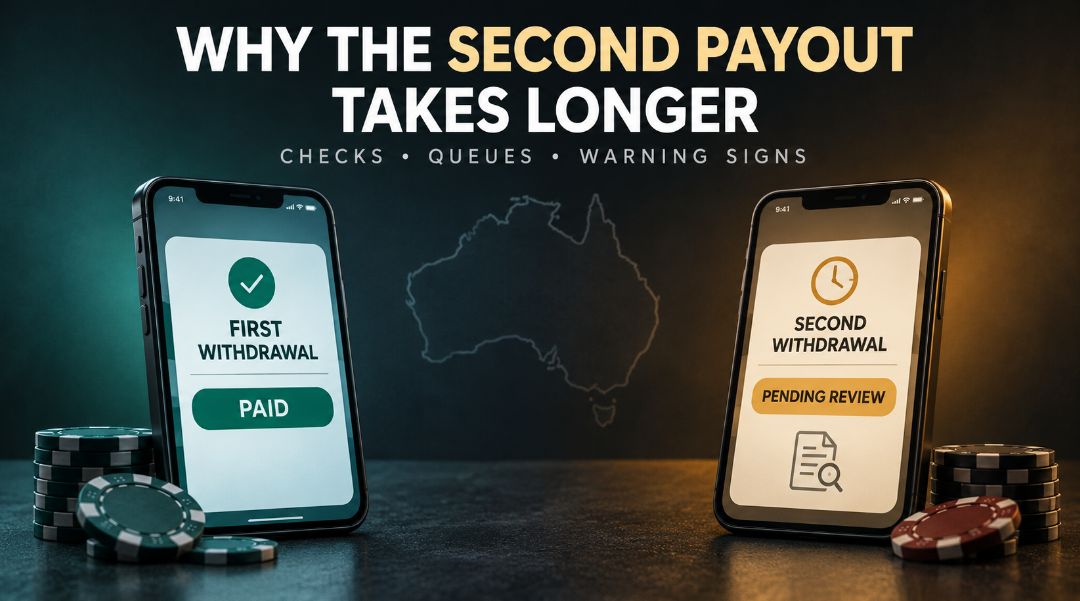
Your first casino withdrawal arrives in two hours. The next one sits pending for three days.
Support mentions a “routine security review”. Another agent blames the payment provider. By Friday, someone introduces a batch-processing schedule you have never seen before.
For an Australian player using an offshore casino, that change creates an obvious question: did the operator make the first payout quick to earn your trust, then move the goalposts once you deposited again?
That is a plausible concern, but it is not an established industry-wide rule. The evidence does not show that offshore casinos generally fast-track first withdrawals and deliberately delay second ones. First withdrawals can also take longer because initial verification remains incomplete.
What is documented is less tidy—and more useful. Operators sometimes postpone checks until players withdraw, provide inadequate explanations, and create friction around accessing account balances. Other delays arise from payment changes, transaction reviews, processing schedules or bonus conditions.
The important distinction is between a legitimate check and an unexplained obstacle.
One successful payment proves that a casino completed one transaction. It does not prove that later withdrawals will receive the same treatment, that a larger balance is secure, or that the operator offers enforceable consumer protections.
What Is the First vs. Second Withdrawal Phenomenon?
The phrase describes a player’s experience of receiving an initial withdrawal quickly, followed by a slower subsequent cash-out.
It is a descriptive label, not a recognised regulatory category or a proven universal casino strategy.
The pattern can involve:
-
A small first withdrawal followed by a larger request.
-
An automated payment followed by manual review.
-
A change in withdrawal method.
-
Additional identity or funding questions.
-
A request submitted outside a payment-processing window.
-
A later withdrawal involving bonus-related winnings.
Several causes can produce the same visible result: the second payment takes longer.
That matters because the sequence alone does not explain the motive. “They paid me quickly once and slowly afterwards” is evidence of inconsistent timing. It is not, by itself, proof of deliberate manipulation.
Equally, a security explanation does not automatically make the delay reasonable. The casino still needs a defensible basis for its actions, subject to the rules governing its operation.
Why a Fast First Payout Builds So Much Trust
A completed withdrawal feels more convincing than a licence badge or a positive review.
The money reaches your account. The casino has demonstrated that its payment system can work. An abstract promise becomes a real transaction.
The mistake is treating that experience as a complete safety assessment.
A A$100 withdrawal and a A$5,000 withdrawal may encounter different checks or limits. A crypto payment and a bank transfer may follow different routes. A withdrawal of ordinary cash winnings and one involving a promotional balance may raise different questions.
An initial payment also says nothing definitive about future liquidity or dispute handling.
A fast payout can strengthen trust without proving that the casino intentionally designed it as a trust-building tactic. Payment-service providers themselves describe withdrawal speed as relevant to customer retention. That commercial incentive is real, but it does not establish a deliberate first-fast, second-slow policy.
The sensible conclusion is narrower: the operator paid that amount, through that method, under those circumstances.
How a Casino Withdrawal Actually Works
A withdrawal is not one event. It is a sequence.
First, the player submits a request. The casino then assesses eligibility, completes any required checks and authorises payment. A payment provider processes the instruction, and the receiving institution or wallet completes the final stage.
The practical timeline has four parts:
-
Request and queue time.
-
Casino review and approval.
-
Payment-provider processing.
-
Receipt of funds.
The crucial measure is end-to-end time: from submitting the request to receiving usable funds.
A casino can advertise a fast payment method while leaving its own review stage outside the headline. “Paid within minutes after approval” tells you little if approval takes four days.
Likewise, a completed status in the casino cashier does not necessarily establish that money has arrived.
Before interpreting a delay, identify the stage. Has the casino authorised the withdrawal? Has it transmitted the payment? Is there a provider reference or blockchain transaction identifier?
Without that information, “processing” is a label rather than an explanation.
Seven Reasons a Later Withdrawal Can Take Longer
1. The Amount or Account Activity Has Changed
A larger transaction or unusual account activity can prompt further review.
This does not mean every large withdrawal should be delayed. It means a previous small payment does not necessarily establish how a different transaction will be assessed.
Relevant changes may include substantially larger deposits, a different withdrawal pattern or activity that triggers fraud monitoring.
A legitimate review should relate to identifiable circumstances, although an operator may be restricted from revealing details of a money-laundering investigation.
There is no universal amount that guarantees automatic approval. Advice claiming that withdrawals below a particular figure always avoid checks is unreliable.
2. Identity Verification Is Not Permanently Complete
“Verified” does not always mean “no further questions ever”.
Changed personal details, unusual activity or new payment arrangements can create a reason to request additional information. A casino may need to distinguish the account holder from someone attempting unauthorised access.
However, basic checks that could reasonably have occurred earlier should not become a convenient surprise at withdrawal.
The UK Gambling Commission explicitly addresses this distinction for its licensees. It permits additional information where a new legal obligation arises, but rejects withholding withdrawals for information that could reasonably have been requested before.
That is a useful benchmark—not a promise that those British rules protect an Australian account at an offshore casino.
3. The Payment Method Has Changed
A first withdrawal to one destination does not establish ownership of another.
Moving from a card to a bank account, changing an e-wallet or providing new payment details can require confirmation. Operators also investigate third-party funding because it can raise fraud concerns.
The problem is timing.
The UK regulator has documented cases where operators accepted deposits from potentially problematic sources, allowed gambling, and investigated only when the customer requested payment.
A payment-ownership question can be legitimate. Accepting the money without resolving a known issue, then introducing that issue only after a win, deserves scrutiny.
4. Source-of-Funds Questions Have Appeared
Identity verification asks who you are. Source-of-funds checks ask where money used for gambling came from.
Source-of-wealth checks concern the broader origin of a person’s wealth. These are related concepts, but they are not interchangeable.
Depending on the circumstances and applicable rules, an operator may request relevant financial evidence.
The strongest warning sign is not the existence of a funding check. It is an unexplained decision to postpone an apparently foreseeable check until withdrawal.
The UK Gambling Commission has documented an operator requesting information covering almost four years of deposits only after a customer sought to withdraw winnings.
That example establishes a real withdrawal-friction problem. It does not establish that every second withdrawal receives such treatment.
5. Bonus Conditions Differ From the First Transaction
The first payment may involve cash winnings without a bonus. A subsequent withdrawal may involve a promotion with additional conditions.
The relevant questions include:
-
Was qualifying wagering completed?
-
Did the game contribute fully?
-
Did any maximum-bet rule apply?
-
Does the offer cap withdrawable winnings?
-
Did the promotion expire?
A bonus review is not automatically a fabricated obstacle. But an operator should identify the applicable condition rather than rely on a vague “bonus abuse” accusation.
Players should preserve the terms attached to the offer they accepted. A generic promotion page may not explain the specific transaction under review.
6. The Withdrawal Missed a Processing Window
Some payment operations run scheduled batches rather than continuous payouts.
A request completed before a cut-off can move quickly. Another submitted afterwards may wait for the next run.
This is a genuine operational explanation. It is not proof that the casino is targeting repeat players.
The useful details are the schedule, time zone, business-day policy and whether approval must occur before the cut-off.
Australian players should avoid assuming that an overseas cashier uses Sydney, Melbourne or Brisbane time.
A published timetable can explain a delay. An endlessly shifting “next batch” cannot provide meaningful accountability.
7. The Payment Provider Has a Problem
A payment can fail or slow after casino approval.
Expired cards, closed accounts, bank rejection and technical problems can require correction. A fast method also cannot compensate for incorrect destination details.
The casino should distinguish this stage from an internal review.
If it blames the bank before transmitting the payment, the explanation does not fit the timeline. If it says the transfer has left, ask for the relevant reference and release date.
This turns an argument about impressions into a question about evidence.
Legitimate Review or Withdrawal Obstruction?
There is no perfect test from outside the operator. Some valid investigations limit what support can disclose.
Nevertheless, the following comparison helps identify where clarification is needed.
These are warning indicators, not automatic proof of fraud.
The most useful test is consistency. Do the explanation, document request and transaction status fit together?
A casino cannot reasonably explain the same delay as an unapproved internal review and a completed transfer awaiting bank settlement without clarifying the sequence.
What Regulators Have Actually Documented
The strongest evidence concerns unfair withdrawal friction—not a universal second-payment slowdown.
In July 2024, the UK Gambling Commission reported receiving around 2,000 withdrawal-delay complaints annually. It described withdrawal delays as its leading complaint subject, while noting that complaints remained low relative to completed withdrawals.
Its documented concerns included:
- Inadequate explanations for information requests.
- Funding checks postponed until withdrawal.
- Third-party payment investigations initiated too late.
- Terms giving operators excessive discretion.
- Attempts to place commercial interests ahead of customers.
The regulator also stated that operators should not keep accepting deposits indefinitely and then use anti-money-laundering procedures to frustrate withdrawals when relevant information should have been sought earlier.
This evidence supports scepticism about unexplained delays. It does not justify inventing a global rule that casinos always pay quickly once, then deliberately slow down.
British regulatory expectations also remain jurisdiction-specific. Their existence does not create equivalent protection for an Australian customer using an illegal offshore service.
A Worked Example: Same Casino, Different Circumstances
Consider a fictional player, Alex.
Alex withdraws A$150 through an existing wallet. The casino approves it quickly, and the funds arrive that afternoon.
Two weeks later, Alex requests A$2,400 to a newly added bank account. The request arrives after the published processing cut-off. The casino asks for account-ownership evidence.
The second withdrawal could reasonably take longer because several circumstances changed.
Now consider a different sequence.
Alex uses the same verified details and withdrawal method. Support initially promises payment within 24 hours. After that deadline, it requests another identity document without explaining the need. The document is accepted, but support then introduces a processing window absent from the information originally supplied.
That does not prove deliberate wrongdoing. It does provide stronger grounds for a formal complaint.
The difference is not simply first versus second. It is changed circumstances versus changed explanations.
Why Australian Offshore Players Face Additional Risk
Online pokies and casino-style gambling services cannot lawfully be provided to people located in Australia, including by offshore operators.
An Australian-themed website, AUD balance or familiar payment logo does not remove that restriction.
ACMA investigates prohibited services and requests website blocking. Its guidance encourages Australians to avoid illegal gambling operators.
For a player with a delayed offshore withdrawal, the practical problem is not just the wait. It is uncertainty about the company holding the money, the applicable complaint process and the enforceability of any outcome.
A foreign licence should be checked against the actual legal entity and domain. A badge alone establishes very little.
Do not confuse Australia’s register of licensed interactive wagering providers with authorisation for online casino games. Wagering and casino-style services are different categories.
An initial successful cash-out cannot bridge that consumer-protection gap.
PayID and Crypto Do Not Eliminate Casino-Side Delays
Payment speed and casino approval speed are separate.
A bank payment can only move after the operator initiates it. A cryptocurrency withdrawal can remain inside the casino’s queue before anything appears on the blockchain.
For crypto, a valid transaction identifier can help establish that a transfer exists. A “paid” label without one does not, by itself, identify an on-chain payment.
PayID also does not certify an operator’s legitimacy. AUSTRAC has warned about “PayID pokies” schemes involving nominated accounts, changing recipients and misleading branding.
Neither method guarantees that a casino has adequate funds or will follow fair terms.
For a delayed withdrawal, the important question is therefore not “Is this a fast payment method?” It is “Has the operator actually released this payment?”
What to Do When a Repeat Withdrawal Stalls
Preserve the Timeline
Save the withdrawal amount, submission time, method, status changes and support conversations.
Keep copies of the relevant withdrawal and bonus conditions. Record when documents were requested, submitted and accepted.
This creates a factual chronology rather than relying on memory.
Ask for a Specific Status
Request confirmation of:
-
Whether the withdrawal is approved.
-
Whether further evidence is outstanding.
-
Whether it has reached the payment provider.
-
When the next update is due.
A useful response identifies a stage. “Please be patient” does not.
Protect Your Documents
Verify the operator’s identity and submission channel before sending sensitive material.
Do not share passwords, one-time codes, wallet seed phrases or private keys. A request for financial evidence does not justify unrestricted access to your accounts.
If asked to resend information, request the reason the earlier submission was insufficient.
Keep the Dispute Separate From Gambling
Do not deposit again to “unlock” an existing withdrawal.
Do not cancel a withdrawal and gamble the balance merely because it remains accessible. That changes a payment dispute into exposure to further losses.
A new bonus does not resolve an unpaid balance.
Use the Formal Complaint Route
Submit the chronology in writing and request a complaint reference.
Where an operator claims a licence, verify the regulator and any stated dispute service independently. Escalation does not guarantee recovery, especially where the service operates illegally in Australia.
Contact your bank or payment provider promptly if you suspect fraud. Describe events accurately; an authorised gambling payment should not be misrepresented as unauthorised.
How Casino Reviewers Should Test This Properly
One withdrawal is inadequate evidence for a broad “fast payouts” claim.
A credible test should distinguish first and repeat withdrawals, record amounts and methods, and document verification status. It should include submission, approval and receipt timestamps.
Reviewers also need comparable circumstances. A small crypto withdrawal and a large bank transfer cannot cleanly establish a repeat-player penalty.
Results should separate observed performance from advertised timeframes and explain the limits of the sample.
Even several successful payments cannot guarantee future reliability. But transparent records provide considerably more value than an unexplained “instant withdrawals” badge.
Final Verdict
A fast first withdrawal followed by a slow second one deserves investigation, not an automatic accusation.
The key questions are what changed, where the payment sits and whether the casino’s explanation remains consistent.
Documented regulatory concerns show that withdrawal friction can be real and unfair. They do not establish a universal first-fast, second-slow offshore strategy.
For Australian readers, the strongest lesson is that one successful cash-out proves one successful cash-out—not safety, future payment reliability or meaningful legal protection.
If the delay is driving further gambling or financial distress, Australia’s National Gambling Helpline provides free, confidential support on 1800 858 858, available 24/7. Gambling Help Online also offers support.
Frequently Asked Questions
Why was my first casino withdrawal fast but my second one delayed?
The second withdrawal may involve a larger amount, different payment details, additional verification or a different processing window. Bonus conditions can also affect eligibility. The sequence alone does not prove deliberate obstruction. Ask the casino what changed and which stage the withdrawal has reached.
Do casinos deliberately pay the first withdrawal quickly to build trust?
A quick payout can build trust, but the article does not establish an industry-wide strategy of deliberately paying first withdrawals quickly and delaying later ones. Documented withdrawal problems include postponed checks and inadequate explanations. Those practices deserve scrutiny without assuming that every repeat-payment delay has the same motive.
Can a casino request more documents after verifying my account?
Yes. Changed account details, new payment arrangements or unusual activity can create a reason for additional checks. However, prior verification does not justify unlimited, unexplained requests. Ask what information is outstanding and why documents already accepted are insufficient.
What is the difference between identity verification and source-of-funds checks?
Identity verification establishes who holds the account. Source-of-funds checks examine where the money used for gambling came from. Source-of-wealth checks concern the broader origin of a person’s wealth. These are distinct checks, so completing one does not necessarily resolve the others.
What does “pending withdrawal” actually mean?
“Pending” does not identify a precise stage unless the casino explains it. The request could be awaiting approval, verification or a payment-processing window. Ask whether the casino has authorised the withdrawal and whether it has transmitted the payment. A cashier status alone does not establish that funds are on their way.
Can batch processing explain a slower second withdrawal?
Yes. A request that misses a processing cut-off may wait until the next scheduled batch. Check the stated schedule, time zone and business-day policy. A consistent timetable can explain a delay; repeated promises of the “next batch” without a clear schedule provide little accountability.
Are crypto and PayID withdrawals always instant?
No. Both remain subject to the casino’s approval process. Crypto can sit in an internal queue before a transaction appears on the blockchain, and a bank payment cannot arrive before the operator initiates it. The useful measure is end-to-end time, from submitting the request to receiving usable funds.
What warning signs suggest a withdrawal is being unfairly obstructed?
Warning signs include changing explanations, repeated document requests without reasons, missed deadlines without updates and accusations that do not identify an applicable rule. A demand to deposit more money to release an existing balance is especially concerning. These indicators warrant investigation, but they do not automatically prove fraud.
What should I do if my second withdrawal remains unpaid?
Save the withdrawal details, relevant terms, document submissions and support conversations. Request a written explanation of the payment stage and any outstanding requirements. Use the operator’s formal complaint process and independently verify any claimed regulator or dispute service. Do not deposit more to “unlock” the payment or cancel it simply to gamble the balance.
Does one successful withdrawal prove an offshore casino is safe for Australians?
No. It shows that one payment succeeded under particular circumstances. It does not establish future payout reliability, the security of a larger balance or effective dispute resolution. Offshore operators cannot lawfully provide online pokies and casino-style games to people located in Australia, and accepting AUD does not change that position.
Sources
- UK Gambling Commission: Documented withdrawal complaints, delayed checks, transparency expectations and unfair operator practices
- UK Gambling Commission: Identity verification and additional information requested at withdrawal
- RoxPay: Withdrawal workflows, payment failures, batch processing and payment-provider infrastructure
- Dimers: Circumstances that can prompt further identity and payment checks
- ACMA: Australian online gambling regulation, illegal operators and website blocking
- Australian Government: Interactive Gambling Act and prohibited online casino services
- AUSTRAC: Illegal online gambling and PayID pokies risks
- ANZ: Gambling scam warning signs and security precautions
- Department of Social Services: National Gambling Helpline and Australian support services
- Gambling Help Online: Confidential gambling support across Australia
Last Updated on October 12, 2026 by Pokie-Player