Key Points
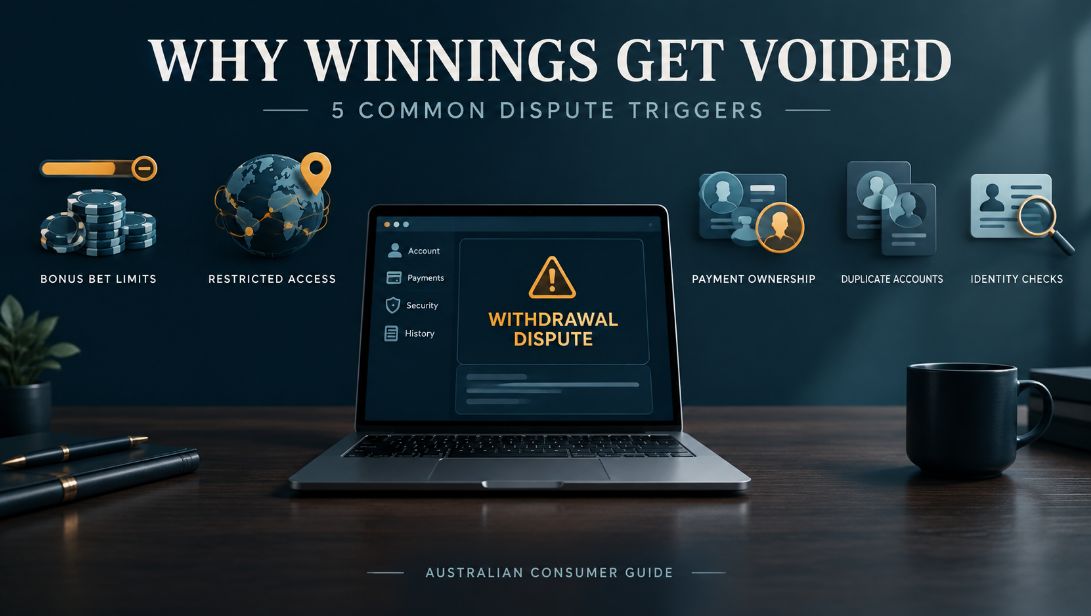
Offshore casinos may void winnings over five main issues:
- Bonus-rule breaches, such as exceeding the maximum permitted stake while a promotion is active.
- Restricted account access, including location masking or prohibited VPN use. Changing IP addresses alone does not prove fraud.
- Third-party payments, such as depositing with a partner’s card, even with their permission.
- Duplicate accounts or breaches of household bonus restrictions.
- Identity-verification problems, including inaccurate details or unresolved payment-ownership checks.
A casino’s allegation does not automatically justify confiscation. If your winnings are removed, stop depositing, preserve your records and request the exact clause, evidence and balance calculation in writing.
For Australians, overseas licensing does not authorise an operator to offer online casino games here. Avoiding illegal offshore services is the strongest protection; following account rules cannot guarantee payment.



Why Offshore Casinos Void Winnings: 5 Triggers and How to Respond
Offshore casinos may cancel winnings after identifying a bonus-rule breach, restricted account access, duplicate accounts, third-party payments or identity-verification problems. However, a casino’s allegation is not proof that its decision is fair or legally enforceable.
The distinction matters. A delayed withdrawal is not the same as forfeited winnings. An expired bonus is not necessarily the same as a lost cash deposit. A changing internet connection does not automatically prove fraud.
For Australian readers, there is another important limitation: providers are prohibited from offering online casino games, including online pokies, to people in Australia. An overseas licence does not authorise an operator to offer those services here.
The safest way to avoid an offshore casino withdrawal dispute is not to deposit with an illegal offshore service. If your money is already involved, understanding the stated rules and preserving evidence can help you challenge an unexplained decision.
The five issues below are recurring contractual triggers, not a statistically ranked list. Each section explains the problem, the distinction that often gets missed and the steps that can reduce avoidable disputes.
What Does It Mean When a Casino Voids Winnings?
Voiding winnings means the operator treats some or all of a recorded win as invalid and removes it or refuses to pay it.
That differs from several other account actions:
| Account action | What it means |
|---|---|
| Withdrawal pending | A payment request remains under review or processing |
| Account suspended | Access is temporarily restricted |
| Bonus cancelled | Promotional credit is removed |
| Winnings voided | The operator invalidates a recorded win |
| Deposit refunded | Deposited money is returned, potentially without associated winnings |
| Withdrawal capped | Payment is limited under a stated rule |
Ask the operator which action it has taken and which balance it affects.
“Your account breached our terms” is not a complete explanation. A meaningful decision should identify the applicable clause, the alleged conduct and how the disputed amount was calculated.
A contractual clause also does not automatically make every deduction justified.
1. Exceeding the Maximum Bet While a Bonus Is Active
A bonus maximum-bet rule limits the stake permitted while specified promotional conditions apply.
This can differ from the game’s own maximum stake. A game may allow a large wager even though the bonus terms prohibit it.
That creates an important trap: a button accepting a bet does not prove that the bet complies with the promotion.
How the Breach Happens
Consider a hypothetical promotion with an A$5 maximum stake.
A player makes ordinary A$2 spins, then purchases an A$80 feature. If the terms include feature purchases within the maximum-bet restriction, that purchase may breach the rule.
Other potential triggers include:
-
Increasing denomination without checking the total stake.
-
Activating optional paid features.
-
Adding a side bet.
-
Using a post-round double-up feature.
-
Assuming the restriction ends when the visible bonus credit disappears.
These are not universal rules. Their treatment depends on the applicable promotion.
Published operator terms provide examples of maximum-bet clauses extending to purchased bonus rounds and doubling features.
What Happens to the Winnings?
An operator may attempt to cancel the bonus and associated winnings.
Do not assume that every breach justifies removing every account balance. The distinction between deposited money, bonus money and winnings matters.
Ask the operator to identify the exact wager, its timestamp and the clause supporting the deduction.
How to Reduce the Risk
Save the complete promotional terms before accepting an offer. Identify the maximum stake, its currency and whether it includes additional game purchases.
If a breach has already occurred, stop playing and request clarification. Continuing to wager does not erase the earlier transaction and can make the balance harder to trace.
2. Restricted Access, VPN Use and Suspicious Login Patterns
Offshore operators may restrict particular countries, prohibit location masking or investigate unusual account-access patterns.
However, “multiple IP addresses” needs careful explanation.
An IP address is part of an internet connection’s addressing system. A changed IP address is not, by itself, proof that multiple people control an account.
Moving between home Wi-Fi and mobile data can produce different connection records. So can travelling or changes made by an internet provider.
The relevant issue is what the operator actually alleges.
Ordinary Changes Versus Restricted Access
There is a material difference between:
-
Using your own account on another ordinary connection.
-
Giving another person access to your account.
-
Logging in from a prohibited location.
-
Masking your location to bypass restrictions.
-
Operating several linked accounts.
Some published terms specifically prohibit VPN use to circumvent regional restrictions. Other terms connect shared IP addresses with duplicate-account investigations.
Those clauses should not be collapsed into the claim that every new connection automatically voids winnings.
The Australian Issue
Do not use a VPN to bypass an Australian block or disguise your location.
A website becoming accessible through another connection does not change the Australian restrictions on providers offering online casino services.
Likewise, acceptance of an Australian address or deposit does not establish that the service is authorised here.
What to Do During a Dispute
Ask for the dates, alleged locations and precise restriction involved.
Provide truthful context, such as a mobile connection or travel dates, where relevant. Never fabricate an explanation.
If you suspect account compromise, secure the account and associated email rather than making further gambling transactions.
3. Depositing With a Partner’s Card or Another Person’s Account
Using a payment method registered to someone else can create a serious ownership dispute.
Examples include a partner’s debit card, a friend’s e-wallet or another person’s bank account.
Permission between partners does not necessarily satisfy the operator’s payment rules. The casino may require the gambling account and payment account to have the same verified holder.
Published operator terms provide examples of third-party deposits being treated as invalid, with associated winnings potentially voided.
Why Permission Is Not Enough
A player may reasonably say, “My partner agreed.”
That addresses personal consent. It does not necessarily address the operator’s identity, payment-ownership or financial-crime controls.
The operator may ask who supplied the funds, who controlled the payment account and whether the transaction can be verified.
A joint bank account is different from an account held solely by a partner. Even then, the operator may request evidence that the player is a named holder.
The Common Mistake
A deposit succeeds, so the player assumes the method has been approved.
Successful payment processing does not establish that ownership checks are complete. A dispute may emerge only when a withdrawal is requested.
How to Reduce the Risk
Do not use someone else’s payment credentials or misrepresent ownership.
If a disputed third-party deposit has already been made, stop adding transactions and request written instructions about its treatment.
Do not submit another person’s identification as your own. Do not create a second gambling account to “match” the payment method.
If the operator requests a refund route, ask it to explain who will receive the funds and what will happen to the remaining balance.
4. Duplicate Accounts and Household Bonus Restrictions
Duplicate-account rules can apply at several levels.
An operator may restrict accounts or promotional eligibility by person, household, address, payment method, device or IP address.
These categories are not interchangeable.
One account per person does not necessarily mean one welcome bonus per person if separate terms restrict offers to one household.
How Disputes Develop
A person might open another account because they forgot their original login. Two partners might separately register from the same address. Another household member might already have claimed a promotion.
Those situations differ from one person deliberately creating multiple accounts, but they can still trigger an investigation.
Some published offshore terms link welcome-offer restrictions to shared IP addresses or multiple accounts.
Shared Connections Are Not Conclusive Proof
A shared address or connection can be a relevant indicator. It is not automatically proof that one person controls every associated account.
The operator should explain whether the allegation concerns duplicate registration, household eligibility, shared payment details or coordinated activity.
Vague accusations of “bonus abuse” are difficult to evaluate without those details.
How to Reduce the Risk
Recover an existing account rather than registering again. Do not borrow another person’s identity to obtain a new-player offer.
Where a dispute already exists, ask the operator to identify the relevant restriction and explain how it links the accounts.
Do not create further accounts to contact support or access the disputed balance. That can add another alleged breach without resolving the original problem.
5. Identity, Address and Source-of-Funds Problems
Identity verification can involve checking a player’s name, date of birth, address and payment ownership.
Additional checks may concern the origin of funds or the circumstances of particular transactions.
Problems can arise from inaccurate registration details, mismatched documents, unreadable files or information that cannot be reconciled.
Deliberately false information creates a different issue from an outdated address or a poor-quality photograph.
Verification Is Not Automatically Forfeiture
A request for more information may justify a review. It does not, by itself, establish a right to confiscate everything in an account.
The UK Gambling Commission provides a useful regulatory comparison: its rules prohibit certain withdrawal-stage identity demands where the information could reasonably have been requested earlier.
Its guidance also distinguishes necessary compliance checks from a right to confiscate deposits.
Those are requirements and expectations for the businesses within that regulatory framework. They are not a guarantee that an Australian customer of an unrelated offshore casino can enforce identical protections.
How to Respond
Ask for a specific document list and the reason each item is required. Use a verified submission channel and keep a record of what you supplied.
Do not alter document details or purchase verification services.
If requests become inconsistent or excessive, preserve the correspondence and consider independent advice before disclosing more sensitive information.
A verification request is not a reason to pay a separate “release fee” to an unknown person.
Bonus Conditions Beyond the Maximum Bet
Maximum-bet breaches are only one category of promotional dispute.
Other conditions may determine whether a bonus balance becomes withdrawable.
Wagering Requirements
A wagering requirement specifies qualifying betting turnover.
For example, a hypothetical A$100 bonus with 30-times wagering on the bonus alone requires A$3,000 in qualifying stakes.
That does not mean A$3,000 must be deposited. It also does not predict the eventual loss or remaining balance.
If the multiplier applies to deposit plus bonus, the calculation changes.
Game Contributions
Different games may contribute different proportions toward wagering. Some may be excluded.
An excluded game might fail to contribute, breach a restriction or have another stated consequence. Check which applies rather than assuming they are equivalent.
Expiry and Conversion Limits
A promotion may expire before wagering is completed. It may also limit the amount of promotional winnings that can become cash.
A conversion cap is different from a daily withdrawal-processing limit.
Do not make extra deposits or gamble faster simply to avoid losing a bonus. The promotion is not worth abandoning a spending limit.
Can an Offshore Casino Use Any Rule It Wants?
An operator can publish terms. That does not mean every clause is fair, every allegation is accurate or every deduction is enforceable.
British regulatory guidance, for example, challenges terms granting excessive discretion and stresses fair treatment of customer balances.
However, an offshore dispute depends on the actual operator, licence, applicable law and available complaint process.
A foreign licence logo alone does not establish that a particular website is covered. Nor does it establish authorisation to serve Australians.
Avoid two extremes:
-
Assuming all deductions are valid because the terms mention forfeiture.
-
Assuming every disputed deduction will be reversed by a regulator.
The practical task is to establish who operates the website, what rule allegedly applied and which organisation can actually consider the complaint.
What Australian Players Need to Know
The Interactive Gambling Act restricts providers from offering prohibited online gambling services to people in Australia.
The ACMA identifies online casino games and online pokies among the prohibited services.
A website may display Australian dollars, accept local registration details or use Australian imagery without being authorised to offer those games here.
Its absence from a blocked-site list is not proof of approval.
If an overseas service refuses to return money, the ACMA identifies options including independent legal advice and contacting the relevant licensing authority.
Reporting an illegal service to the ACMA serves a different purpose from obtaining an individual refund. Do not assume that submitting a report guarantees recovery.
No checklist can remove the enforcement and recovery risks created by an illegal offshore service.
What to Do If Your Winnings Have Already Been Voided
1. Stop Adding Money
Do not deposit to unlock the balance, demonstrate loyalty or satisfy an unexplained payment demand.
Keep the dispute separate from further gambling.
2. Preserve the Evidence
Save:
-
Deposit and withdrawal records.
-
Account-balance screenshots.
-
Bonus acceptance details.
-
Relevant terms and their dates.
-
Game and transaction histories.
-
Support messages.
-
Verification requests and submission records.
Keep transaction identifiers and timestamps where available.
3. Request a Written Decision
Ask the operator to identify the clause, evidence, affected transactions and calculation.
Request separate figures for deposited funds, promotional credit and disputed winnings.
4. Use the Formal Complaint Process
Ask for a complaint reference and a final written response.
Check the stated licensing authority independently. Confirm that the legal entity and domain match the claimed authorisation.
A copied badge is not enough.
5. Contact Relevant Organisations Truthfully
Depending on the circumstances, seek independent legal advice, contact the claimed licensing authority or report the illegal service to the ACMA.
Tell your payment provider accurately what happened. A gambling loss or contractual dispute is not automatically an unauthorised payment.
Do not make a false fraud report to seek reimbursement.
A Sample Complaint About Voided Winnings
“Please treat this message as a formal complaint about the removal of my balance.
Please provide the exact contractual clause relied upon, the version of the terms applicable at the relevant time and the transactions said to breach that clause.
Please identify the amount removed from deposited funds, bonus funds and winnings separately. Please explain how each amount was calculated.
If the decision concerns account access, payment ownership or linked accounts, please specify the alleged issue and the information I can provide to respond.
Please preserve the account and transaction records while this complaint is reviewed. Please also provide your complaint reference, final-response process and the details of any relevant external dispute body.”
Keep the complaint factual. Do not claim evidence you do not have.
Prevention Checklist: What Actually Helps?
The most important protection for Australian readers is avoiding illegal offshore online casinos.
For an existing account or dispute, focus on evidence rather than supposed tricks:
-
Keep accurate identity and address information.
-
Never disguise your location to bypass restrictions.
-
Do not share account access.
-
Do not use another person’s payment credentials.
-
Preserve the terms attached to an accepted promotion.
-
Distinguish cash balances from promotional balances.
-
Request reasons for deductions in writing.
-
Do not assume completed wagering erases an earlier alleged breach.
-
Avoid further deposits while a complaint is unresolved.
These steps can improve the clarity of a dispute. They cannot guarantee payment from an offshore operator.
Final Verdict
The five issues covered here—bonus stake limits, restricted access, third-party payments, duplicate accounts and verification—require different evidence and different responses.
A changed IP address is not automatically fraud. A partner’s consent does not necessarily satisfy payment rules. A verification delay is not automatically a lawful forfeiture.
The strongest response is to identify the precise allegation, preserve the relevant records and challenge unsupported deductions through the appropriate process.
For Australians, the underlying warning remains more important than any individual casino rule: an overseas licence does not make an offshore online casino authorised to serve Australia, and careful record-keeping cannot eliminate the risk of non-payment.
Frequently Asked Questions
Why do offshore casinos void winnings?
Offshore casinos may cite bonus maximum-bet breaches, restricted account access, third-party payments, duplicate accounts or identity-verification problems. However, an allegation does not automatically justify removing a balance. Ask for the exact rule, supporting evidence and calculation of the disputed amount.
Can changing IP addresses cause a casino to cancel winnings?
A changed IP address alone does not prove fraud. Switching between home Wi-Fi and mobile data can change connection records. The relevant distinction is whether the operator alleges ordinary connection changes, shared account access, duplicate accounts or location masking that breaches its terms.
Can I deposit using my partner’s card with their permission?
Your partner’s permission does not necessarily satisfy the casino’s payment-ownership rules. An operator may require the gambling account and payment method to belong to the same verified person. A successful deposit does not mean ownership checks are complete or that a withdrawal will be approved.
What should I do if an offshore casino voids my winnings?
Stop depositing and preserve your transaction history, relevant terms, screenshots and correspondence. Request a written explanation identifying the alleged breach and separating deposited funds, bonus credit and winnings. Use the formal complaint process and independently check any claimed licensing authority. Reporting the service to the ACMA does not guarantee recovery.
Does an overseas licence make an online casino authorised in Australia?
No. An overseas licence does not authorise an operator to offer online casino games or online pokies to people in Australia. Accepting Australian dollars or Australian registration details does not establish authorisation either. Following the operator’s account rules cannot eliminate the risk of non-payment.
Sources
- ACMA: Australian restrictions on online casino services under the Interactive Gambling Act.
- ACMA: Illegal offshore gambling risks and options when recovering money.
- ACMA: Gambling website blocking and prohibited services.
- ACMA: Reporting prohibited interactive gambling services.
- PokerStars: Bonus wagering, maximum-bet restrictions and promotional caps.
- Duxcasino: Examples of maximum-bet, purchased-feature and bonus-expiry clauses; inclusion is not an endorsement.
- Ritz Slots: Examples of VPN, location and linked-account restrictions; inclusion is not an endorsement.
- Smooth Spins: Example of payment-ownership restrictions in published operator terms.
- Spinbet: Examples of household, account-information and linked-activity clauses; inclusion is not an endorsement.
- UK Gambling Commission: Withdrawal fairness, verification and limits on operator discretion.
- UK Gambling Commission: Identity verification and treatment of deposited funds.
- UK Gambling Commission: Distinguishing deposited funds from promotional restrictions.
Last Updated on October 19, 2026 by Pokie-Player