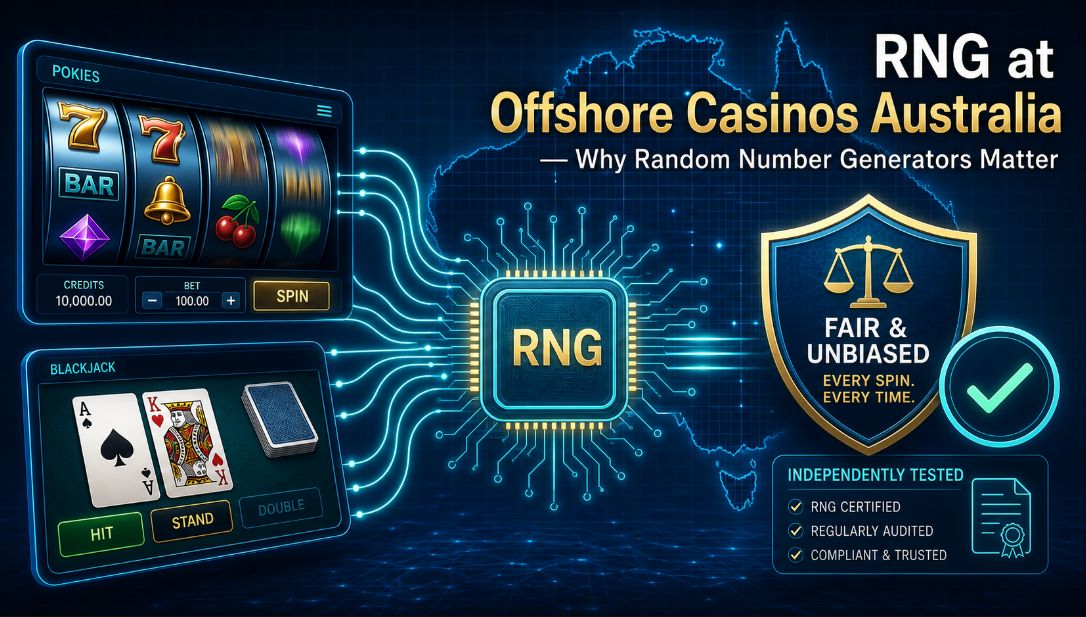
Random Number Generators (RNGs) are the backbone of every spin, bet and card draw at offshore casinos, and for Australian casino players they are the main thing standing between fair results and rigged games. While bonuses and flashy themes grab attention, RNG and how it is implemented should be the first technical concept you understand before you deposit a single dollar at an overseas site.



What RNG Is and How It Works in Practice
At its core, an RNG is a piece of software that constantly generates long sequences of numbers, which are then mapped to game outcomes like reel positions, card draws or dice rolls. In modern online casinos this is usually a “pseudo‑random” number generator driven by algorithms rather than pure physical randomness.
For pokies, an RNG works roughly like this:
-
The RNG is always running in the background producing numbers.
-
When you hit “spin”, the game takes a snapshot of the current RNG output.
-
That snapshot is translated into which symbols land on each reel.
-
The result is checked against the game’s paytable, and any win is paid.
For digital blackjack or roulette, the same idea applies: RNG outputs determine which card is drawn next or where the virtual ball lands on the wheel.
The important point: the RNG does not “remember” previous spins, and it does not tighten up or loosen just because you are winning or losing. Each event is independent, and the math is tied to long‑term return to player (RTP), not to short‑term streaks.
Why RNG Matters More at Offshore Casinos
In Australian land‑based venues, regulators control machine standards, audit games and set minimum payout percentages. When you move to offshore casinos, you leave that framework behind and rely heavily on the operator’s integrity and its technical infrastructure. RNG is central to that.
1. It Guarantees Unpredictability
A properly implemented RNG ensures that:
-
Every spin or deal is unpredictable.
-
No player can “solve” or forecast the next outcome.
-
No casino employee can manually manipulate individual game results.
Without a sound RNG, a slot or table game can be skewed away from its advertised payout statistics, turning what should be a transparent edge into a hidden, adjustable lever.
2. It Enforces the Game’s RTP Over Time
The maths of a pokie or table game (its RTP and volatility) is baked into the way RNG outputs are mapped to outcomes. If the RNG is genuine and untouched, the game will behave as its design dictates over large numbers of plays.
If the RNG is compromised, RTP is effectively meaningless. The operator could quietly reduce the frequency of winning combinations or jackpots without changing the numbers shown in the help screen.
3. It Protects You From “Hot/Cold” Myths and Emotional Bias
Many gamblers follow patterns like “this game is cold” or “the machine owes me a win” based on recent spins. True RNG destroys those myths. A fresh random draw happens every time, and past spins do not influence future ones.
Understanding this protects Australians from chasing losses on the assumption that a particular slot is “due”, which is one of the fastest ways to burn a bankroll.
How RNG Is Typically Implemented at Reputable Offshore Casinos
While details vary by provider, most serious offshore casinos use established game studios and independent testing to ensure RNG quality.
Common practice includes:
-
Industry‑standard algorithms: Well‑known pseudo‑random algorithms tuned for gaming use, not simple “home‑made” routines.
-
Large number ranges: RNG outputs are drawn from huge numeric spaces to minimise repeating cycles and make prediction infeasible.
-
Mapping logic: Outputs are mapped to game events in a way that preserves the intended odds and payout tables.
-
Continuous running: RNGs are constantly generating values, not just triggered when you click, reducing timing attacks or external influence.
Game studios design, code and embed RNG into each title; the casino then integrates the games. Your job as a player is to favour operators who use respected studios and allow third‑party testing of their games.
Testing and Certification: How RNG Is Checked
Because players can’t see inside the RNG, independent testing and certification are critical. Trustworthy offshore casinos usually work with recognised labs and bodies, such as:
-
Technical testing labs that verify random number generation and payout statistics.
-
Certification seals on game providers’ websites showing that their RNG has passed statistical tests.
-
Periodic audits where large samples of game outcomes are analysed for randomness and compliance with stated RTP.
These processes don’t make the games “better” for the player—they confirm that the edge you face is the one advertised, not something quietly inflated.
When you see a casino actively referencing external testing and listing providers known for strong compliance, it’s a good sign. When an operator is vague about who built its games, where they were tested or how often audits are performed, caution is wise.
Practical Ways Aussies Can Judge RNG Fairness
You can’t directly inspect code, but you can still vet RNG indirectly. Useful checks include:
1. Look at the Game Providers
Stick to casinos that use well‑known studios rather than anonymous in‑house games with no background. Established providers have reputations to protect and are more likely to use solid RNG practices and independent audits.
If a site’s lobby is full of suppliers you’ve never heard of and there is no information about testing, that’s an RNG red flag.
2. Check for Testing and Certification
Scan the casino’s footer and help pages for references to independent testing. Many reputable operators explain:
-
Which lab tested their games.
-
How often audits occur.
-
Which games or categories are covered.
Casinos that offer this level of transparency make it easier to trust that RNG is being monitored rather than left to chance—or design.
3. Compare Experiences Across Sites
If the same branded slot feels drastically different at two offshore casinos over time, it can be due to volatility and variance. But if you repeatedly see unusual patterns at one operator—hardly any bonus rounds, strangely frequent near‑misses, or outcomes that defy the known behaviour of the game—it’s reasonable to step back.
Variance can be wild, but when a site consistently feels “off”, it may be better to move to an operator with clearer testing credentials.
4. Avoid “Rigged” Narratives Based Only on Short Streaks
Even with perfect RNG, you can have long losing streaks, short winning bursts, clusters of near‑misses or back‑to‑back jackpots; randomness is messy by nature. Labelling a game as rigged based solely on a bad few hours is understandable emotionally, but not reliable evidence.
Instead, look at the long view: how often does the casino pay withdrawals, how do bonuses behave over time, and what do independent reviewers say about the operator’s behaviour?
Common Misconceptions About RNG at Offshore Casinos
Understanding RNG also means dismantling some popular myths.
“The Casino Tightens Slots at Night”
RNG doesn’t know the time of day. The game’s payout behaviour is set in its design; the RNG simply generates outcomes that reflect that design. While casinos can in theory change version settings (like RTP) at the configuration level, doing so dynamically to “tighten at night” would be obvious over time and destructive to trust.
What players experience as “tight nights” is usually variance plus the psychology of remembering bad runs more than average ones.
“If I’m Losing Too Much, the Game Is Rigged”
Losing more than expected can happen in pure random systems. High‑volatility slots are designed to produce extended losing streaks punctuated by occasional big hits. That doesn’t prove the RNG is rigged; it reflects the game’s volatility profile.
Real rigging would show up in systematic patterns across many players or clear contradictions with published payout statistics, not just a bad evening.
“Hot and Cold Machines Exist Online”
Because RNG is centralised, online games don’t “heat up” or “cool down” in the way players sometimes talk about land machines. Every spin is independent; if you feel a game is in a cold patch, it’s your perception of randomness rather than the RNG’s mood.
Recognising this helps Aussies avoid chasing streaks—one of the most dangerous habits at offshore sites.
RNG, Live Dealer Games and Hybrid Models
For live dealer games at offshore casinos, RNG interacts with physical randomness. Cards are shuffled, wheels spin and dice roll for real, but certain elements—side bets, random multipliers, bonus rounds—still rely on software‑driven RNG.
What this means for Australians:
-
The core outcome (such as which card you get or where the ball lands) is driven by physical processes.
-
Additional features that boost payouts or trigger special events are managed by RNG.
-
Fairness depends both on the integrity of the studio’s equipment and on the quality of its RNG implementation.
Live studios typically publish information about their practices, and reputable casinos work only with operators that accept regular audits. As always, choose brands that disclose more rather than less.
Why RNG and RTP Need to Be Understood Together
RNG and RTP are tightly intertwined. RTP tells you the long‑term percentage a game will pay back; RNG is the mechanism that delivers the individual results that collectively produce that percentage.
At offshore casinos:
-
A fair RNG is what makes published RTP believable.
-
RTP gives you a yardstick for how the game will treat your bankroll over time.
-
Volatility describes how rough or smooth the ride will feel session by session.
Understanding all three lets Aussies make calmer, more informed decisions: choose high‑RTP games with trustworthy RNG, pick volatility that matches your risk tolerance, and ignore short‑term superstition.
Responsible Gambling: RNG Doesn’t Remove Risk
Even with perfectly fair RNG and strong RTP, offshore casino play is still risky. The house edge remains, and variance ensures unpredictable streaks. RNG is there to keep the game honest, not to guarantee you a win.
To keep RNG‑based games in the realm of entertainment:
-
Treat every session as money spent on fun, not on investment.
-
Set strict limits and stop once they’re reached, regardless of short‑term results.
-
Avoid trying to “beat” randomness with systems or patterns; they don’t work against independent RNG.
-
Step back and seek help if gambling begins to cause financial, emotional or social problems.
Fair randomness is essential, but your own habits still determine whether offshore play remains a hobby or becomes a problem.
Final Thoughts: RNG at Offshore Casinos Australia – Why It Matters
For Australian players using offshore casinos, RNG is the invisible engine that decides whether each game runs as advertised or quietly tilts against you. It matters because:
-
It ensures outcomes are genuinely unpredictable and not manually manipulated.
-
It underpins the RTP and volatility figures that guide your choice of games.
-
It protects against myths about “due” wins or machines that owe you money.
-
It is one of the few technical areas where independent testing can verify fairness.
Once you understand RNG, you see offshore casinos more clearly: not as mysterious luck machines, but as software systems with defined edges and behaviours. That clarity helps you choose better sites, treat wins and losses with more perspective, and keep play within boundaries that feel healthy and sustainable.
FAQs: RNG at Offshore Casinos for Aussie Players
What is RNG in online casinos?
RNG stands for Random Number Generator. It is software that constantly produces random numbers, which are then mapped to game outcomes such as reel positions, card draws or dice rolls. Every spin or deal you see in a digital game is driven by these random outputs rather than being manually chosen.
Why does RNG matter at offshore casinos for Australians?
At offshore casinos, you don’t have Australian regulators overseeing every machine. A properly implemented RNG is what keeps games fair by ensuring each result is independent, unpredictable and in line with the maths of the game. Without a good RNG, an operator could quietly skew outcomes away from the advertised payout rates.
Is every online pokie result really random?
A well‑designed pokie using a certified RNG will produce independent results on every spin. The system does not “remember” past wins or losses. However, randomness naturally creates streaks and clusters, so you can still experience long losing runs or sudden bursts of wins even when the RNG is working correctly.
Can offshore casinos rig their RNG to make players lose more?
In theory, an operator that controls its own game software could manipulate RNG or use versions that don’t match the stated payout statistics. Reputable casinos avoid this because it destroys trust and risks losing licences. To protect yourself, focus on sites that use recognised game providers and clearly reference independent testing of their RNG and games.
How can I tell if a casino’s RNG is fair?
You can’t see the code directly, but you can look for signs of fairness. Check whether the casino uses well‑known game studios, mentions independent testing or audits on its site, and has a solid track record for paying withdrawals. Independent reviews and player feedback can also help you spot operators that behave consistently.
Does RNG mean I can’t use systems to beat pokies and table games?
Correct. RNG ensures that results are random and independent, so betting systems like doubling after losses or following “patterns” do not change the underlying odds. These systems may change how your bankroll swings, but they can’t overcome the built‑in house edge of an RNG‑driven game.
Is RNG used in live dealer games as well?
In live dealer games, physical actions such as card shuffles and roulette spins determine core outcomes. However, some features like random multipliers, side bets or bonus rounds use RNG behind the scenes. Fair play in live games depends on both honest physical processes and reliable RNG for any software‑driven elements.
What’s the relationship between RNG and RTP?
RTP (Return to Player) describes the long‑term percentage a game pays back, while RNG produces the individual results that eventually add up to that percentage. If the RNG is fair and correctly implemented, the game’s RTP should hold over many spins. If RNG is compromised, RTP becomes unreliable because outcomes no longer follow the intended maths.
Do “hot” or “cold” machines exist when RNG is used?
No. With proper RNG, online games don’t have memory or moods, so they can’t be genuinely hot or cold. What players experience as hot or cold streaks is the normal behaviour of randomness. Believing a game is “due” can encourage dangerous chasing of losses, so it’s important to understand that each spin is independent.
Can long losing streaks still happen with fair RNG?
Yes. Randomness naturally produces streaks, and high‑volatility games are designed to have extended dry spells with occasional big hits. A long losing run is not proof that RNG is rigged; it is part of how these games work. This is why responsible limits and realistic expectations matter so much.
How should Australians factor RNG into their offshore casino choices?
Treat RNG as a core trust signal. Choose casinos that use reputable software providers, mention independent testing and have consistent reputations for fairness and paying out. Combine that with sensible bankroll management and strict time and money limits, and you’ll be better placed to enjoy offshore play as entertainment rather than chasing patterns in random outcomes.
Sources
- Return to Player and Pokies Maths in Australia
- Guide to RTP, Paylines and Randomness in Online Pokies
- RTP and Variance in Australian Pokies – How the Numbers Work
- What RTP and RNG Mean for Aussie Real‑Money Play
- Gambling Help Online – Australia
Last Updated on July 21, 2026 by Pokie-Player