Key Points
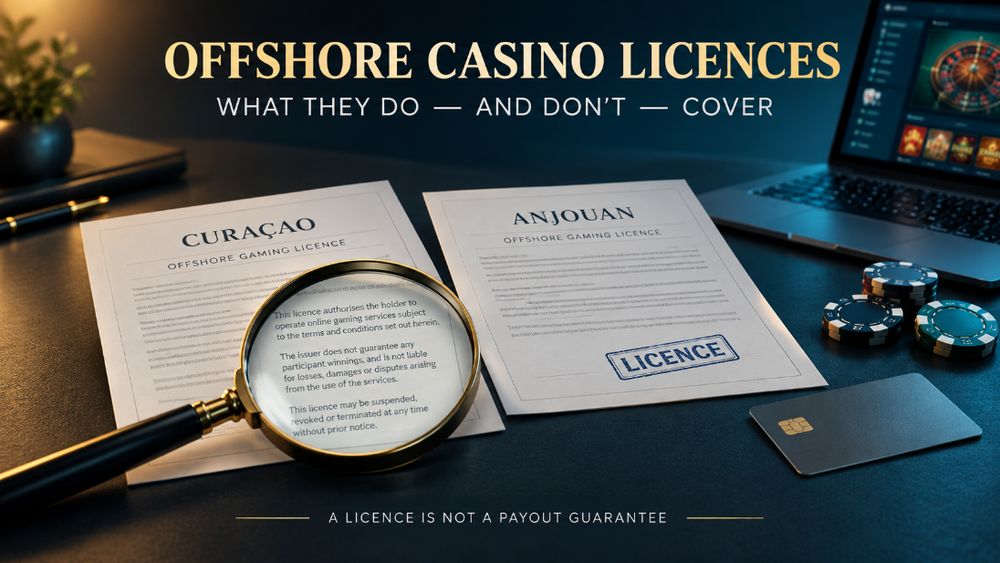
- A genuine offshore licence is not a safety guarantee. It does not automatically ensure fast withdrawals, fair bonus terms, protected balances or recovery of unpaid winnings.
- Curaçao and Anjouan licences do not authorise operators to provide prohibited online casino services to people located in Australia.
- Both frameworks separate regulatory supervision from individual dispute resolution. Neither authority acts as a personal debt collector for players.
- Curaçao’s published complaints policy directs players through the operator first, then independent alternative dispute resolution (ADR) where necessary.
- Anjouan explicitly states that its authority does not handle, mediate or adjudicate player complaints. Its process also directs unresolved disputes to approved ADR providers.
- Complaint deadlines matter. Check the applicable procedure promptly rather than relying on repeated promises from live-chat support.
- Verify the legal entity, licence category, current status and relevant website – not just the badge in the footer.
- Assess independent, dated operator history. Documented withdrawals and complaint outcomes offer more useful evidence than star ratings or unsupported “instant payout” claims.
- One successful withdrawal proves only that one payment succeeded. It does not guarantee future payouts or establish that the service is authorised in Australia.
- If a dispute arises, preserve evidence, submit a formal complaint and use the verified escalation route. Never deposit more to “release” an existing balance.


Curaçao and Anjouan Casino Licences: The Truth About Player Protection
An offshore casino can hold a genuine gambling licence and still expose Australian players to serious risks.
That is the distinction many review pages gloss over.
A licence is not a payout guarantee. It does not automatically protect your account balance if an operator fails. It does not make every bonus condition fair. Most importantly, a Curaçao or Anjouan licence does not authorise an operator to provide prohibited online casino services to people located in Australia.
The badge in the footer answers a narrow question: does this business hold a particular permission from a particular jurisdiction?
It does not answer the questions that matter when money goes missing.
Will the operator explain a withdrawal delay? Does it follow its published conditions? Is an independent dispute service available? Can you establish which company holds your money? Has the business repeatedly left similar complaints unresolved?
Those questions require evidence beyond a logo.
There is another correction worth making. Saying offshore regulators “rarely intervene” suggests a measurable frequency that the available evidence does not establish. The clearer point is that Curaçao and Anjouan explicitly separate regulatory supervision from resolving individual player disputes.
A regulator can oversee licence compliance without acting as your personal debt collector.
A Gambling Licence Is Permission, Not Insurance
A valid licence places an operator within a licensing framework. Depending on the jurisdiction and licence category, that framework can include compliance duties, supervision and enforcement powers.
That is materially different from operating without any identifiable permission.
However, a licence should not be interpreted as insurance against everything that can go wrong.
It does not automatically establish that:
- Every withdrawal will be approved quickly.
- Every promotional condition is reasonable.
- Your funds are protected against insolvency.
- A regulator will decide your payment dispute.
- An independent ruling will produce immediate recovery.
- The operator can legally serve your location.
Each claim needs its own evidence.
A genuine licence can be relevant without being sufficient. The mistake is turning one verified credential into a blanket declaration of safety.
The opposite mistake is assuming that every offshore licence is meaningless. A licence can establish obligations and escalation routes. The useful approach is to identify those obligations precisely—and avoid promising protections that do not follow from them.
What a Licence Can—and Cannot—Tell You
Licensing verification is the beginning of an assessment, not the end.
For Australians, the final row is decisive. A foreign permission cannot override Australian restrictions on providing online casino-style gambling services.
Curaçao: Do Not Confuse the Current Framework With Old Claims
Curaçao’s licensing framework has changed.
The Curaçao Gaming Authority, or CGA, identifies itself as the regulator for online gaming under the National Ordinance on Games of Chance, commonly called the LOK. It also supervises compliance with anti-money-laundering and counter-terrorist-financing requirements.
That matters because older articles may describe historical arrangements as though they remain a complete account of the current system.
An operator’s old certificate or a review written several years ago cannot establish its present status.
The current framework also includes published complaints requirements and independent alternative dispute resolution, or ADR.
Those developments deserve acknowledgement. A critical review should not ignore reforms merely because the jurisdiction has a controversial reputation.
But reforms are not a reason to suspend scrutiny.
The practical questions remain whether the actual operator is licensed, whether the relevant website is covered, whether its complaint procedure is accessible and whether it follows that procedure.
A description of the regulatory framework is not evidence that every licensee complies with it.
What the Curaçao Regulator Does Not Do
Curaçao’s published player complaints policy makes a particularly important distinction.
The CGA does not resolve or make decisions on individual complaints about gambling-related transactions. It does not mediate individual disputes.
Instead, the policy directs complaints through the operator and, where unresolved, an independent ADR provider.
The CGA can use information about complaints to support supervisory and enforcement work. That is not the same as deciding that a casino owes you A$2,000 and arranging its payment.
Three processes should therefore remain separate:
- Operator complaint handling.
- Independent dispute resolution.
- Regulatory reporting about misconduct or licence breaches.
Confusing them can waste time.
Writing to a regulator may identify a compliance problem without replacing the operator’s formal complaint procedure or the relevant ADR process.
A statement that “the casino is regulated, so the regulator will get your money back” misrepresents that distinction.
How Curaçao’s Complaints Process Is Supposed to Work
The complaints policy published in June 2025 provides a structured process.
Players generally have six months from the relevant incident or bet settlement to lodge a complaint under that policy.
Operators must provide a formal complaint submission route. Standard complaints should receive assessment and a response within four weeks. A further four-week extension is permitted where necessary, with prior written notice.
Responsible-gambling complaints receive a different, prioritised timetable.
The policy also requires access to independent ADR, free to the player, with the operator bearing the cost.
Those are meaningful procedural obligations. They do not guarantee that a player’s account of the dispute will be accepted or that a disputed balance will immediately become withdrawable.
Before relying on them, identify the operator’s actual complaint form, final-response process and named ADR provider.
A complaints policy that mentions “independent resolution” without useful contact information deserves further questioning.
So does a support agent who treats repeated live chats as a substitute for registering a formal complaint.
Anjouan: A Licence Also Has Defined Limits
Anjouan is an autonomous island within the Union of the Comoros.
Anjouan Gaming describes its role as administering internet gaming licensing under the authority of the Anjouan Offshore Financial Authority, with supervisory oversight from the Anjouan Gaming Board.
Its published framework includes B2C and B2B licence categories, compliance obligations and enforcement powers such as suspension and revocation.
That provides information worth checking. It does not justify labelling every Anjouan-licensed casino safe.
The licence category matters. A business-to-business permission should not be treated as equivalent to permission for a company to operate a consumer-facing casino.
The identity matters too. The registered holder should match the legal entity identified in the casino’s terms.
Anjouan’s published register allows searches by licence number, company name or operational domain. Verification results include the holder, licence type and status.
That establishes recorded licensing information—not an independent assessment of payout reliability.
Anjouan Does Not Adjudicate Individual Player Complaints
Anjouan’s published player complaint process is explicit: the authority does not handle, mediate or adjudicate player complaints.
Unresolved player-operator disputes are directed to an approved independent ADR provider.
Its procedure requires players to complain to the operator first, using the complaint function accessible through the operator’s interactive site seal. Operators are required to investigate and respond within 30 calendar days.
The published submission windows are short:
- Game-outcome disputes: within 14 calendar days of the relevant session.
- Account disputes, including payments, suspensions and bonuses: within 30 calendar days.
Unresolved complaints can then proceed through the approved ADR process. The operator bears the cost.
These deadlines make generic advice to “wait another few weeks” potentially unhelpful. Check the applicable procedure promptly.
The authority separately accepts reports concerning potential licence breaches, including failures to follow complaint or ADR obligations. That compliance-reporting channel is not the same as asking it to decide the merits of your payment claim.
Why “Rarely Intervenes” Needs Careful Wording
There is no reliable intervention rate in the evidence reviewed that supports a numerical comparison between these jurisdictions.
Anecdotes about unanswered complaints can identify experiences worth investigating. They cannot establish how every dispute is handled.
The stronger criticism rests on published policy: direct regulatory adjudication is not the ordinary route for individual player-payment disputes in either framework.
That is a limitation players should understand before depositing—not discover after a withdrawal stalls.
It also means two statements can be true simultaneously:
- The operator is subject to regulatory obligations.
- The regulator will not personally determine your transaction dispute.
A credible article explains both.
Oversight, mediation, adjudication and payment recovery are different activities. Treating them as interchangeable makes a licence appear more protective than the documented process actually is.
How to Verify a Footer Licence Claim
Start by treating the badge as a claim requiring confirmation.
Match the Legal Entity
Compare the company in the casino’s terms with the registered licence holder.
Record the company name and licence number. A brand name alone may not identify the contracting business.
Check the Relevant Domain
Establish whether the website you are using belongs to the licensed operation.
Do not assume a similarly named site or replacement address has the same status.
Check Status and Category
Look for current licensing information, not merely a certificate’s original issue date.
Confirm whether the permission is relevant to consumer-facing operation. Suspension or inactive status should not be presented as an active licence.
Use Current Authority Information
Regulatory portals and verification systems can change.
At the time of this review, the CGA’s website carried a notice that its online gaming portal was offline during a platform transition. That illustrates why an old verification link may not provide a current answer.
An unavailable record is not proof of fraud. It is also not permission to assume validity.
If the details cannot be reconciled, label the claim unverified.
What Independent Operator History Should Include
A verified licence is one evidence point. Operator history provides another.
Useful history is specific, dated and attributable to the correct business.
Look for records showing:
- Withdrawal requests and receipt dates.
- Amounts and payment methods.
- Whether verification was complete.
- Whether a bonus affected the balance.
- The reason given for a dispute.
- The operator’s response.
- The documented outcome.
A review saying “fast payouts” without those details offers little substance.
Likewise, an isolated complaint may omit relevant facts. A casino can reject a claim for reasons that deserve examination rather than automatic dismissal.
The most useful evidence shows what happened and how the operator handled it.
History should also be current. An excellent record under previous ownership cannot establish present conduct. A recent problem should not be concealed by repeating an old award.
Evaluate the operating company and relevant period—not just the logo.
Look for Patterns, Not Just Star Ratings
Star ratings compress too much information.
A five-star review might describe a successful deposit rather than a withdrawal. A one-star review might concern gambling losses rather than operator misconduct.
Read the substance.
More informative patterns include repeated reports of:
- The same unexplained withdrawal obstacle.
- Requests that change after earlier requirements are satisfied.
- Unclear bonus clauses being used to confiscate balances.
- Missing final responses.
- Failure to identify an ADR provider.
- Unresolved complaints with comparable facts.
Patterns deserve investigation, not instant conviction.
Several posts may concern the same incident, and repeated text does not necessarily represent independent experiences.
A public operator response is also only part of the evidence. “Resolved” should ideally be supported by confirmation of what resolution occurred.
Neither the loudest complaint nor the most polished reply should automatically decide the assessment.
Withdrawal History Is Stronger Than a Logo—but Still Limited
A documented withdrawal establishes that a particular payment succeeded.
It does not insure future transactions.
A small payment through an existing wallet may not predict a larger transfer involving new details. A withdrawal without a bonus may not test the same conditions as promotional winnings.
A transparent review should separate those circumstances.
It should also measure the entire timeline: submission, verification, approval, transfer and receipt.
“Instant after approval” leaves the approval stage outside the claim.
Even several successful tests cannot guarantee future solvency or conduct. Their value is that they replace unsupported marketing with observable evidence.
For Australian readers, there is a further limit: a favourable payment history does not make the underlying prohibited service authorised.
Reputation can inform a risk assessment. It cannot rewrite the law.
Bonus Terms Can Undermine a Licensed Operator’s Appeal
A licence does not make a large bonus good value.
Consider a fictional A$100 deposit with a A$100 bonus.
A 35x requirement on the bonus means A$3,500 in qualifying turnover. Applying 35x to both deposit and bonus means A$7,000.
The same headline multiplier can therefore describe twice the obligation.
Other conditions can materially change the offer:
- Expiry periods.
- Maximum permitted bets.
- Excluded games.
- Partial wagering contributions.
- Withdrawal caps.
- Restrictions attached to free-spin winnings.
The important question is whether the operator disclosed the applicable terms clearly and applied them consistently.
A badge does not settle that question.
If a complaint arises, preserve the conditions attached to the offer you accepted. A current promotion page may not establish the terms governing an earlier transaction.
Neither Licence Automatically Protects Your Money or Data
Do not infer deposit insurance from licensing status.
Check whether the operator expressly explains how player funds are held and what happens if the business becomes insolvent. Even a stated safeguard needs careful interpretation.
The same caution applies to personal information.
Verification can involve identity documents and financial evidence. A licence does not eliminate uncertainty about processing, access or security.
ACMA warns that illegal gambling operators can expose Australians to inaccessible winnings, disappearing balances and unauthorised withdrawals. NSW’s GambleAware service also identifies risks to personal data and financial security.
These are additional concerns beyond ordinary gambling losses.
A working cashier proves that deposits can be accepted. An encrypted connection establishes neither the operator’s honesty nor its ability to repay balances.
Do not provide passwords, one-time codes or unrestricted account access to someone claiming to process a withdrawal.
What Australian Players Need to Understand
The Australian legal position should come before any comparison of foreign licences.
The Interactive Gambling Act prohibits providers from offering online casino services to people located in Australia. A Curaçao or Anjouan licence does not override that restriction.
AUD accounts, Australian branding and local-looking banking do not establish authorisation.
Australia’s licensed interactive wagering register should not be treated as a register of approved online casinos. Wagering and casino-style gambling are different service categories.
ACMA can investigate illegal services and take enforcement action. Reporting an operator is not equivalent to having an Australian regulator adjudicate an overseas withdrawal claim.
The practical lesson is not to search for the “right” foreign badge as a workaround.
It is to recognise that an overseas licence can be genuine while the service remains prohibited to supply to Australians—and while individual recovery remains uncertain.
If You Already Have a Dispute
Preserve the transaction history, relevant terms, withdrawal details and written communications.
Identify the legal operator and applicable complaint policy. Submit a factual formal complaint rather than relying solely on live chat.
Check deadlines and retain acknowledgement of submission. If the process reaches its escalation stage, use the named, verified ADR provider.
Report suspected licence breaches through the authority’s relevant compliance route, keeping that separate from the payment claim.
Contact your bank or payment provider promptly if you suspect fraud or unauthorised debits. Describe the transactions accurately.
Do not deposit more to release existing funds.
A clear evidence file can improve the handling of a complaint, but no escalation route should be presented as guaranteed recovery.
Final Verdict
A Curaçao or Anjouan licence can establish a regulatory relationship. It does not guarantee payment, insure your balance or authorise prohibited online casino services in Australia.
Both frameworks distinguish individual disputes from regulatory supervision. Understanding that distinction is more valuable than another reassuring footer logo.
The standard should be accountability: verified identity, current status, accessible procedures and a documented history of conduct.
Even then, gambling and offshore exposure remain risks.
For free, confidential gambling support in Australia, call 1800 858 858, available 24/7, or contact Gambling Help Online.
Sources
- Curaçao Gaming Authority: Regulatory mandate, LOK framework and current portal notices
- Curaçao Player Complaints Policy: Published policy text covering deadlines, ADR and the limits of direct CGA intervention
- Anjouan Gaming: Licensing framework, supervisory structure and enforcement functions
- Anjouan Gaming: Player complaint procedure, submission deadlines and limits on the authority’s role
- Anjouan Gaming: Approved ADR providers and escalation requirements
- Anjouan Gaming: Reporting suspected licence breaches separately from individual disputes
- Anjouan Gaming: Licence verification and scope of register information
- Anjouan Gaming: Licence-status definitions
- ACMA: Prohibited online casino services and the Australian licensing distinction
- ACMA: Withheld winnings, disappearing balances and unauthorised-payment risks
- GambleAware NSW: Offshore gambling and personal-data risks
- Department of Social Services: National Gambling Helpline and Australian support services
- Gambling Help Online: Free, confidential support across Australia
Last Updated on October 13, 2026 by Pokie-Player