
When an offshore casino voids winnings, cancels a withdrawal, closes an account, or applies a bonus term that was never clear before a win, the player’s first reaction is often frustration. The second reaction is usually confusion.
Many casino websites claim to be licensed in Curaçao, but the player may not know who actually issued the licence, which company operates the brand, where to send a formal complaint, or whether the Curaçao Gaming Authority can force the casino to pay.
The practical reality is important. A complaint can create pressure, preserve evidence, and move a dispute into a formal process. It does not guarantee that an offshore operator will reverse its decision or pay a disputed balance. Australian players also have limited local consumer protections when using offshore casino services that are prohibited from being offered to people in Australia.


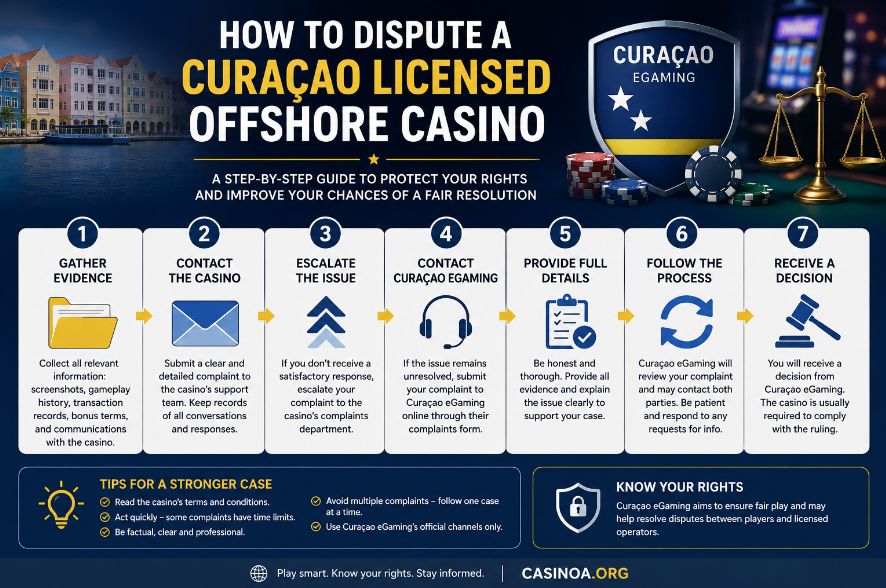
The strongest approach is to be organised. Build a complete evidence file, submit a written complaint to the operator, follow the casino’s stated dispute procedure, use the relevant Alternative Dispute Resolution route where available, and report suspected regulatory breaches to the Curaçao Gaming Authority.
This guide explains how to do that professionally when an offshore casino appears to have unfairly voided winnings.
Start With the Right Expectation
A dispute is not the same as a complaint in live chat.
Live chat can be useful for asking questions, but it is not enough when a casino has cancelled a cashout, confiscated a balance, or accused a player of breaking terms. A formal dispute should be written, structured, supported by evidence, and clear about the remedy being requested.
The goal is to create a record that answers five key questions:
- Who is making the complaint?
- Which casino and legal operator are involved?
- What happened?
- Why is the decision unfair or inconsistent with the published terms?
- What outcome does the player want?
For example, a weak complaint says: “You stole my winnings. Pay me now.”
A stronger complaint says: “On 8 August 2026, I requested a withdrawal of $850 from account number 12345. On 10 August 2026, the casino cancelled the withdrawal and removed the balance, referring to a maximum-bet rule. The relevant promotion page did not display that rule, and the casino accepted the bets without warning. I request restoration of the $850 balance or payment of the approved withdrawal, together with a written explanation and the exact term relied on.”
The second version is factual, specific, and easier for a compliance team, ADR provider, regulator, or lawyer to assess.
Identify the Operator First
Before filing a dispute, identify the legal entity behind the casino brand.
Do not rely only on the logo, website name, or a review page. Go to the casino’s footer, Terms and Conditions, Privacy Policy, Responsible Gambling page, and complaints section. Look for:
- Legal company name
- Registered address
- Curaçao licence number
- Licence holder name
- Company registration number
- Website domain covered by the licence
- Complaints email address
- ADR (Alternative Dispute Resolution) provider details
- Terms governing dispute resolution
- Date of the current terms and conditions
Take screenshots or save PDF copies of these pages before contacting support. Casino terms can change, and the wording displayed after a dispute starts may not be the wording that applied when the player registered, deposited, or accepted a bonus.
The exact licensing route matters because Curaçao’s online gaming regime has changed.
Historically, many casinos relied on older master-licence arrangements. Familiar legacy references include Cyberluck Curaçao N.V. under 1668/JAZ and Gaming Curaçao N.V. under 365/JAZ. A casino might still display one of these identifiers in a website footer or in old terms.
However, players should not assume that a legacy master-licence holder is always the correct current complaint destination. Curaçao introduced a new licensing framework under the National Ordinance on Games of Chance, known as the LOK. The current system focuses on the operator’s own complaints procedure and access to independent Alternative Dispute Resolution.
In other words, the correct question is not simply, “Which old master licence is printed on the footer?” The better question is, “Which legal entity operates this casino today, what licence status does it claim, and what formal complaint and ADR procedure does it publish?”
Check Whether the Licence Claim Is Real
A licence badge is not proof by itself.
Some questionable casinos display a generic Curaçao image, a licence logo that does not link anywhere, an outdated master-licence number, or a regulator name that is no longer accurate. Others may use a real company name that does not clearly cover the casino domain where the player registered.
Check these details carefully:
- Does the casino name appear in the legal terms?
- Does the legal company name match the payment receipts or account emails?
- Does the licence reference identify the exact operator?
- Does the licence information cover the specific casino domain?
- Is there a complaints policy?
- Does the policy name an ADR provider or explain escalation?
- Is the current company information consistent across the footer, terms, privacy policy, and contact page?
If the casino cannot identify its operator, does not publish a complaints process, or relies only on vague claims such as “licensed and regulated worldwide,” that is a serious warning sign.
A legitimate dispute needs an identifiable target. If the operator cannot be identified, it is harder to submit an effective complaint and much harder to pursue legal options.
Preserve Evidence Before Contacting Support
The quality of the evidence often decides whether a complaint is taken seriously.
Create a single folder for the dispute. Use clear file names and keep original documents unchanged. Screenshots should include the date, time, page address where possible, and relevant account details.
Useful evidence includes:
- Casino username and registered email address
- Account number or player ID
- Date the account was opened
- Deposit receipts and transaction references
- Withdrawal request confirmation
- Date and amount of the cancelled or rejected withdrawal
- Screenshots of the account balance
- Screenshots of the bonus offer and promotional page
- A copy of the terms and conditions in force at the time
- Full bonus terms and wagering conditions
- Betting history or gameplay history
- Game history where available
- Chat transcripts
- Support emails
- KYC documents submitted to the casino
- Evidence that documents were approved or rejected
- The casino’s withdrawal policy
- Any account closure email
- The exact reason given for voiding winnings
If the dispute concerns an alleged rule breach, collect the casino’s evidence as well. Ask it to identify the exact rule, the date the rule was accepted, and the specific activity it believes breached that rule.
Do not edit screenshots, alter statements, crop out relevant details, or submit misleading material. Casinos may reject a complaint if they believe evidence has been manipulated.
Common Reasons Casinos Void Winnings
Casinos may void winnings for legitimate reasons in some cases, but the decision should be supported by clear evidence and published terms.
Common reasons include:
- Breach of maximum-bet rules while using a bonus
- Multiple accounts linked to the same person, address, device, or payment method
- Use of someone else’s card or e-wallet
- Identity or address verification failures
- Chargebacks or disputed deposits
- Restricted-country access
- VPN or location-masking use
- Bonus abuse allegations
- Incorrectly credited winnings
- Technical or game-error claims
- Self-exclusion or responsible gambling restrictions
- Suspicious payment activity
The existence of one of these reasons does not automatically make the casino’s decision fair.
For example, a maximum-bet term may be buried in a separate page and never shown near the offer. A casino may allege multiple-account activity based on weak device data. A technical error claim may be made without explaining the error. A KYC rejection may rely on documents that were previously accepted.
A player should focus on whether the casino’s reason is specific, supported by evidence, and consistent with the terms that applied at the time.
Use Customer Support First
Under Curaçao’s newer complaints framework, the first stage is internal resolution with the operator.
Start with a support ticket or email, not an emotional live-chat argument. Ask support to register the issue as a formal complaint if it has not already done so.
Your first message should be concise. Include:
- Your full name
- Casino username and account number
- Registered email address
- Date of the disputed event
- Transaction or withdrawal reference
- Exact amount in dispute
- Clear description of the problem
- Remedy requested
- A request for the complaint reference number
- A request for the casino’s formal complaints procedure
A practical subject line is:
Formal Complaint: Voided Withdrawal of [Amount] – Account [Username or ID]
Ask the casino to confirm receipt in writing. Do not rely on a verbal promise made in chat.
If support says the decision is final, ask for the written final determination, the exact terms relied upon, the evidence used, and the escalation route to ADR.
Submit the Official Complaint Form
A Curaçao-licensed operator should provide an official complaint process. This may be an online form, a downloadable document, or a dedicated complaint email address.
The form should normally request:
- Player name
- Address and country of residence
- Account number
- Date of the complaint
- Date of the disputed event
- Complaint category
- Detailed description
- Supporting documents
- Desired resolution
Use a neutral, chronological format.
Example Complaint Structure
Player details
Full name, casino username, account number, registered email, residential country.
Disputed event
State the date, game or bonus if relevant, withdrawal amount, and casino decision.
Background
Explain the sequence of events in order. Avoid adding assumptions or unrelated complaints.
Casino’s reason
Quote the exact reason the casino gave. Include the relevant email, ticket number, or chat transcript.
Why you dispute the decision
Explain why the term was unclear, was not applicable, was applied after the event, or was not supported by evidence.
Evidence attached
List every document with a file name.
Requested resolution
State exactly what you want. Examples include restoration of funds, payment of the withdrawal, reversal of an account closure, correction of a bonus calculation, or a written explanation.
Escalation request
State that if the complaint is not resolved, you request the details of the independent ADR provider and the formal escalation process.
Do not send dozens of separate emails. One complete submission is stronger than repeated messages that change the story or omit information.
Understand the Expected Timelines
Under the Curaçao player complaints guidelines, operators should acknowledge and explain the handling process within a defined period.
For ordinary complaints, the operator should assess and respond within four weeks. If the matter is complex or information is missing, it may extend that period once by an additional four weeks, provided it gives written notice beforehand.
Responsible-gambling complaints are expected to be prioritised. These can include failures to implement self-exclusion, targeting of vulnerable players, or failures involving cooling-off protections.
Players should not let a case drift indefinitely. Keep a timeline showing:
- Date the dispute occurred
- Date support was contacted
- Date the formal complaint was submitted
- Date the casino acknowledged receipt
- Dates of every follow-up
- Any deadline given by the operator
- Date of the final decision
- Date the ADR escalation was requested
If the casino fails to acknowledge the complaint, refuses to provide a complaint form, or ignores its own stated timeframe, that is relevant evidence for a regulatory report.
Escalate to Alternative Dispute Resolution
If the casino rejects the complaint or does not resolve it within the stated process, the next route may be independent Alternative Dispute Resolution.
Under the newer Curaçao framework, operators are expected to offer ADR access to players. The casino’s terms should explain the ADR provider, complaint conditions, procedure, and the effect of an ADR decision.
ADR is designed to provide a structured review outside the casino’s internal support team. The operator should bear the cost of the ADR process, rather than charging the player to raise a complaint.
Before submitting an ADR case, prepare a clean case file:
- Formal complaint sent to the casino
- Proof that the casino received it
- Casino’s final response or evidence of non-response
- Chronology of events
- Terms and bonus conditions
- Payment and withdrawal records
- KYC evidence
- Screenshots and chat transcripts
- A clear summary of why the casino’s decision is disputed
- The exact remedy requested
ADR is not guaranteed to produce the outcome a player wants. However, it is usually more useful than continuing informal live-chat discussions.
If a casino claims to be Curaçao-licensed but has no visible complaint form, no named ADR option, and no meaningful escalation procedure, note this in your evidence file.
Contacting the Curaçao Gaming Authority
The Curaçao Gaming Authority does not act as a civil court or directly resolve individual player disputes. It cannot order a casino to compensate a player or overturn every disputed withdrawal decision.
However, reporting the matter can still be useful.
The CGA can use complaints to identify potential breaches of licence conditions, poor complaint handling, unfair terms, responsible gambling failures, or wider patterns of misconduct. A single complaint may not lead to a visible outcome, but multiple reports about the same operator can support regulatory supervision.
A regulatory report should include:
- Casino brand and website domain
- Legal operator name
- Licence information displayed by the casino
- Player account number
- Date and amount of the dispute
- Internal complaint reference number
- Summary of the casino’s actions
- Copies of key evidence
- Explanation of why the conduct may breach the operator’s obligations
- Confirmation that internal resolution and ADR were attempted, where applicable
Do not expect the CGA to provide updates on an investigation. Regulators often cannot disclose enforcement activity or individual case details.
For a player seeking direct recovery of a substantial balance, independent legal advice may be necessary. The CGA’s role is supervision and enforcement, not personal debt collection.
What About Cyberluck 1668/JAZ and Gaming Curaçao 365/JAZ?
Cyberluck Curaçao N.V. 1668/JAZ and Gaming Curaçao N.V. 365/JAZ are legacy licence references that appear on many older casino websites, terms pages, and review articles.
If a casino displays one of these details, preserve it as evidence. It can help establish the casino’s claimed licensing history and identify the operator’s stated compliance structure at the time of the dispute.
However, do not assume that sending an email to an old master-licence holder is the complete or most effective modern process.
Curaçao’s licensing system has changed. The current dispute route should begin with the casino operator’s own formal complaint procedure, then move to the independent ADR option named in its terms. A report to the CGA can be made if the casino appears to be breaching its regulatory obligations.
The legacy licence information can still matter, especially for disputes involving older accounts or older terms. But the casino’s current legal operator, current licensing information, and current complaint policy should guide the process.
If a casino uses a legacy licence number but offers no current complaint procedure, no ADR details, and no identifiable legal entity, treat this as a significant warning sign.
Avoid Common Dispute Mistakes
Players often weaken valid cases by making avoidable mistakes.
Do not:
- Threaten staff or send abusive messages
- Open new accounts after a dispute begins
- Deposit more money to “unlock” a withdrawal
- Pay a tax, insurance fee, or release fee to receive winnings
- Use a VPN, alternate identity, or different payment method to regain access
- Submit altered documents
- Make a chargeback without understanding the possible consequences
- Share passwords, one-time bank codes, or crypto wallet keys
- Send evidence through unofficial social-media accounts
- Accept a verbal explanation without requesting it in writing
- Miss a stated complaint or ADR deadline
A calm, consistent evidence trail is usually more effective than repeated escalation through chat.
Australian Players: Important Limits
Australian players should be aware that online casino-style services are prohibited from being offered to people in Australia. This limits the protections available when using offshore casino websites.
A Curaçao licence does not make an offshore casino an Australian-licensed gambling service. It does not guarantee that Australian consumer protections apply. It also does not guarantee access to Australian ombudsman schemes, local dispute resolution, or direct regulatory recovery of funds.
If the dispute involves fraud, identity theft, unauthorised card use, or a suspected scam, contact your bank or payment provider promptly. If gambling is creating financial pressure or loss of control, stop depositing and seek confidential support through Gambling Help Online.
Final Checklist
Before sending a formal dispute, confirm that you have:
- Identified the casino’s legal operator
- Saved its licence and company details
- Captured the relevant terms and bonus rules
- Recorded the disputed amount and key dates
- Downloaded payment and withdrawal evidence
- Saved all casino communications
- Submitted a written formal complaint
- Requested a written final determination
- Checked the ADR route in the casino’s terms
- Prepared a clear evidence file
- Reported possible regulatory breaches to the CGA where appropriate
- Avoided new deposits, fee payments, and unofficial links
Final Thoughts
A casino voiding winnings does not always mean the decision is correct. But a player’s best chance of a fair review comes from a formal, organised, evidence-led complaint.
Start with the operator. Ask for the complaint form, the exact terms relied on, the evidence behind the decision, and a written final outcome. If the issue remains unresolved, use the casino’s ADR route and report potential licence breaches to the Curaçao Gaming Authority.
Legacy licence details such as Cyberluck 1668/JAZ and Gaming Curaçao 365/JAZ can still help identify what a casino claimed about its regulatory status. Yet current Curaçao disputes should focus on the present operator, the current complaints policy, and the available ADR process.
For Australian pokie players, the most important protection is caution before depositing. Once funds are held by an offshore casino, recovery can be difficult. Clear records, careful verification, and realistic expectations are essential.
Top 8 FAQs
What should I do if a Curaçao casino voids my winnings?
Start by submitting a written formal complaint to the casino. Ask for the exact rule it relied on, supporting evidence, the relevant terms, and a written final decision.
What evidence should I attach to a casino dispute?
Include withdrawal confirmations, deposit receipts, account screenshots, bonus terms, game history, KYC documents, support chats, emails, and the casino’s reason for voiding the winnings.
How long should a Curaçao casino take to answer a complaint?
The operator should normally assess and respond to a formal complaint within four weeks. A complex case may take longer if the casino gives written notice and explains the delay.
Can I contact the Curaçao Gaming Authority directly?
Yes. You can report suspected licence breaches or poor complaint handling to the Curaçao Gaming Authority. However, it does not act as a court or guarantee recovery of an individual player’s funds.
What is Alternative Dispute Resolution?
Alternative Dispute Resolution, or ADR, is an independent escalation process for complaints that the casino does not resolve internally. Check the casino’s terms for its named ADR provider and procedure.
Should I contact Cyberluck 1668/JAZ or Gaming Curaçao 365/JAZ?
These are legacy Curaçao licence references that may appear in older casino terms. Save the details as evidence, but first follow the casino’s current complaint procedure and ADR route.
Can I make another deposit to unlock my withdrawal?
No. Do not deposit more money, pay a release fee, or send crypto to receive an existing balance. These requests are serious warning signs.
Can Australian players rely on Curaçao casino protection?
No. A Curaçao licence does not make an offshore casino an Australian-licensed service, and Australian players may have limited consumer protection or recovery options in a dispute.
Sources
- Curaçao Gaming Authority: Online Gaming and Complaints
- Curaçao Gaming Authority: Player Complaints Policy Guidelines
- Curaçao Gaming Authority
- ACMA: Online Gambling Services
- Gambling Help Online Australia
Last Updated on September 11, 2026 by Pokie-Player