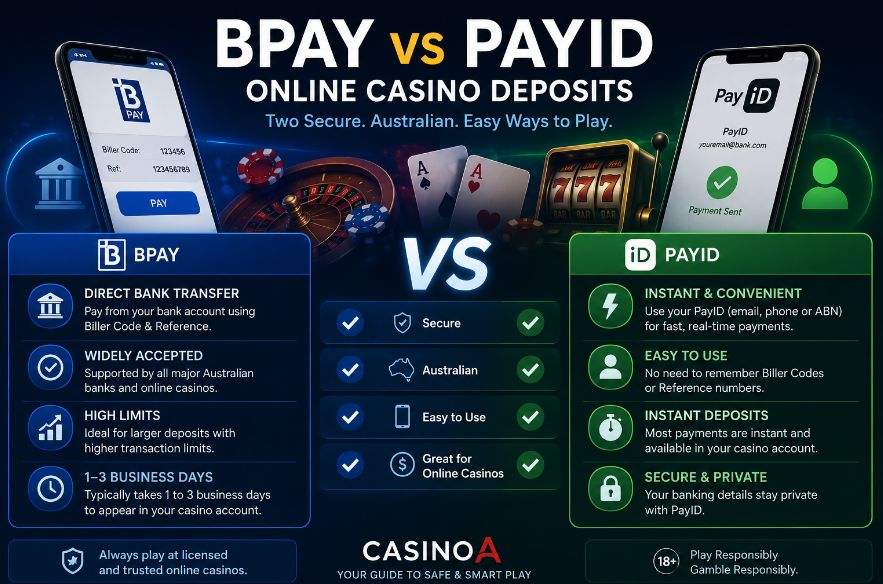
In a Nutshell
- PayID payments can usually arrive within seconds, including outside normal business hours
- BPAY payments often take one to three business days to process and clear
- BPAY is rarely offered by offshore casino sites because it is slower and designed for bill payments
- PayID is more common because it uses Australia’s fast bank-transfer infrastructure
- Neither BPAY nor PayID is anonymous; both create bank transaction records
- Always check the PayID recipient name before approving a transfer
- A local payment option does not mean an online casino is legal, licensed or regulated in Australia



BPAY vs PayID for Online Casino Deposits: Comparison
Australian players often see familiar payment names when looking at online casino deposit options. BPAY and PayID are both recognised local payment methods, but they work in very different ways. The biggest difference is speed: PayID payments can usually arrive within moments, while BPAY is a bill-payment system that may take one to three business days to clear and appear in the recipient’s account.
That difference matters when a player expects funds to be credited quickly. It also helps explain why BPAY is rarely offered by offshore casino websites, while PayID has become a common local bank-transfer rail on sites targeting Australians. Neither method is anonymous, however. Both connect a payment to a bank account, and both create a transaction record.
For Australians, there is also an important legal context. Online casino-style gambling services, including online pokies, roulette and casino games, are prohibited from being offered to people in Australia. A payment method appearing on a website is not proof that the operator is licensed, safe, or entitled to provide gambling services to Australian customers.
BPAY and PayID at a Glance
BPAY is designed for paying established billers. A customer enters a BPAY biller code and a customer reference number through their bank. The payment is then routed through the BPAY network to the relevant organisation.
PayID is a simpler way to address a bank payment. Instead of entering a BSB and account number, a payer can use a mobile number, email address, Australian Business Number, organisation identifier or another registered PayID. The receiving name should appear before the transfer is authorised, giving the sender an opportunity to check who will receive the money.
The payment itself is generally sent through Australia’s New Payments Platform, commonly called the NPP. This infrastructure supports fast account-to-account payments between participating financial institutions.
Deposit Speed: Why PayID Is Faster
Speed is the clearest distinction between BPAY and PayID.
A PayID payment can usually be processed in seconds. The player enters the recipient’s PayID, reviews the displayed account name, confirms the amount, and authorises the bank transfer. If both institutions support the relevant real-time payment service and no security review applies, the funds generally reach the receiving account almost immediately.
That speed suits businesses that need to confirm payment before providing access to a product or service. In the gambling context, an operator may be able to identify the incoming payment and credit a customer balance quickly. It does not guarantee instant crediting, because the website may still use manual checks, payment processors, risk controls or internal account reviews.
A first transfer to a new recipient can take longer. Banks may delay an unfamiliar payment while they assess fraud risk. Large values, unusual payment patterns, new payees and warnings triggered by scam-prevention systems can also slow a payment. A delay is not automatically a problem, but it should be treated as a reason to pause and verify the recipient rather than trying to send the money again.
BPAY operates differently. A payment may leave the customer’s bank account promptly, but that does not mean the recipient has received cleared funds or that its systems have posted the payment. BPAY payments are affected by bank cut-off times, weekends, public holidays and the biller’s own reconciliation process.
If a BPAY payment is made before the relevant bank cut-off on a weekday, the biller may treat it as received that day. The actual funds and account update can still take longer. A payment made after cut-off time, on a weekend or during a public holiday may not be processed until the next business day. From a practical perspective, one to three business days is a reasonable expectation for a BPAY payment to be fully recognised, although some billers take longer.
That is a poor match for a customer who expects a gaming balance to update straight away. A casino would need to wait for confirmation, reconcile the reference number and decide when to release funds. It would also need to deal with support requests from customers whose bank balance shows a debit but whose casino account still shows no deposit.
Why BPAY Is Rarely Offered by Offshore Casinos
BPAY is a widely trusted Australian bill-payment brand, but it is not built as a universal deposit tool for overseas merchants. It is typically used by organisations that can operate as recognised billers and issue the correct biller code and customer reference number.
For an offshore casino, that creates several difficulties.
First, BPAY is mainly intended for bill payment rather than rapid consumer funding. An online casino deposit flow depends on fast confirmation. A delay of one or more business days can reduce conversion, create customer-service work and increase the chance that a player changes their mind before funds are credited.
Second, BPAY needs structured merchant onboarding and local payment arrangements. An offshore gambling brand may use overseas entities, third-party processors, constantly changing domains or bank accounts that do not fit neatly into a conventional Australian biller setup. It is much easier for a site to ask a customer to make an ordinary account-to-account transfer than to become a formal BPAY biller.
Third, BPAY’s payment references are usually connected to a biller relationship. This structure works well for utilities, government agencies, telecommunications businesses, insurers and credit providers. It is less suitable for a gambling site that needs a different payment reference for each customer, each deposit and sometimes each payment processor.
Fourth, BPAY’s slower settlement profile creates operational risk for the casino. If an operator credits a customer before funds settle and the payment fails, is reversed or cannot be matched correctly, it may face a loss. If it waits until the funds are confirmed, the customer experiences a slow deposit.
Finally, a familiar domestic payment name can create expectations around regulation, consumer safeguards and complaint pathways. But the payment method itself does not regulate the gambling business receiving the money. A BPAY transaction would not make an offshore casino Australian-licensed or give the player the protections available with a properly regulated local service.
For these reasons, BPAY is more likely to appear as a payment option for legitimate Australian billers than as a practical option for offshore casino deposits.
Why PayID Became the Preferred Local Rail
PayID solves several problems for a business seeking Australian bank transfers. It is local, fast, simple to enter and does not require the customer to type a BSB and account number. The payer can use a mobile number or email address, while the recipient can receive funds through a participating Australian financial institution.
For a customer, the process is straightforward:
- Select PayID or bank transfer as the deposit method.
- Receive a mobile number, email address or other PayID to pay.
- Open the banking app and start a PayID payment.
- Check the displayed recipient name carefully.
- Enter the transfer amount and payment description if required.
- Approve the transfer.
- Wait for the operator to identify and credit the payment.
This is faster than BPAY because the transaction can be sent through Australia’s real-time payments infrastructure. It works outside standard business hours, including weekends and public holidays, provided the sending and receiving institutions support the service.
For operators, PayID can offer immediate payment confirmation and a relatively low-friction deposit experience. It can also reduce the burden of handling long card details and card-payment declines. For a player, it offers the convenience of using an existing banking app rather than creating a separate wallet.
However, “preferred local rail” does not mean “recommended gambling method.” PayID has been increasingly used by illegal gambling websites and scam operations that target Australians. A site may direct a player to send money to a personal-looking mobile number or to a business account with a name that does not match the casino brand. That should be treated as a serious warning sign.
A legitimate payment instruction should be clear, consistent and verifiable. If the PayID recipient name is unfamiliar, generic, unrelated to the website, or changed at the last minute, do not transfer money. Contact your bank immediately if you suspect you have sent money to a scammer or an unlawful gambling operation.
Anonymity: Neither Method Is Anonymous
Many payment-method comparisons use the word “anonymous” loosely. In banking, anonymity has a specific practical meaning: whether the payer’s identity, bank relationship and transaction information are concealed from the recipient, financial institutions or authorities.
Neither BPAY nor PayID is anonymous.
With BPAY, the bank records the payer’s account, the recipient biller, the amount, date, biller code and customer reference number. The biller can use the reference number to match the payment to an account or invoice. The financial institution also retains transaction records under its legal and compliance obligations.
With PayID, the transfer is tied to the payer’s bank account. The recipient can generally see identifying information associated with the incoming transfer, although the exact display can vary between banks and payment setups. The sender is also shown a recipient name before payment, helping to reduce the chance of transferring funds to the wrong account.
The practical privacy difference is small:
- BPAY can reveal less obvious recipient information to the customer because the user pays a biller code and reference number rather than viewing standard account details.
- PayID can be more transparent before payment because the sender sees a name linked to the PayID.
- Both methods are traceable through bank records.
- Both can be reviewed by financial institutions for fraud, anti-money-laundering and scam-prevention purposes.
- Neither prevents an operator, payment intermediary or bank from associating a deposit with a customer.
A player should not choose BPAY or PayID because they expect secrecy. If a website advertises “anonymous PayID deposits” or claims that bank payments cannot be traced, that is misleading and should raise concern.
Privacy Versus Safety
It is useful to separate privacy from safety.
Privacy concerns the amount of personal information shared during a transaction. Safety concerns whether the recipient is legitimate, whether the payment can be disputed, whether funds are protected and whether a player has meaningful recourse if something goes wrong.
PayID may feel more private than sharing a physical card number because it does not involve entering card details on a website. That does not make the payment anonymous or inherently safer. A bank transfer can be difficult to recover once it has been sent, particularly when funds have been moved quickly through multiple accounts.
BPAY may feel safer because it is associated with established bill payments. Yet the safety of a BPAY payment depends on the biller being legitimate and the biller code and reference details being correct. It should not be used as proof that a gambling service is authorised.
For both methods, the safest approach is to verify the recipient before paying:
- Check whether the recipient name displayed by your bank matches the business you believe you are paying.
- Do not rely solely on logos, social-media ads, positive reviews or a polished casino website.
- Be wary if a website asks you to transfer money to a different person or company from the casino brand.
- Treat changing bank details as a warning sign, especially if support staff pressure you to pay quickly.
- Avoid sending a second transfer because a website claims it cannot see the first one.
- Keep a record of payment instructions, transfer confirmations and communication with the operator.
- Contact your bank quickly if you believe you have been deceived or sent funds to the wrong recipient.
Deposit Limits and Responsible Gambling
Payment speed can make gambling more impulsive. A PayID deposit may arrive fast enough to reduce the pause that sometimes occurs with slower payment methods. That convenience can be unhelpful for anyone trying to manage spending, avoid chasing losses or maintain a gambling budget.
BPAY’s slower process is not a responsible gambling tool, but its delay can create a natural pause. A player may have time to reconsider the payment before the funds are credited. PayID removes much of that delay, making it important to set personal safeguards before initiating a transfer.
Useful steps include setting bank transfer limits, using gambling blocks where available, avoiding deposits after losses, and keeping gambling money separate from essential expenses. Never use rent, bills, savings earmarked for urgent needs, or borrowed money for gambling.
If gambling is causing financial stress, relationship problems or difficulty controlling deposits, help is available through Gambling Help Online and state-based gambling support services. Speaking to a financial counsellor can also help with a practical plan to manage debts, recurring payments and bank-account access.
Which Is Better for Casino Deposits?
From a purely technical perspective, PayID is faster and more convenient than BPAY for an Australian bank transfer. It supports real-time payments, is available around the clock, and can be easier to use because it replaces BSB and account details with a familiar identifier.
BPAY is better suited to scheduled or routine bill payments. It is slower, more dependent on business-day processing and less suited to an operator that wants to credit deposits immediately. That is why BPAY is uncommon on offshore casino sites.
But speed should not be the only factor. For Australians, the more important issue is whether the gambling service is permitted to offer its product locally and whether it provides meaningful consumer protections. Illegal offshore casino sites can use PayID precisely because it is fast and familiar, but the use of a local payment rail does not make the operator trustworthy.
If a website asks for a PayID payment, verify the recipient name, the operator’s status and the exact payment purpose before transferring money. Never assume that a fast bank payment is reversible or protected in the same way as a card dispute.
Final Thoughts
BPAY and PayID are not interchangeable deposit methods. BPAY is a bill-payment system that may take one to three business days, especially where cut-off times, weekends, public holidays and internal biller processing are involved. PayID uses Australia’s real-time payments infrastructure, making it capable of delivering funds in seconds, 24 hours a day.
That speed makes PayID more attractive to offshore gambling websites, while BPAY’s slower biller-based model makes it less practical. However, neither payment option is anonymous. Both are connected to banking records, and both should be used with caution when a website’s identity, licensing or payment instructions are unclear.
For Australian gamblers, a local payment method is not a sign of a locally regulated casino. The safest decision is to avoid transferring money to prohibited or unverified gambling services, particularly where the recipient details do not clearly match the brand requesting the payment.
BPAY vs PayID FAQs
Is PayID faster than BPAY for online casino deposits?
Yes. PayID transfers can usually be processed within seconds when both banks support fast payments and the transaction is not held for security checks. BPAY is a bill-payment service and may take one to three business days to be fully processed, especially after bank cut-off times or on weekends and public holidays.
Is BPAY available at online casinos?
BPAY is rarely offered by offshore online casino websites. Its biller-code system and slower processing times are less suitable for operators that want to credit deposits quickly. PayID and standard bank transfers are more common because they can provide faster payment confirmation.
Is PayID anonymous?
No. PayID is not anonymous. A PayID payment is linked to the sender’s bank account and creates a transaction record. Before authorising a payment, your banking app normally displays the name associated with the recipient’s PayID, so check it carefully.
Is BPAY anonymous?
No. BPAY payments are also traceable. Your bank records the payment, while the biller can use the biller code and customer reference number to match it with an account or transaction. BPAY may reveal fewer visible banking details to the payer, but it does not provide anonymity.
Can a PayID deposit be delayed?
Yes. Although PayID is normally near-instant, banks may delay a first payment to a new recipient or flag a transfer for fraud and security checks. Larger, unusual or high-risk payments can also take longer to clear.
Can I reverse a PayID payment?
Usually, no. Once a PayID payment has been sent and received, it can be difficult to recover. If you entered the wrong details or suspect a scam, contact your bank immediately and keep any transfer records and payment instructions.
Why would a casino use a different PayID name?
A payment recipient name may differ where an operator uses a third-party payment processor. However, an unfamiliar name, a personal-looking PayID, frequently changing recipient details, or pressure to deposit quickly are important warning signs. Do not proceed unless you can independently verify who will receive the money.
Are online casino deposits legal in Australia?
Online casino services, including online pokies, roulette, blackjack and poker, are prohibited from being provided to people in Australia under the Interactive Gambling Act. The Australian Communications and Media Authority has also warned of illegal gambling services offering PayID deposits to Australians.acma.
Does using PayID mean an online casino is Australian-licensed?
No. PayID is an Australian payment-addressing service, but its availability does not show that the recipient is licensed, regulated or authorised to offer gambling services in Australia. A local payment method is not a guarantee of consumer protection.
What should I check before sending a PayID payment?
Confirm the recipient name shown in your banking app, make sure it matches the business you intend to pay, and avoid transferring funds if the details are unclear or change unexpectedly. Never send another payment simply because a website claims it cannot see the first transfer.
Sources
- BPAY Australia
- PayID Australia
- New Payments Platform Australia
- Australian Communications and Media Authority: Online Gambling
- Gambling Help Online
Last Updated on September 11, 2026 by Pokie-Player