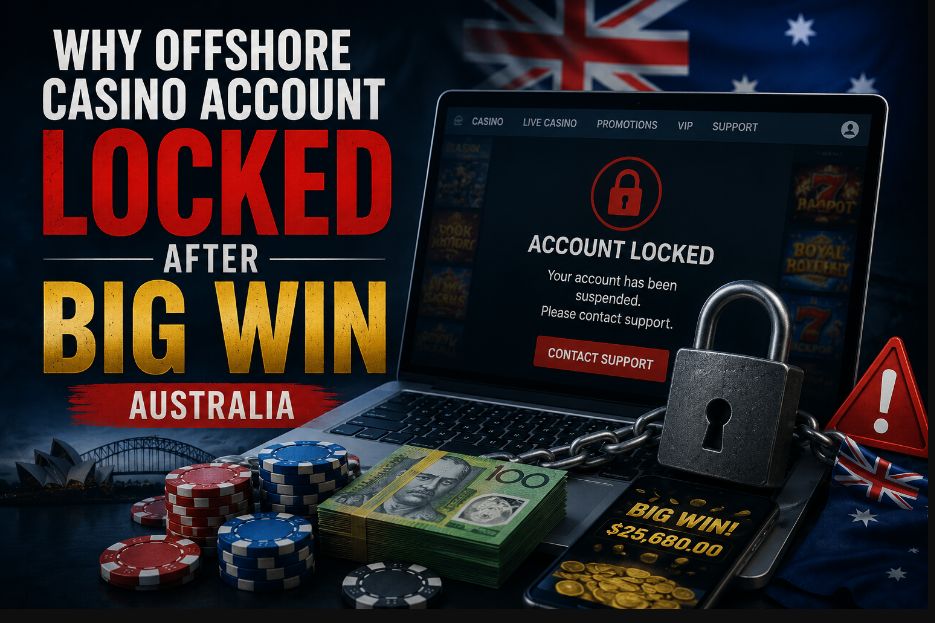
Many offshore casino accounts get locked right after a big win, and while it feels like a scam, it is often an automated security trigger rather than a deliberate attempt to block your payout. For Australian pokie players using offshore sites, understanding these triggers and knowing how to respond calmly can make the difference between a short delay and a long-running dispute.



Why Offshore Casinos Lock Accounts After Big Wins
Big wins are one of the most common events that push a casino’s security system into “high alert” mode. Offshore platforms use automated algorithms to flag unusual behaviour and then temporarily lock accounts while staff review the activity.
Typical triggers around big wins include:
-
A sudden jump in your balance compared with your usual stakes.
-
Multiple high-value bets in a short time frame or “rapid cash-outs.”
-
A withdrawal request that exceeds your usual deposit or play pattern.
From the casino’s perspective, these patterns could indicate fraud, hacked accounts, collusion, or bonus abuse. For the player, they can simply mean “you got lucky,” but the system does not know that until someone manually checks the account.
Common Security Triggers (That Aren’t a Scam)
Most locked accounts are the result of one or more standard triggers that operators are required to act on. Understanding these helps you avoid unnecessary stress.
1. Logging in from a Different IP or Location
If you log in from a new device, different Wi‑Fi, or a mobile network in another region, the casino may treat that as suspicious. This is especially true if:
-
You normally play from home but suddenly log in from another country.
-
You use a VPN that shows changing locations.
-
Your IP switches several times within a short period.
The system might assume someone else accessed your account and apply a temporary lock while they verify your identity.
2. Mismatched Names on Bank Cards or Wallets
Using a card, bank account, or e‑wallet that is not in your own legal name is a major red flag. Offshore casinos must comply with anti‑money‑laundering rules, so they will often:
-
Lock the account when they see third‑party payment methods.
-
Ask for documents proving that the payment method belongs to you.
-
Refuse withdrawals until the mismatch is resolved.intercom+1
Even minor inconsistencies – such as a nickname, missing middle name, or different surname after marriage – can trigger extra checks.
3. Pending or Incomplete KYC Verification
Know Your Customer (KYC) checks are mandatory for any serious gambling operator, including offshore casinos that accept Australian players. If you have:
-
Not yet uploaded full ID and proof of address.
-
Uploaded documents that are expired or blurry.
-
Provided details that don’t match your registration form.
then your account may be locked until verification is completed. This often happens precisely when you request your first big withdrawal, because that is when the casino is obliged to confirm who you are.
4. Bonus Abuse or “Irregular Play”
Many offshore casinos have strict rules about how bonuses can be used. Examples of behaviour that can trigger a lock:
-
Using multiple accounts to claim the same welcome bonus.
-
Betting above the maximum allowed stake while a bonus is active.
-
Playing excluded games using bonus funds.
Automated systems look for these patterns and may suspend the account while staff review logs. In some cases, a misunderstanding of the rules looks similar to intentional abuse from the casino’s perspective.
5. Payment Problems and Chargebacks
If a deposit is reversed, disputed, or flagged by your bank, the casino will usually lock the account until the matter is resolved. This can include:
-
Chargebacks raised after losing a session.
-
Bank reports of suspicious activity.
-
Repeated failed deposits from the same card or wallet.
From a risk perspective, casinos treat unresolved payment issues as potential fraud and pause withdrawals to protect themselves.
6. Responsible Gambling and Self‑Exclusion
Sometimes, the lock is actually a feature you turned on yourself. Many operators offer:
-
Self‑exclusion for a set period.
-
Cooling‑off or time‑out tools.
-
Deposit and loss limits that can block further play.
If you previously requested a self‑exclusion or set strict limits, the system may lock your account automatically after a high‑intensity session.
How to Tell If It’s a Security Check or a Real Scam
For Australian players on offshore sites, the first task is to distinguish a legitimate review from a rogue operator.
Signs it is a routine security check:
-
You receive clear emails explaining the lock and asking for documents.
-
Support answers via live chat or email and gives realistic timeframes.
-
The casino has a track record with recognised game providers and independent reviews.
Warning signs of a potential scam:
-
No response from support for days or weeks.
-
Vague accusations (“bonus abuse”) with no specific examples.
-
Refusal to release any part of your balance, even deposits, after you comply.
Most reputable offshore casinos prefer to keep paying customers happy, so genuine locks are usually temporary and solvable when you cooperate.
Step‑by‑Step Recovery Process for Locked Accounts
If your account was locked after a big win, follow a clear recovery path instead of panicking. This process is tailored for Aussie players dealing with offshore platforms.
Step 1: Stop Making Assumptions and Gather Information
Before you send angry messages or post complaints, check what the casino has already told you.
-
Look through your email inbox and spam folder for any messages from the casino.
-
Check on‑site notifications and your account message center.
-
Take screenshots of any error messages or lock screens.
This documentation helps you understand the trigger and gives you evidence if you later need to escalate the dispute.
Step 2: Review the Casino’s Terms and Conditions
Go to the casino’s main terms page and search for sections on:
-
“Verification,” “KYC,” or “identity checks.”
-
“Bonus terms,” “abuse,” or “irregular play.”
-
“Suspension,” “account closure,” or “security reviews.”
Note down anything that might apply to your situation, such as maximum bet limits while using a bonus or rules about third‑party payments. This helps you frame your communication around specific clauses rather than general frustration.
Step 3: Contact Customer Support Calmly
Use live chat if available; otherwise send a detailed email. Include:
-
Your full name, username, and registered email.
-
Date and approximate time of the big win.
-
Date and method of your withdrawal request.
-
A clear question: “What specific reason caused my account lock, and what documents or actions are required to unlock it?”
Polite, structured messages tend to receive faster and more helpful responses than emotional complaints.
Step 4: Prepare Standard Verification Documents
Most legitimate casinos will request similar KYC documents. Get them ready before support even replies:
-
Photo ID: passport, driver’s licence, or national identity card.
-
Proof of address: utility bill, bank statement, or government letter from the last three months.
-
Payment method proof: a masked card photo, bank screenshot, or e‑wallet statement showing your name and partial card or account number.
Make sure all images are clear, uncropped, and show the required details without exposing full card numbers or sensitive information.
Step 5: Resolve Any Payment or Name Mismatches
If your deposits came from a card or account in someone else’s name, explain this honestly and expect that the casino may:
-
Request additional evidence.
-
Ask you to switch to a payment method in your own name.
-
Limit withdrawals from the problematic method.
Where possible, correct discrepancies by updating your account details to match your ID, and use only your own banking channels going forward.
Step 6: Wait for the Verification Window
Once documents are submitted, most casinos quote a review window between 24 and 72 hours. During this time:
-
Avoid sending repeated messages every hour; it can slow the process.
-
Keep an eye on your email for follow‑up requests.
-
Do not attempt to open new accounts at the same casino; this will likely complicate matters.
If the casino misses its own stated timeframe, politely ask for an update and reference the original estimate they provided.
Step 7: Request Access to Your Balance If the Lock Persists
If your account remains locked beyond a reasonable period, you can ask for clarity about your balance.
-
Request a breakdown of deposited funds, bonus funds, and winnings.
-
Ask whether you can withdraw at least your deposit and any uncontroversial winnings.
-
If they refuse, ask which specific clause in the terms justifies withholding your balance.
This approach forces the casino to anchor its decision in documented rules rather than vague language.
Step 8: Escalate to External Help if Needed
For offshore sites, options are more limited than with fully regulated Australian operators, but you still have routes.
You can:
-
Search for recognised dispute resolution or licensing bodies listed in the casino’s footer.
-
File a complaint with independent watchdog or review portals that accept player disputes.
-
In serious cases, seek legal advice from specialists in online gambling disputes.
While not every case leads to a full payout, documenting your steps and using formal channels increases your chances of a fair outcome.
How Aussie Players Can Reduce the Risk of Future Locks
Prevention is better than recovery. Australian players using offshore casinos can take several practical steps to make account locks less likely.
1. Verify Early, Not After a Big Win
Complete KYC soon after opening an account, even if you’re only playing small stakes. This way, when a big win arrives, the casino does not have to rush verification under pressure.
2. Keep Location and Devices Consistent
Avoid constant VPN use or rapid switching between distant locations when playing. Stick to one main device and network where possible so that big wins look like normal play from the same user.
3. Use Only Your Own Payment Methods
Always deposit from cards, accounts, and wallets in your own legal name. This reduces friction at withdrawal time and aligns with anti‑money‑laundering requirements offshore casinos must follow.
4. Respect Bonus Rules and Limits
Read bonus terms and avoid aggressive strategies that break maximum bet rules or target excluded games. Treat bonuses as extra entertainment rather than a loophole to exploit, and your account is less likely to be flagged.
5. Take Responsible Gambling Tools Seriously
Use deposit limits, loss limits, and time‑outs to keep play within healthy boundaries. Not only does this protect you, it also demonstrates to the casino that you are playing in a stable, controlled way, which helps reduce risk flags.
Final Thoughts for Australian Offshore Casino Players
Having your offshore casino account locked right after a big win is stressful, but in many cases it reflects automated security systems and regulatory obligations rather than deliberate theft. For Aussie players, the best approach is to understand common triggers, cooperate with verification, and follow a structured recovery process instead of reacting emotionally.
By verifying early, using consistent devices and payment methods, respecting bonus rules, and relying on responsible gambling tools, you can dramatically reduce the likelihood of future locks and enjoy offshore play with fewer surprises.
FAQs: Offshore Casino Accounts Locked After a Big Win
Why did my offshore casino account get locked after a big win?
Most offshore casinos use automated security systems that flag unusual activity, such as a sudden large win followed by a big withdrawal request. When this happens, the casino may temporarily lock your account to review the session, check for fraud, and verify your identity before releasing the funds.
Is my offshore casino trying to scam me by locking my account?
In many cases, a lock is a routine security or compliance check rather than an attempt to avoid paying out. The casino must protect itself against hacked accounts, money‑laundering and bonus abuse. As long as the operator communicates clearly and processes verification within a reasonable timeframe, the lock is usually a temporary measure.
Can logging in from a different location cause my account to be locked?
Yes. Logging in from a new country, using a VPN, or switching between multiple IP addresses in a short period can trigger security rules. The system may treat this as suspicious and lock the account until the casino confirms that the person playing and cashing out is genuinely you.
Do mismatched names on my bank card or e‑wallet matter?
They do. If the name on your payment method does not match the name on your casino account, the operator may suspect third‑party payments or money‑laundering. This can lead to an account lock, requests for extra documents, and sometimes restrictions on withdrawals until the mismatch is resolved.
Why does the casino ask for ID only after I win big?
Many offshore casinos let players deposit and play with minimal checks, but they are required to verify identity before paying out larger amounts. A big win or first major withdrawal can be the trigger that forces the casino to apply full KYC procedures, including photo ID and proof of address.
What documents do I need to unlock a locked casino account?
Most offshore casinos ask for a clear photo of a government‑issued ID (such as a passport or driver’s licence), a recent proof of address (like a utility bill or bank statement), and evidence of the payment method used (for example, a masked card photo or e‑wallet screenshot). Providing these quickly and accurately usually speeds up the review.
How long does it take to unlock a locked offshore casino account?
Timeframes vary, but many operators aim to review documents within 24 to 72 hours. Delays can occur if the images are unclear, the details do not match your registration, or additional checks are required. Staying responsive to follow‑up requests and avoiding duplicate messages helps keep the process moving.
What should I do first if my account is locked after a big win?
Start by checking your email and on‑site messages for an explanation from the casino. Then contact support via live chat or email, ask for the exact reason for the lock, and request a list of documents needed to restore access. Take screenshots of messages and keep copies of anything you send in case you need to escalate the issue later.
Can I still withdraw my deposit if my account remains locked?
In many situations, once verification is complete, casinos will allow at least your deposited funds and legitimate winnings to be withdrawn. If the lock persists after you have cooperated fully, you can politely ask the operator which specific clause in their terms justifies holding your balance and whether partial payouts are possible.
How can Australian players reduce the risk of future account locks?
You can lower the chance of being locked by completing verification early, using only payment methods in your own name, avoiding constant VPN use, respecting bonus rules and maximum bets, and setting sensible deposit limits. These steps make your account look stable and transparent to the casino’s risk systems.
Where can I get help if I believe my casino is acting unfairly?
If you feel a lock is unjust or communication has broken down, you can look for independent dispute channels listed by the casino, file a complaint with reputable review and watchdog sites, and seek advice from services that specialise in gambling issues and player protection. Keeping a clear record of all messages and documents will support your case.
Sources
- Gambling Help Online – Australia
- ACMA – Online Gambling Information
- Account Closure Help for Casino Players
- Guide to Online Casino Disputes and Winnings
- Why Betting Accounts Get Suspended
Last Updated on September 11, 2026 by Pokie-Player