Summary
Your Queensland club’s gaming room layout does not change a machine’s odds, but it can influence whether you enter, how absorbed you become and when you decide to leave.
- Entry points and sightlines matter: Screens, pathways and room boundaries affect exposure to gaming and access to other facilities.
- Separation rules are specific: Machines must not be located in designated dining or live entertainment areas. That does not mean every gaming area must be a fully enclosed, soundproof room.
- Cash access creates a pause: ATMs and cash-dispensing EFTPOS facilities must not be in or close to gaming areas. Queensland’s guidance does not prescribe one universal minimum distance.
- Lighting and sound can affect immersion: Research suggests environmental cues can influence play, but effects vary. Not every design choice proves deliberate manipulation.
- Supervision and safety also shape layouts: Machine clearances, staff sightlines and unobstructed exits serve practical regulatory purposes.
- Longer sessions increase exposure: More betting can mean greater theoretical gambling cost, even though individual results remain unpredictable.
Before playing, locate the exit, non-gaming seating and staff assistance. Keep your own time and spending limits rather than relying on the room to prompt a break.
Inside Your QLD Club’s Gaming Room: How Layout, Lighting and Cash Access Shape Your Visit
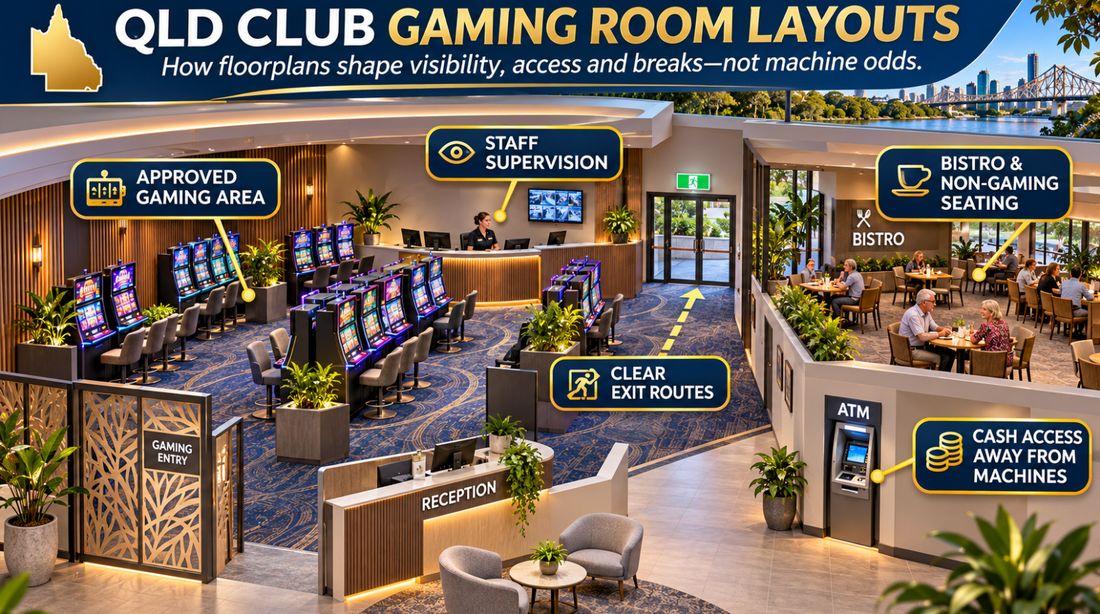
Your local Queensland club’s floorplan does more than organise the bistro, bar and gaming lounge. It determines what you see, which activities you pass, how easily you obtain cash and how much effort it takes to interrupt a session.
Those details can influence gambling behaviour without changing a machine’s odds.
A screened entrance may keep gaming out of sight of diners while making the lounge feel more separate from everyday activity. A cash facility positioned away from machines creates a pause. Lighting and sound can affect immersion, although research does not support the claim that every decorative choice predictably increases spending.
Queensland also regulates important parts of this environment. Gaming machines must operate within approved gaming areas, machine placement is subject to clearance requirements, and cash-dispensing facilities cannot be in or close to gaming areas.
However, the rules are more nuanced than “gaming rooms must be completely separated from bars and restaurants”.
This guide examines the invisible architecture of Queensland club gaming: what the rules require, what research suggests and what you can notice before a short visit becomes a longer session.
The Floorplan Changes the Session, Not the Odds
The first distinction is between game mathematics and gambling exposure.
A machine’s position beside a wall does not make it due to pay. A darker corner does not improve the return to player. A terminal near the entrance is not automatically more generous.
The floorplan matters because it can affect your decisions around the game:
-
Whether you enter the gaming area.
-
Whether you notice time passing.
-
Whether another activity interrupts play.
-
How easily you obtain more money.
-
Whether you leave after collecting a balance.
-
Whether staff can supervise the machines.
The financial connection is straightforward. More time spent gambling can mean more bets and greater exposure to the house edge.
That does not mean every longer session produces a larger loss. Individual outcomes remain unpredictable.
It means the environment can influence how much gambling occurs, even though it does not control the outcome of a particular bet.
Queensland Gaming Areas Must Be Approved
A Queensland club cannot treat every spare corner as an authorised machine location.
The Office of Liquor and Gaming Regulation, known as OLGR, approves gaming areas through plans submitted as part of the licensing process.
Two types of plans matter.
Whole-of-site plans
These show the licensed premises and immediate surroundings, including street frontage.
They identify gaming areas, ATMs, EFTPOS terminals and other relevant facilities.
This allows the regulator to consider how gaming sits within the broader venue.
Gaming area plans
These show the gaming area in greater detail, including individual machine positions, doors, windows, walls, cameras and other features.
Machines may only be played within an approved gaming area.
However, the regulator’s guidance allows machines to be positioned within that approved area provided layout, clearance, supervision and other applicable requirements are met.
The approved boundary is therefore important, but it does not necessarily freeze every machine into one permanent position.
Must Gaming Be Completely Separate From the Bistro and Bar?
Not in the blanket sense often implied.
Queensland guidance says machines must not be located in a designated dining or live entertainment area.
It also specifies a minimum clearance of two metres from a bar, with an exception for an unutilised end.
Those requirements should not be rewritten as a universal rule demanding a fully enclosed, soundproof gaming room.
A gaming area can be defined by structural boundaries or screens. The approved plans establish its extent.
The practical distinctions are:
| Feature | Relevant Queensland position |
|---|---|
| Designated dining area | Machines must not be located there |
| Live entertainment area | Machines must not be located there |
| Bar proximity | Minimum clearance generally applies |
| Enclosed room | Not established as a universal requirement by the guidance reviewed |
| Gaming boundary | Must correspond with the approved area |
| Other venue facilities | Patrons should not have to pass through gaming to reach most facilities |
This matters because the boundary between activities can be physical, visual and regulatory without being an entirely separate building.
Entry Points Decide Who Encounters Gaming
An entrance is a decision point.
A route that branches clearly towards dining, reception or gaming lets visitors choose their destination. A route that draws everyone past machines creates a different experience.
Queensland’s planning guidance addresses this directly.
It says patrons should not be required to travel through the gaming area to access toilets, ATMs or the majority of the venue’s facilities.
It also says there should be no direct street access to gaming areas. Where that is unavoidable, a wall or screen creating a foyer may provide adequate separation.
These are expressed as planning expectations. They should not all be described as identical statutory offences.
What this means for a diner
You should be able to visit a club for its main non-gaming facilities without treating the gaming floor as a compulsory passageway.
If you arrived for lunch, the route to the bistro should not quietly redefine the outing.
That is particularly relevant for people avoiding gambling cues or attending with family.
Sightlines Work in Both Directions
Sightlines determine what patrons can see, but they also determine what staff can supervise.
Queensland requires gaming layouts to allow continuous supervision of every available machine from normally staffed locations.
Direct sight is preferred. Mirrors or CCTV can assist where direct observation is not possible.
The faces of machines must be visible through the supervision arrangement.
A secluded-looking corner is therefore not necessarily an unsupervised corner.
Visibility is not always a sales tactic
A clear view across a gaming room can help staff identify problems and maintain oversight.
Similarly, a screen may protect non-gaming patrons from exposure rather than exist solely to create immersion.
It is too simplistic to label every open sightline manipulative and every screen harmful.
The useful question is what the design makes easier: supervision, separation, navigation or uninterrupted play.
One feature can serve several purposes at once.
Why Gaming May Be Screened From Outside
Queensland requires licensees to ensure gaming equipment, including jackpot signage, is not readily visible to passing pedestrians.
This provides an important alternative explanation for screened entrances and restricted street-facing views.
A screen may be there to satisfy visibility requirements, not to conceal an exit or trap patrons.
However, restricting outside visibility can also reduce contact with daylight and street activity from some seating positions.
That creates a design tension.
The venue must meet its external-visibility obligations while maintaining a legible, properly supervised environment inside.
The existence of screening alone does not establish misconduct. Its placement and practical effect deserve closer attention.
Cash Access Is a Deliberate Point of Friction
The route to additional money is one of the most consequential parts of a gaming floorplan.
Under Queensland’s requirements, ATMs and cash-dispensing EFTPOS facilities must not be located in or close to gaming areas.
ATMs installed at licensed premises must accept debit cards only.
OLGR also strongly recommends placing ATMs as far from gaming areas as possible.
The distinction between a rule and a recommendation matters:
-
Being outside and not close to gaming is a regulatory requirement.
-
Maximising distance is additional regulator guidance.
-
Screening ATMs from the gaming room is recommended responsible-service practice.
The aim of distance is not merely aesthetic. Moving away from a machine creates an opportunity to interrupt the sequence of spending.
A pause is not guaranteed to change someone’s decision. It does create space for one.
There Is No Universal ATM Distance in the Guidance
Be cautious when someone claims Queensland requires every ATM to be exactly five or ten metres from gaming.
The statewide guidance reviewed uses “not in or in close proximity to” a gaming area rather than prescribing one universal distance.
Suitability involves the actual layout.
A facility just beyond a doorway may still raise proximity concerns. A larger venue may be able to place cash access substantially further away.
Also distinguish cash-dispensing EFTPOS from an ordinary payment terminal.
OLGR says it has no issue with the location of EFTPOS terminals not used to dispense cash, provided they are appropriately signed and identified on the plan.
A bistro card terminal is therefore not automatically governed in exactly the same way as a cash-withdrawal facility.
Note Breakers and Redemption Terminals Are Different
Not every machine handling money is an ATM.
Queensland’s gaming-area guidance permits note breakers within gaming areas, but says they should not be positioned where patrons can use them without a break in gaming.
Cash redemption terminals have their own placement provisions.
The guidance says they must be at least two metres from gaming machines or positioned so patrons cannot access them without a break in gaming. Its general clearance list also specifies two metres from redemption terminals.
These details should not be collapsed into a single “cash machine rule”.
Their functions differ:
-
An ATM provides access to bank funds.
-
A note breaker exchanges denominations.
-
A redemption terminal converts eligible credits or tickets according to the system.
For a patron, the useful question is whether the transaction creates a meaningful stopping point—or simply feels like another action within the same session.
Lighting Can Influence Behaviour, but Evidence Has Limits
Dim gaming rooms are often discussed as though their effects are universally proven.
The research is more specific.
A published study involving three laboratory experiments found longer play and greater total spending under dim rather than bright ambient lighting.
It also found that the relationship changed when participants’ self-awareness was increased by removing screening between machines.
That supports the proposition that lighting and privacy can interact.
It does not establish that a particular Queensland club’s lighting causes a measurable increase in every patron’s spending.
Laboratory settings differ from real venues. Participants, games, session lengths and financial conditions can all affect results.
The practical conclusion is modest: ambient lighting is not necessarily behaviourally neutral, but it is not a reliable mind-control switch.
Soundscapes Are More Complicated Than “Louder Means More Spending”
A gaming room combines machine sounds, voices, background music and intermittent announcements.
Together, these can make the space feel lively, private or absorbing.
However, greater stimulation does not always produce greater immersion.
A 2025 experiment involving 156 undergraduate participants tested different levels of audiovisual cues during simulated slot play.
Immersion was highest in the intermediate condition, not the most intense condition.
That is an important correction to simplistic explanations.
The evidence suggests that audiovisual features can influence the experience, but the relationship is not necessarily linear.
It also does not prove longer real-money sessions at a specific club.
For a patron, the useful observation is whether the room makes it difficult to notice fatigue, conversation, time or the decision to stop—not simply whether the music is loud.
Sensory Separation Can Be Comfortable and Risky
A gaming lounge separated from a busy bistro can offer a quieter, more comfortable experience.
It can also reduce the interruptions that normally divide an evening into distinct activities.
This is the central tension of sensory isolation.
The same enclosure that prevents machine noise disturbing diners may allow a player to focus more continuously on the screen.
Neither function proves the designer’s intention.
A responsible assessment should avoid claiming that every partition is engineered to exploit patrons.
Instead, examine the effect:
-
Can you easily see a way out?
-
Can you locate staff?
-
Is non-gaming seating readily accessible?
-
Does taking a break involve leaving the immediate machine environment?
-
Can you comfortably check the time?
These questions are more useful than guessing why a particular carpet or ceiling colour was chosen.
Machine Layout Also Serves Safety and Access
Not every gap between machines exists to influence psychology.
Queensland’s guidance specifies clearances, including two-metre aisles where machines are arranged in rows and 1.5 metres from non-staff doorways.
Placement must not interfere with fire exits, safety or security features.
Other requirements address walls, corners and back-to-back machines.
These provisions matter because a gaming room must function as a physical environment, not just a commercial one.
A layout that feels spacious may reflect access and safety obligations.
Conversely, an awkward route is not proof of a deliberate maze strategy. Renovations, structural columns and existing building constraints can contribute.
The correct watchdog approach is to identify observable concerns and compare them with applicable requirements—not infer intent from inconvenience alone.
Jackpot Displays Can Create Misleading Impressions
Large overhead displays can draw attention across a gaming area.
Queensland’s linked-jackpot guidance requires patrons to be able to identify which machines participate in the link.
Displays must be positioned above participating machines, and venues must avoid situations where a jackpot sign overhangs machines that are not part of that system.
This is a practical consumer issue.
A prominent jackpot figure should not lead you to assume every nearby terminal is eligible.
Check the individual machine’s information.
Proximity to a large display does not improve the underlying chance of winning, and a growing jackpot does not establish that a payout is imminent.
More Time Can Mean More Financial Exposure
The connection between architecture and spending is best explained through turnover.
Suppose a hypothetical session involves 300 bets of A$1 each. That creates A$300 in turnover.
At an illustrative 8% house edge, the theoretical gambling cost is A$24.
If continued play doubles the turnover under the same assumptions, the theoretical cost also doubles.
This does not predict the actual result. A player can win, lose more quickly or exhaust available money before completing that number of bets.
The example explains why session length matters even when game odds remain unchanged.
You do not need to believe every design feature is manipulative to recognise the value of maintaining your own stopping point.
A Two-Minute Floorplan Check
Before starting, notice five things.
1. Your exit route
Identify a straightforward route back to reception or outside.
2. Non-gaming alternatives
Locate the bistro, lounge or other seating without treating another machine as your break area.
3. Cash access
Recognise that a trip to obtain more money is a new decision, not an automatic extension of the original budget.
4. Staff and help information
Identify where staff are based and where support information is displayed.
5. Your own time reference
Set an independent stopping reminder rather than relying on the room to make time obvious.
These observations do not improve winning chances. They help keep environmental cues from becoming your only guide.
What Good Venue Design Should Deliver
A patron-friendly layout should make choices clear.
You should be able to understand where gaming begins, find non-gaming facilities and leave without unnecessary confusion.
Staff should be able to supervise available machines.
Help information should be visible rather than buried in decorative clutter.
Queensland requires specified gaming and support signage, including help information at relevant transaction points.
A venue’s customer liaison officer can also assist, although the recommendation to have one available during gaming hours comes from the voluntary responsible gambling code.
Compliance is a minimum benchmark. The broader question is whether the room supports informed decisions and meaningful breaks.
If Something Appears Wrong
Raise a specific concern with a supervisor.
Useful details include a blocked route, an apparently unsupervised area, cash access beside machines or missing help signage.
Record the venue, date and relevant location without photographing other patrons unnecessarily.
If the explanation is unsatisfactory, concerns about gaming compliance can be directed to OLGR.
Avoid declaring a breach based on appearance alone. The approved plans, actual function of equipment and applicable conditions may matter.
Final Verdict
Your local QLD club’s floorplan cannot change the result of a spin, but it can shape the decisions surrounding it.
Entrances influence exposure. Screens change sightlines. Cash-access distance creates friction. Lighting and sound can affect immersion, although their effects are not universal or precisely predictable.
Queensland’s rules recognise that physical layout matters, especially around approved gaming boundaries, supervision and access to money.
The most useful response is awareness, not paranoia: understand the room, maintain an independent budget and treat every extension of a session as a fresh decision.
For free, confidential gambling support, call 1800 858 858.
Sources
- Business Queensland: Gaming guideline G03—approved areas, entrances, pedestrian visibility and routes to other facilities
- Business Queensland: Gaming guideline G09—machine placement, dining restrictions, clearances and redemption facilities
- Business Queensland: Gaming guideline G10—ATM and cash-dispensing EFTPOS placement
- Business Queensland: Gaming guideline G11—continuous supervision, direct sight, mirrors and CCTV
- Business Queensland: Gaming guideline G12—linked-jackpot machine grouping and signage
- Journal of Gambling Studies: Experimental research on ambient lighting, play duration and spending
- Effects of Audiovisual Cues on Game Immersion during Simulated Slot Machine Gambling: Experimental findings and limitations
- Business Queensland: Required gaming information and gambling-support signage
- Business Queensland: Customer liaison officers and assistance for patrons experiencing gambling harm
- Business Queensland: Time limits, spending limits, breaks and signs of gambling harm
Last Updated on November 16, 2026 by Pokie-Player