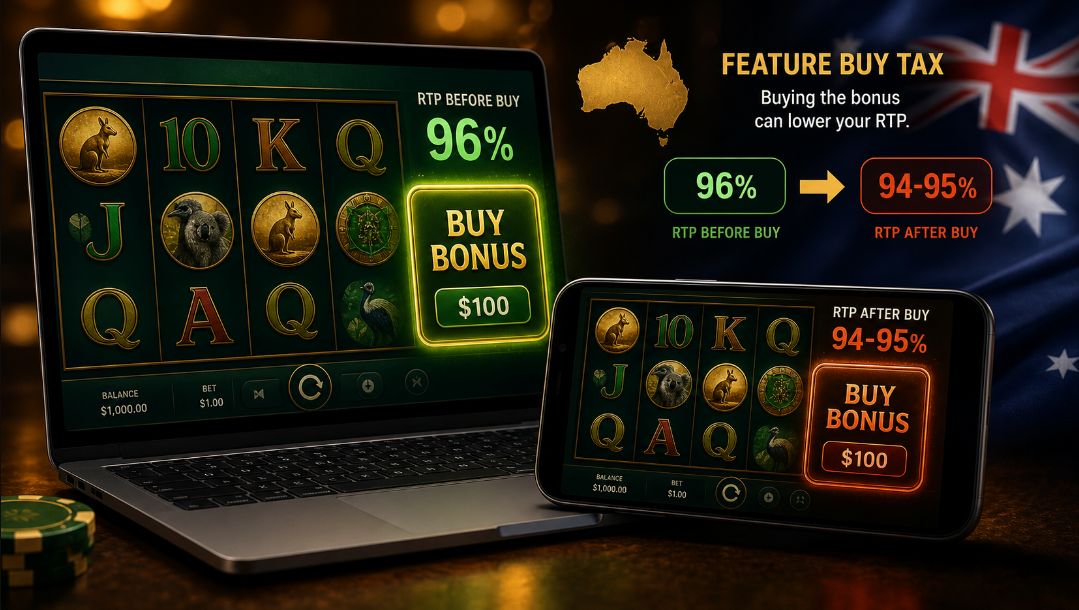
Feature buys have become a staple of modern online pokies, especially at offshore casinos serving Australian players, but there’s a catch many people miss: on some games, buying the bonus actually reduces the RTP by 1–2%, effectively charging you a “feature buy tax” on every purchase. Knowing which titles do this – and how the maths works—can save a serious slice of your bankroll over time.

What Is a Feature Buy on Pokies?
A feature buy (often called “Bonus Buy”) lets you skip the base game grind and pay a fixed multiple of your stake to trigger the free spins or bonus round instantly. Instead of waiting for scatters to land naturally, you click the buy button and the slot launches straight into its main feature.
Typical mechanics:
-
You pay between 60× and 500× your current bet depending on the slot and which bonus mode you choose.
-
The game treats that payment as one big “spin cost” and immediately runs the free spins round.
-
Some titles offer multiple feature buys (standard vs “super” bonus), each priced at different bet multiples.
The appeal is obvious for Aussie players:
-
No more waiting 200+ spins for a feature.
-
Fast, decisive sessions that suit mobile play and PayID or crypto deposits.
The danger lies in how the slot’s RTP is recalculated when you use that button.
How RTP Is Normally Split Between Base Game and Bonus
Every pokie has a total RTP (Return to Player), but that percentage is split across two areas:
-
Base game RTP – the value you receive from regular spins (small hits, medium wins, features, and dead spins).
-
Bonus RTP – the value that comes from the free spins or special features over time.
For example, a slot with 96% total RTP might be structured roughly like this:
-
72% of stakes returned via base‑game outcomes.
-
24% returned via features triggered naturally.
When you play normally, that mix averages out to 96% over huge numbers of spins. The base game is “paying for” most of your small wins and occasional feature hits, while the bonus brings the extra 24% on top.
What a “Feature Buy Tax” Actually Is
On many modern slots, the developer provides separate RTP figures for feature buys and for natural play. In some titles, those feature‑only RTP numbers are equal to or even slightly higher than the base game RTP. But on others, the RTP when you buy the bonus is lower, which is where the “feature buy tax” comes in.
This tax happens when:
-
The game’s overall RTP is split between base and feature.
-
The developer sets a specific RTP for the feature‑buy mode that is lower than the combined figure for normal play.
-
Buying the bonus repeatedly means you are only playing in that lower‑RTP mode, permanently accepting worse odds than the advertised main game RTP.
Practically, that means:
-
Natural play might give 96% RTP.
-
Feature buy mode might give only 94–95% RTP.
So as a feature buyer, you’re effectively charged an extra 1–2% house edge every time you skip the base game—your “feature buy tax.”
Why Some Pokies Lower RTP When You Buy the Bonus
There are a few reasons developers and casinos might design feature buys with reduced RTP:
-
Balancing extreme volatility and big max wins
-
Feature buys concentrate the high‑payout potential into single events.
-
Lowering RTP slightly offsets the increased chance of hitting large wins per purchased bonus.
-
-
Protecting revenue when players skip base‑game value
-
Base spins are designed to pay a substantial part of the RTP.
-
If players bypass those spins entirely, the developer may trim the feature‑only RTP to keep long‑term profitability in line.
-
-
Compliance with jurisdictional or operator demands
-
Some markets or casinos push for lower effective RTP on high‑risk features.
-
Developers respond by creating separate RTP calculations for bonus buy modes.
-
For Aussie players at offshore casinos, the outcome is simple: two people playing the same pokie can face different odds depending on whether they buy the feature or let it land naturally.
How Much Does a 1–2% RTP Drop Really Cost You?
On a single bonus buy, 1–2% might sound minor. Over many buys, it adds up.
Imagine two pokies at offshore casinos:
-
Game A: 96% RTP in natural play; 94% RTP in feature‑buy mode.
-
Game B: 96% overall, and 96%+ RTP even when buying the feature.
If you spend A$10,000 total on feature buys over time:
-
At 96% RTP, the expected long‑term loss is A$400.
-
At 94% RTP, expected loss jumps to A$600.
That extra A$200 is your feature buy tax: money you would statistically keep if you were playing a game where the feature buy RTP matched the main game.
For serious slot enthusiasts and grinders, avoiding those “taxed” titles can make a huge difference across months and years of play.
How to Spot Feature Buy RTP in Game Rules
Many providers now publish RTP breakdowns in the game info screen or rules. When you open the menu, look for lines like:
-
“Overall RTP: 96.00%”
-
“Feature Buy (100× bet) RTP: 95.00%”
-
“Super Feature Buy (500× bet) RTP: 94.50%”
If the feature buy RTP is equal to or slightly above overall RTP, the game is not charging a tax on feature buyers. If those numbers are clearly lower, you know buying the bonus puts you into a reduced‑value mode.
Some practical steps for Aussies:
-
Always open the game rules before using feature buy.
-
Compare overall RTP and the listed RTP for each buy option.
-
Use external guides and review sites that compile RTP differences across bonus‑buy pokies.
If you can’t find any RTP information for feature buys, treat that as a warning sign and think twice before hitting the button.
How Bonus Buy Mechanics Interact With Variance
Even on games where feature buy RTP matches the main RTP, the mechanic sharply changes how variance feels:
-
A natural bonus might appear every 150–300 spins on average.
-
Buying the feature compresses those 150–300 spins’ worth of cost into a single purchase.
-
You experience the full risk of multiple spins in one hit, rather than spread out slowly.
With or without the tax, this means:
-
You can blow an entire session budget on one bad bonus.
-
Chasing “one more buy” after a weak result is dangerously easy.
-
Your emotional experience of wins and losses becomes more intense.
When you add a 1–2% RTP drop on top of that compressed volatility, the long‑term cost of repeated feature buys can be much higher than grinding the base game—even though both modes share the same headline max win.
Feature Buy Tax and Casino Bonuses
Another subtle “tax” comes from how casinos structure their promotions:
-
Many welcome offers, reload bonuses and free‑spin deals exclude feature buys from wagering.
-
Using a bonus buy while a bonus is active can void the promotion or block cashouts.
-
Even when allowed, feature buys may contribute less than 100% to wagering, effectively diluting bonus value.
For Aussies, this means:
-
Feature buys during bonus play can be financially inefficient or outright dangerous.
-
It’s often better to clear wagering through normal spins, then use feature buys later with real‑money balances if the RTP is acceptable.
Understanding both the mathematical tax (RTP reduction) and the promotional tax (bonus restrictions) helps you plan smarter sessions.
Practical Rules for Aussie Feature‑Buy Fans
If you enjoy buying features and want to protect your bankroll at offshore casinos, use these simple rules drawn from expert guides and community discussions:
-
Check RTP for each mode before you buy
-
If feature buy RTP is lower than the overall RTP, treat that game as taxed.
-
Consider favouring titles where buy and natural RTP are equal or where buy RTP is slightly higher.
-
-
Treat each feature buy as a separate risk decision
-
The cost (often 100× bet or more) is like paying for hundreds of spins in advance.
-
Do not see it as a shortcut to profit; see it as a high‑intensity gamble.
-
-
Avoid buying features with bonus money
-
Read casino terms to see whether bonus buys are excluded.
-
Clear wagering via normal play, then decide if you want to buy features with cash.
-
-
Limit number and size of buys per session
-
Set a cap: for example, “no more than three buys tonight” or “max 300× total cost”.
-
Stop if you hit that limit, even if the last bonus underperformed.
-
-
Prefer feature‑buy games with transparent and fair RTP
-
Use Aussie‑focused bonus‑buy guides to find pokies that treat buyers and natural players similarly.
-
Avoid opaque titles that hide RTP or don’t list separate figures for buy modes.
-
Example: Comparing Two Feature‑Buy Pokies
Consider two hypothetical offshore pokies that Australians might play:
-
Pokie X
-
Overall RTP: 96.2%.
-
Standard feature buy (100× bet) RTP: 95.0%.
-
Super feature buy (500× bet) RTP: 94.5%.
-
-
Pokie Y
-
Overall RTP: 96.0%.
-
Feature buy (100× bet) RTP: 96.0%.
-
Super feature buy (500× bet) RTP: 96.1%.
-
If you’re a feature‑buy enthusiast:
-
On Pokie X, every buy comes with a 1–1.5% tax versus natural play, making long‑term results worse.
-
On Pokie Y, buying the feature preserves or slightly improves RTP, meaning the mechanic is purely about variance and pace rather than additional edge.
Aussie players who care about their bankrolls will favour Pokie Y for frequent buys and treat Pokie X as an occasional novelty at most, if they play it at all.
Responsible Gambling: Feature Buys and Bankroll Health
Feature buys are fun and popular, but they magnify risk, especially when combined with RTP reductions. Responsible gambling guidelines are even more important here:
-
Set hard budgets and stick to them – decide your maximum spend on buys before you start.
-
Avoid tilt buys – don’t buy features emotionally after a loss to “get it back.”
-
Keep perspective – even fair RTP buys can produce long losing sequences; there is no guarantee of a good result.
-
Use tools – set deposit limits, time reminders, or cooling‑off periods at your casino if buys start to feel compulsive.
Remember: the feature buy button is designed to speed up the game and intensify your experience, not to remove the house edge. The more you respect that, the more likely you are to keep offshore play in the safe entertainment zone.
Final Verdict: Understanding the Feature Buy Tax
For Australian slot enthusiasts, “feature buy tax” is shorthand for a real, measurable issue: on some bonus‑buy pokies, the RTP when you purchase the free spins is lower than the RTP for playing normally, quietly increasing the house edge by 1–2% and costing you more across repeated sessions.
If you love buying features, you don’t have to stop—but you should be selective:
-
Check RTP differences in the game rules.
-
Prefer slots where feature buys are fairly priced in terms of RTP.
-
Treat each buy as a separate, high‑variance bet, not a guaranteed shortcut to profit.
By understanding the maths behind feature buys and recognising when a game is charging you extra for the convenience, you can still enjoy instant bonus action at offshore casinos while keeping your bankroll, and your expectations, under far better control.
FAQs: Feature Buy Tax and RTP on Pokies
What is a feature buy on pokies?
A feature buy (or bonus buy) is a button that lets you pay a fixed multiple of your current bet to trigger the free spins or bonus round instantly. Instead of waiting for scatters to land naturally, you purchase direct access to the main feature in one go.
What does “feature buy tax” mean?
Feature buy tax refers to the hidden cost some pokies apply when you buy the bonus instead of triggering it naturally. On certain games, the RTP (Return to Player) is lower in feature‑buy mode than in normal play, which means you face a bigger house edge every time you purchase the feature.
How can buying the bonus lower the RTP?
Many modern pokies are designed with separate RTP values for natural play and for feature buys. When you buy the bonus, the game recalculates its payouts based only on that mode. If the developer sets the feature‑buy RTP slightly lower than the overall RTP, regular use of the buy button effectively reduces your long‑term expected return.
Is the RTP reduction usually big when you buy features?
Most of the time, the reduction is relatively small, often around 1–2 percentage points. For example, a pokie might offer 96% RTP in normal play but only 94–95% RTP for bought bonuses. While that difference seems minor, it can add up over many feature buys and large volumes of play.
Why would a developer lower RTP on feature buys?
Developers sometimes reduce feature‑buy RTP to balance out higher hit potential and volatility inside the bonus round. When players skip the base game and jump straight into the most lucrative part of the slot, trimming RTP helps keep overall profitability and risk levels where the designer and casino expect them to be.
Do all bonus‑buy pokies have a feature buy tax?
No. Some pokies keep RTP the same or even slightly higher when you buy the feature. Others clearly state lower RTP for bonus buys. The key is to check the game rules or information screen and compare the overall RTP with the listed RTP for each feature‑buy option before you decide to use it.
How can I check if a pokie’s feature buy lowers RTP?
Open the game’s help or info menu and look for RTP details. Many slots list “overall RTP” as well as separate figures for “bonus buy” or “super bonus.” If those buy‑mode percentages are lower than the main RTP, you know the game is applying a feature buy tax when you purchase the bonus.
Is it always a bad idea to buy the bonus if RTP is lower?
Not always. Some players love the intense, fast‑paced experience of bonus buys and accept the extra cost as part of the fun. However, if you care about long‑term value and bankroll preservation, it’s sensible to limit buys on games with reduced RTP and focus more on titles where bonus buys are fairly priced.
How does feature buy tax affect my bankroll over time?
Over a handful of feature buys, the difference might be hard to notice. Over dozens or hundreds, a 1–2% lower RTP can translate into hundreds of dollars in additional expected losses, especially if you’re buying expensive bonuses priced at 100× or more of your current stake.
Should I use feature buys with casino bonus money?
Often it’s risky. Many casinos exclude feature buys from bonus wagering or treat them differently in the terms and conditions. Using bonus money to buy features can waste value or even violate the rules. It’s usually safer to clear wagering with normal spins, then decide whether to buy features later with real‑money funds.
What’s the safest way for Aussie players to use feature buys?
Choose pokies that clearly show RTP and avoid games where bonus‑buy modes are significantly lower than natural play. Set strict limits on how many features you’ll buy and how much you’ll spend, and treat each buy as a high‑variance entertainment decision rather than a guaranteed shortcut to big wins.
Sources
- Feature Buy Pokies Australia – RTP and Cost Comparisons
- Guide to Bonus Buy Slots Australia – Maths and Strategy
- Bonus Buy Slots – How Instant Features Work
- Community Discussion on Feature Buy RTP vs Natural Bonuses
- Gambling Help Online – Australia
Last Updated on September 11, 2026 by Pokie-Player