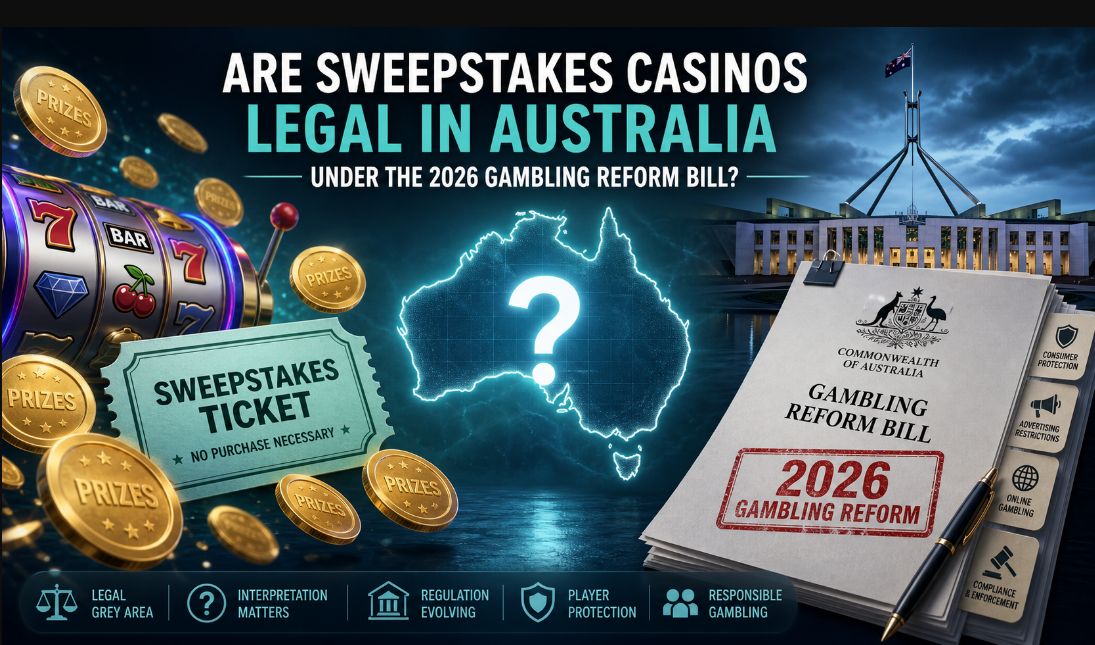
Sweepstakes casinos do not fit neatly into Australia’s gambling framework, and under the 2026 Gambling Reform Bill they sit in a grey area: “trade promotion lotteries” are still legal when structured as genuine promotional prize draws, but casino‑style sweepstakes platforms that feel like real‑money gambling risk falling on the wrong side of the Interactive Gambling Act and state regulations. This review explains how the law treats trade promotions, how sweepstakes mechanics compare, and what Australian players should watch for when using prize‑based casino sites.


What Are Sweepstakes Casinos and Why Aussies Care
Sweeps‑style casinos let players use “credits” or “coins” to play slots or table‑style games, with some of those credits redeemable for prizes or cash once they meet specific conditions. The platforms typically claim they are not offering “real‑money gambling” but rather promotional games tied to prize draws, loyalty schemes, or social entertainment.
Australian casino players are interested because:
-
Traditional offshore casinos face ISP blocks and enforcement by ACMA.
-
Social and sweepstakes sites promise “legal” play with prize redemptions instead of direct wagers.
-
Marketing claims often suggest they fall under trade promotion lottery rules rather than gambling law.
The key legal question is whether these platforms truly operate as trade promotions or are, in substance, interactive gambling dressed in promotional language.
How Trade Promotion Lotteries Work in Australia
“Trade promotions” are prize competitions used to promote goods or services, where entry is free or tied to a non‑gambling purchase and winners are chosen by chance or skill. When chance is involved, they are generally called “trade promotion lotteries.”
Core features across states and territories include:creative.
-
The promotion must primarily promote a trade or business, not function as a gambling service in itself.
-
Entry is free or incidental to buying a product or service that is not itself gambling.
-
Prizes are awarded by a random draw or skill‑based method, with clear conditions and closing dates.classic.
-
There are permit rules and prize‑value thresholds that vary by jurisdiction (for example, NSW and ACT permits above certain amounts).
-
Promotions must comply with Australian Consumer Law and specific state gambling regulations, including disclosure, record‑keeping, and responsible conduct obligations.
Guidelines from regulators like the Victorian Gambling and Casino Control Commission emphasise that trade promotion lotteries must not be used to promote gaming machines, encourage minors to gamble, or induce someone to open a betting account. In other words, trade promotions are supposed to be marketing tools, not disguised gambling platforms.
What the 2026 Gambling Reform Bill Aims to Do
The exposure draft of the Interactive Gambling Amendment (Gambling Reform) Bill 2026 proposes significant changes to Australia’s interactive gambling framework under the Interactive Gambling Act 2001. One of its stated aims is to close loopholes used by subscription‑based and competition‑style services that have been operating in the grey zone between trade promotions and online gambling.infrastructure.
According to specialist commentary, the Bill would:infrastructure.
-
Clarify that services offering “gambling‑like” games tied to prize pools can fall within the interactive gambling regime, even if they use alternative currencies or subscription models.
-
Tighten the definition of prohibited interactive gambling services, making it harder to rely on promotional or subscription labels to escape regulation.
-
Strengthen enforcement powers and penalties for operators targeting Australian consumers with unlicensed interactive gambling.
While the Bill does not specifically name “sweepstakes casinos,” its focus on closing promotion‑based loopholes means that casino‑style sweepstakes platforms will be closely scrutinised.
Where Sweepstakes Casinos Fit: Promotion vs Gambling
To work out whether sweepstakes casinos are legal for Australians under the reform framework, you have to compare their mechanics to the legal tests for trade promotions and interactive gambling.
Trade Promotion Tests
Regulators ask whether a promotion:
-
Promotes a trade or business as the primary purpose.
-
Offers prizes decided by chance or skill, with clear conditions and no gambling inducement.
-
Does not require entrants to gamble, open betting accounts, or participate in gaming machines as a precondition.
Guidance from Victoria and other jurisdictions explicitly warns that promotions should not encourage gambling, be targeted at minors with gambling‑like features, or suggest that winning will improve financial prospects or social status.
Typical Sweepstakes Casino Mechanics
Most sweepstakes casinos:
-
Sell one type of virtual currency (for fun play) and bonus “sweep coins” that can be redeemed for prizes if the player wins.
-
Offer slot‑style or table‑style games that look and feel like traditional online casino products.
-
Require players to create accounts, deposit money or enter via free routes, and interact regularly with the platform as if it were a gaming site.
From a regulator’s perspective, this can look less like a marketing promotion and more like a closed gambling ecosystem where chance‑based games are central, and the “prize draw” framing is largely technical.
Under the 2026 Bill, the closer a sweepstakes platform’s behaviour is to real‑money casino gaming, the more likely it is to be treated as an interactive gambling service rather than a mere trade promotion.infrastructure.
Key Grey‑Area Questions for Australian Players
When Aussies ask whether sweepstakes casinos are “legal,” they are really asking how regulators will answer several overlapping questions.
1. Is the Main Activity Gambling or Promotion?
If the platform’s primary purpose is to run ongoing casino‑style games with prize redemptions, the promotional justification becomes weaker. Genuine trade promotions usually:
-
Run for a defined campaign period with a closing date.
-
Promote a separate product, service, or brand.
-
Offer a finite set of prizes rather than continuous gambling‑like options.
Continuous “casino‑style sweepstakes” that operate year‑round and centre their business on game play rather than external products risk being seen as gambling disguised as a promotion.
2. Is Entry Truly Free or Tied to Non‑Gambling Purchases?
Trade promotion lotteries must be free to enter or tied to buying something unrelated to gambling. Sweepstakes casinos often offer free sign‑up routes but heavily emphasise paid packages to access more coins and games.
Regulators may ask:
-
Are free routes genuinely equivalent in practice, or just a thin layer over a paid gambling model?
-
Does spending money mainly purchase promotional entries, or essentially fund wagering with a chance of prize conversion?
If real‑world spending is effectively the “stake” for casino‑style outcomes, the service may be treated as gambling.
3. Are There Gambling Inducements and Account‑Style Behaviour?
Guidance for trade promotions explicitly warns against promotions that induce people to open betting accounts or link participation to gaming machine play. Sweepstakes casinos usually require:
-
Full account registration.
-
Balance tracking, transaction histories, and ongoing sessions.
-
“VIP,” loyalty or tier features similar to casino programs.
These elements can push the service beyond simple promotional mechanics and into the territory of interactive gambling, especially under the tightened 2026 reforms.
Practical Implications of the 2026 Gambling Reform Bill
The Gambling Reform Bill is still moving through the legislative process, but the government’s stated intention is clear: promotions should not be used as a back door to unlicensed online casino services.
For sweepstakes casino operators:
-
Models relying heavily on subscription fees, paid credits, or casino‑like gameplay will likely face increased legal risk if they target Australians.
-
Operators may need to restructure their offerings so that prize draws are clearly promotional and not the core product.
-
Marketing to Australians that implies a loophole or “legal way to gamble online” is likely to receive regulator attention.
For Australian players:
-
Access to sweepstakes platforms may continue technically, but legal certainty is limited, and services could be blocked or restricted if regulators classify them as interactive gambling.
-
Relying on “promotion” language in site terms is not a guarantee that the service is compliant.
-
Players should assume that services operating like casinos, even with sweeps mechanics, carry the same offshore risks as traditional online gambling.
Step‑by‑Step Checklist for Aussies Evaluating a Sweepstakes Casino
If you are considering joining a sweepstakes casino and want to understand the risk profile under the reform landscape, use this practical checklist based on trade promotion and gambling guidelines.
-
Identify the primary purpose
-
Does the site clearly promote another product or brand, or is the casino game itself the main product?
-
-
Check entry methods
-
Are free entry routes prominent, easy to use, and truly equivalent, or is payment effectively required to participate meaningfully?
-
-
Look for campaign boundaries
-
Is there a defined promotion period, closing date, and prize pool, or are games available indefinitely like a normal casino?
-
-
Review inducement language
-
Does the marketing suggest improved finances, status, or attractiveness through winning, which trade promotion guidelines warn against?
-
-
Examine account and loyalty mechanics
-
Does the site require persistent accounts, balance tracking, and loyalty tiers that mimic online gambling environments?
-
-
Assess responsible gambling measures
-
Are there clear limits, self‑exclusion options, and harm‑minimisation tools, or is the emphasis solely on play and prizes?
-
-
Monitor regulatory updates
-
Keep an eye on ACMA, state regulators, and legal commentaries as the 2026 reforms progress, because interpretations of sweepstakes models may evolve.
-
If several checklist answers point toward a casino‑like, always‑on gaming service with prize redemptions, the platform is more likely to sit in the risk zone targeted by the 2026 Bill, even if it describes itself as a sweepstakes promotion.
Responsible Gambling and Player Protection
Regardless of legal classification, any platform offering chance‑based games with prize outcomes can lead to harm if used excessively. Australian guidelines emphasise responsible gambling as a core principle, including:
-
Keeping play as entertainment only, not a way to fix financial problems.
-
Setting clear limits on time and money spent.
-
Avoiding chasing losses or believing skill can influence pure games of chance.creative.
-
Seeking help from national services when gambling‑related stress, debt, or loss of control appear.
Sweepstakes cosmetics do not change the underlying psychological risks of repetitive chance‑based play, so responsible habits remain crucial.
Bottom Line: Are Sweepstakes Casinos Legal in Australia Under the 2026 Reforms?
Sweepstakes casinos occupy a genuine grey area in Australian law: trade promotion lotteries are lawful when they operate as true, free‑entry marketing promotions, but casino‑style sweepstakes platforms that mimic gambling and rely on paid credits are exactly the kind of models the 2026 Gambling Reform Bill is designed to examine and potentially restrict.infrastructure.
For Australian players, the safest interpretation is:
-
Trade promotions that look like short‑term prize draws, tied to non‑gambling products, and clearly following state and territory rules are still allowed.
-
Sweepstakes platforms that behave like online casinos with continuous gameplay and prize redemptions may be treated as interactive gambling services once the reforms take full effect, even if they use promotional language.
Until regulatory positions on specific brands become clearer, Aussies should treat sweepstakes casinos as high‑risk, offshore‑style products, use them cautiously if at all, and keep informed through official guidance and responsible gambling resources.
FAQs: Sweepstakes Casinos and the 2026 Gambling Reform Bill
Are sweepstakes casinos clearly legal in Australia under the 2026 Gambling Reform Bill?
No, they sit in a genuine grey area. The Bill is designed to tighten rules around interactive gambling and close loopholes used by promotion‑style services, so casino‑like sweepstakes platforms may be treated as gambling rather than simple prize promotions once the reforms fully take effect.
What is a sweepstakes casino?
A sweepstakes casino is a site where you play slot‑style or casino‑style games using virtual coins, with some of those coins redeemable for cash or prizes if you win. The platform usually claims to run prize promotions instead of taking direct bets, but for players the experience often feels very similar to online gambling.
How do trade promotion lotteries work in Australia?
Trade promotion lotteries are prize draws used to promote a business, product or service. Entry is free or tied to a non‑gambling purchase, prizes are awarded by chance or skill, and the promotion runs for a defined period with clear terms. The main purpose is marketing, not running an ongoing gambling service.
Can a sweepstakes casino be considered a trade promotion lottery?
It can only fit that category if the promotion genuinely exists to market another product, offers fair, free or incidental entry, and operates as a limited‑time campaign rather than a full‑time casino. If the platform’s main business is ongoing casino‑style gameplay with prize redemptions, regulators are more likely to treat it as gambling.
Does the 2026 Gambling Reform Bill target sweepstakes casinos directly?
The Bill does not name specific brands, but it is aimed at closing loopholes used by subscription‑based and promotion‑style models that provide gambling‑like services. If a sweepstakes casino looks and behaves like an online casino, the reforms make it harder for that site to rely on promotional wording to claim it is outside gambling law.
Are free‑to‑enter prize draws still allowed under the reforms?
Yes. Genuine trade promotion lotteries that comply with state and territory rules, promote a business rather than gambling, and offer fair, free or incidental entry are still permitted. The reforms focus on services where promotion mechanics are being used to mask continuous gambling activity.
If a sweepstakes casino says it’s “legal”, can Australian players rely on that?
Marketing claims should be treated with caution. Legality depends on how the platform actually operates and how regulators interpret its model, not on how it describes itself. If the site runs casino‑style games all year round, tracks balances and encourages ongoing play for prizes, it may be treated as interactive gambling despite its wording.
What risks do Australians face when using sweepstakes casinos?
The main risks are regulatory uncertainty, possible future blocking or restrictions, and the same harm risks that apply to regular online gambling, including financial loss and addiction. Players also have limited recourse if the service falls foul of reforms or decides to restrict accounts.
How can I tell if a prize‑based platform is more like a casino than a trade promotion?
Look for signs such as persistent accounts and balances, loyalty tiers, continuous access to slot‑style games, heavy emphasis on paid coin packages, and no clear campaign end date. The more the site resembles a full‑time casino, the less likely it is to fall comfortably within trade promotion rules.
Are sweepstakes casinos safer than offshore real‑money casinos?
They may avoid some traditional payment issues, but they can still carry regulatory risk and the same psychological risks of compulsive play. From a responsible gambling perspective, they should be treated with similar caution: set strict limits, avoid chasing losses, and be prepared to stop if play starts impacting your finances or wellbeing.
What should Australian players do if they want to participate in prize promotions safely?
Stick to clearly defined trade promotions run by reputable brands, where entry is free or linked to buying a non‑gambling product and the rules are transparent. Avoid platforms that look and feel like full casinos, keep play within modest limits, and consult official guidance and support services if you are unsure or feel your gambling is becoming a problem.
Sources
- Gambling Reforms 2026 – Frequently Asked Questions
- Australia Gambling Laws and Regulations – ICLG
- Guide to Trade Promotion Lotteries in Australia
- Victorian Trade Promotion Lottery Guidelines
- Gambling Help Online – Australia
Last Updated on September 11, 2026 by Pokie-Player