Summary
- Facial recognition helps Australian pubs and clubs identify self-excluded or barred patrons by comparing camera images with relevant exclusion records.
- A possible match should alert trained staff, who verify identity and follow the applicable exclusion procedure. The technology does not diagnose gambling addiction.
- South Australia requires approved systems in venues authorised for 30 or more gaming machines where at least one accepts banknotes.
- NSW has a voluntary code for participating hotels and clubs, with mandatory facial recognition and a statewide exclusion register expected in 2028.
- Accuracy, current records, privacy protections and respectful staff intervention matter as much as the cameras. Facial recognition supports self-exclusion but cannot guarantee detection or replace broader gambling-harm support.
How Australian Pubs Use AI Cameras to Identify Self-Excluded Players
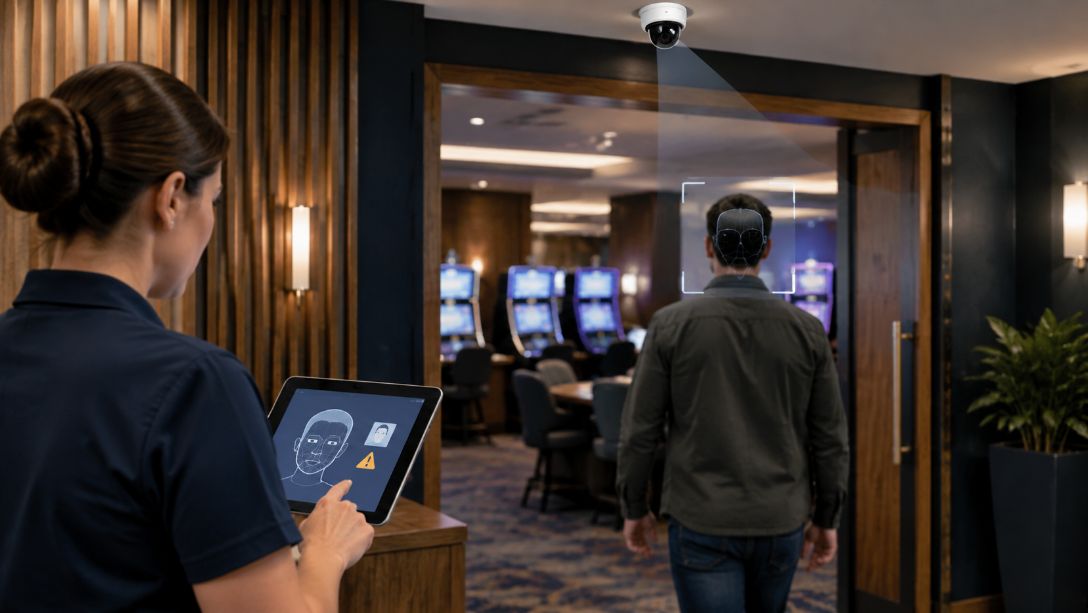
Facial recognition technology is changing how Australian pubs and clubs identify people who have excluded themselves from gambling. Instead of relying entirely on staff to remember photographs, participating venues use cameras and facial-matching software to flag a possible match with an exclusion database.
The camera does not diagnose gambling addiction. It does not determine how much someone can afford to lose. Its narrower purpose is to help staff recognise a person whose exclusion applies to the venue or gaming area.
The most important safeguard is verification. An automated alert should trigger a trained human response, not an unquestioned accusation.
Australia does not have one uniform pub facial-recognition system. South Australia already requires approved technology in qualifying gaming venues. NSW currently has a voluntary code for participating hotels and clubs, with mandatory facial recognition and a statewide exclusion register expected in 2028.
Understanding those differences helps explain what the cameras do, where implementation stands and what patrons should expect.
What Is Facial Recognition Technology in a Gaming Venue?
Facial recognition technology, commonly called FRT, compares facial information captured by a camera with information associated with an existing photograph.
The software extracts distinctive facial features and encodes them into a biometric template. It then compares that template against templates in a reference database.
In a self-exclusion setting, the reference database contains relevant excluded or barred people.
The system produces a potential match when the similarity meets its configured criteria. Authorised staff then review the alert and follow the appropriate procedure.
This is different from ordinary CCTV. CCTV records footage that someone may inspect later. Facial recognition adds automated comparison designed to draw attention to a particular person.
A gaming-floor system is therefore more than a camera installation. It combines image capture, database management, software, communications, staff training and privacy controls.
Why Pubs and Clubs Are Adopting It
Traditional self-exclusion enforcement places a substantial recognition burden on employees.
Staff may need to remember numerous photographs while managing customer service, machine issues, cleaning and responsible-gambling duties. Busy entrances and changes between shifts make consistent identification difficult.
Facial recognition aims to reduce that reliance on memory.
A suitable system can flag a possible excluded patron when they enter the monitored area, giving staff an opportunity to intervene before gambling begins or continues.
However, detecting someone is not the same as helping them.
A venue still needs enough trained staff to receive alerts, verify identity and respond appropriately. An unattended notification provides little practical protection.
The strongest implementation links detection to a respectful intervention process. The weakest treats installing cameras as proof that responsible-gambling obligations have been solved.
Self-Excluded and Barred Patrons Are Not Always the Same
Self-exclusion usually involves a person voluntarily arranging to stay away from specified gambling services or locations.
Barring can arise through other applicable processes, depending on the jurisdiction and scheme.
The categories can overlap, but they should not be treated as interchangeable.
South Australian regulator material describes facial recognition as supporting the identification of barred patrons. NSW’s current hotel and club code focuses on identifying self-excluded patrons.
NSW’s planned reforms also include third-party exclusions, alongside a statewide register.
For staff, the relevant question is not simply whether a face appears in a database. They must understand the person’s current exclusion status, its scope and the required response.
An expired, incorrect or inapplicable record can undermine an otherwise accurate facial comparison.
Where Implementation Stands in Australia
There is no basis for saying every Australian pub with pokies already uses compulsory facial recognition.
The position depends on the jurisdiction, venue and applicable requirements.
| Issue | South Australia | New South Wales |
|---|---|---|
| Current framework | Mandatory approved FRT for qualifying venues | Voluntary hotel and club code |
| Main threshold or scope | Venues authorised for 30 or more gaming machines, where at least one accepts banknotes | Participating hotels and clubs using FRT for self-exclusion |
| Provider approval | Systems must be approved by the regulator | No regulator approval currently required for voluntary installation |
| Reference system | Secure connection with the CBS barring database | Depends on the current exclusion arrangements and implementation |
| Future development | Existing regulated framework | Statewide register and mandatory FRT expected in 2028 |
These are jurisdiction-specific arrangements, not a national technical standard.
A system accepted in one state should not automatically be assumed suitable or authorised elsewhere.
South Australia: An Existing Mandatory Model
South Australia provides a clear example of facial recognition operating within a specific gaming regulatory framework.
Venues authorised to operate 30 or more gaming machines must have approved FRT where at least one machine can operate using a banknote acceptor.
The threshold concerns the venue’s authorisation, not how many machines happen to be occupied.
Only systems evaluated and approved for the purpose can be used.
Consumer and Business Services requires approved systems to communicate securely with its barring database, compare that information with people entering gaming areas and notify the gambling provider of a suspected match.
The systems must also protect against unauthorised access, use and disclosure.
Qualifying venues must operate the approved system while gaming machines can be operated. It is an ongoing operational responsibility, not a one-off equipment purchase.
Smaller venues outside the mandatory threshold may also adopt approved technology under the applicable arrangements.
NSW: A Voluntary Code Before the Planned Statewide Rollout
NSW introduced its voluntary Facial Recognition Technology Code of Practice for hotels and clubs in March 2026.
The code addresses privacy assessment, installation, signage, data security, system performance and staff responses.
It applies to exclusion-related FRT. It does not cover every possible facial-recognition application, such as staff sign-in or unrelated security functions.
The distinction between voluntary guidance and binding law matters.
Breaching the voluntary code is not itself an offence under that code. However, venues still need to meet applicable privacy and other legal obligations.
NSW announced in August 2026 that mandatory facial recognition would accompany its statewide exclusion register, expected in 2028.
That is a planned rollout, not evidence that every NSW gaming-room entrance already operates under the future system.
Currently, Liquor & Gaming NSW does not maintain a list of approved suppliers for voluntary installations.
How a Facial Recognition Alert Works
Although products differ, the practical sequence generally involves five stages.
1. A Relevant Reference Record Exists
The system needs a suitable photograph or biometric template linked to the applicable exclusion record.
If the person is missing from the relevant database, recognition software cannot reliably provide the intended protection.
2. A Camera Captures a Face
A camera obtains an image as the person passes through the monitored location.
Camera placement, lighting and the venue layout influence whether useful images are captured.
3. Software Compares Facial Information
The system creates or uses a biometric representation and compares it with reference records.
A similarity result indicates a possible match. It does not establish identity with absolute certainty.
4. An Alert Reaches Authorised Staff
The system notifies the venue through its configured interface.
That notification needs to reach someone who can act promptly and access the appropriate information.
5. Staff Review and Respond
Staff verify the possible match, check the applicable exclusion and follow the venue’s procedures.
Human oversight is essential because both the facial comparison and the underlying record can be wrong.
Installation Is More Than Adding Another Camera
A responsible deployment begins with the venue’s actual layout and legal position.
Management should determine where relevant entry points are, what areas need coverage and whether the proposed collection is lawful and proportionate.
A small enclosed gaming room presents different operational issues from a large club with several access routes.
Useful implementation questions include:
-
Can cameras capture suitable images at the relevant entrances?
-
Are notices visible before people enter monitored areas?
-
Who receives alerts during every gaming shift?
-
How are database updates handled?
-
What happens during a system outage?
-
How are inaccurate records corrected?
-
Who can inspect or export information?
A supplier’s demonstration cannot answer every venue-specific question.
Testing should reflect real operating conditions rather than an empty room with ideal lighting.
What Staff Should Do After a Possible Match
A possible match should not lead to a public announcement or immediate assumption of wrongdoing.
The response should begin with authorised staff checking the alert and relevant record.
Where further interaction is necessary, staff should approach discreetly, explain the situation appropriately and use the venue’s established verification process.
If the exclusion applies, the next steps should follow the relevant scheme and venue procedures.
The interaction should preserve dignity. Someone returning during self-exclusion may be experiencing distress, shame or difficulty controlling gambling.
A suggested operational sequence is:
-
Acknowledge the alert.
-
Review the image and record.
-
Confirm identity and exclusion scope.
-
Explain the applicable restriction privately.
-
Implement the required response.
-
Offer appropriate support information.
-
Record the outcome securely.
This is a practical framework, not a substitute for jurisdiction-specific procedures.
Staff Training Determines Whether the System Helps
An alert is useful only when employees understand it.
Staff need to distinguish between a potential match and a confirmed identity. They also need to understand privacy restrictions, escalation procedures and the boundaries of their authority.
NSW’s code guidance says authorised staff should be trained before accessing the FRT system or associated devices.
Suggested practical training includes responding to alerts, verifying identity, managing incidents and escalating problems.
Training should also address an incorrect match. Employees must know how to stop an unjustified intervention and arrange correction.
Vendor training on buttons and screens is not enough.
The system’s success depends on how employees behave during an uncomfortable real-world conversation, not simply whether they can navigate the interface.
How Accurate Are Gaming-Venue Systems?
There is no single accuracy percentage that meaningfully describes every facial-recognition deployment.
Performance depends on the system, image quality, configuration, reference database and operating environment.
Two errors are particularly important:
-
A false positive occurs when someone is incorrectly matched to another person’s record.
-
A false negative occurs when someone who should match is not detected.
A marketing claim about high accuracy is incomplete without its testing conditions and error definitions.
Venues should ask how performance was measured, what population was tested and how results translate to their premises.
The OAIC identifies accuracy, bias and discrimination as issues that organisations must address.
Human review reduces risk, but it does not excuse poor system design or unreliable records.
Why Database Quality Matters as Much as Camera Quality
A sharp camera cannot fix an outdated exclusion register.
Records need to reflect the correct person, current status and relevant locations.
Photographs also need to be suitable for their intended purpose.
Database administration should address:
-
Incorrectly associated photographs.
-
Duplicate records.
-
Applicable start and end dates.
-
Changes in exclusion status.
-
Access permissions.
-
Correction requests.
-
Secure transmission between authorised parties.
An accurate facial match to the wrong administrative record can still produce an inappropriate intervention.
For that reason, venues should assess the entire identification process rather than focus exclusively on the algorithm.
Good record governance and clear correction procedures are part of harm prevention.
Does Facial Recognition Scan Everyone?
A system may need to process faces entering its monitored area to determine whether any match the exclusion database.
That raises privacy issues for non-excluded patrons as well as excluded people.
It does not necessarily mean every visitor becomes a permanent named profile.
However, processing and retention are different questions.
The OAIC explains that collecting biometric information can occur even when information is captured and discarded rapidly. Brief processing is not automatically outside privacy law.
Patrons should be able to obtain clear answers about what is captured, what is retained, for how long and who can access it.
Claims such as “we only keep matches” need to describe the actual system accurately, including temporary processing and any related records.
Biometric Privacy: Why a Sign Is Not Enough
Biometric information used for automated identification receives heightened protection as sensitive information under Australian privacy law.
For organisations covered by the Privacy Act, collection needs an appropriate lawful basis.
Depending on the circumstances, that may involve valid consent or a relevant legal exception.
A general obligation to keep excluded patrons away from gambling does not automatically authorise every form of biometric collection.
Similarly, a sign saying facial recognition operates does not, by itself, generally establish valid consent.
Signage still matters. It informs patrons before they enter monitored areas.
But notification and legal authority are separate requirements.
NSW guidance expressly warns that implied consent from entering after seeing a sign will generally not be enough for collecting sensitive biometric information.
What a Useful Privacy Notice Should Explain
A privacy notice should describe facial recognition specifically, rather than hide it within a general reference to CCTV.
Patrons should be able to understand:
-
Why the technology is used.
-
What personal information is collected.
-
Who operates the system.
-
Whether external providers handle information.
-
How information is stored and protected.
-
How access or correction can be requested.
-
How a complaint can be made.
NSW guidance also recommends supporting materials, such as accessible factsheets, website information and an updated privacy policy.
The purpose is practical transparency.
A person should not need technical expertise to discover that biometric matching occurs or to identify someone responsible for answering questions.
Data Security and Supplier Accountability
Facial templates and exclusion records require strong protection.
Responsible arrangements should restrict access to authorised personnel, maintain appropriate audit records and provide processes for deletion, incident response and supplier oversight.
Management should understand whether information is stored locally, hosted externally or transferred between systems.
Offshore handling can create additional privacy considerations.
Hiring a specialist provider does not transfer every responsibility away from the venue. OAIC guidance makes clear that the organisation engaging the provider remains responsible for ensuring its FRT use complies with the Privacy Act.
Contracts should address data handling, security, review rights and what happens when the agreement ends.
A venue should not be unable to explain its own system because “the vendor manages everything”.
Can Facial Recognition Be Used for Marketing?
Technology installed for gambling-harm prevention should not quietly become a customer-tracking tool.
Purpose restrictions are especially important because the same underlying capabilities could potentially support unrelated uses.
South Australian rules prohibit using the relevant gaming FRT system for encouraging gambling, customer loyalty programs and specified other purposes.
The system is not permission to identify excluded people outside the licensed premises.
In NSW, the current exclusion-focused code does not establish approval for every other facial-recognition application.
A responsible venue should keep harm-minimisation functions separate from promotional objectives.
Using an exclusion-related biometric system to improve gambling marketing would contradict the protective rationale that justified its introduction.
Does Facial Recognition Reduce Gambling Harm?
Facial recognition offers a plausible operational benefit: it can help staff detect some excluded people who might otherwise go unnoticed.
That does not establish a particular percentage reduction in gambling harm.
Detection figures, alert volumes and intervention counts measure different things from financial recovery or improved wellbeing.
A stronger evaluation would examine:
-
Whether confirmed detections occur before gambling begins.
-
How quickly staff respond.
-
How often alerts are incorrect.
-
Whether exclusion records remain accurate.
-
What support follows an intervention.
-
How privacy complaints are resolved.
Technology should be judged by outcomes and safeguards, not camera numbers.
It cannot replace counselling, appropriate staffing or broader responsible-gambling practices.
What Patrons Should Ask
Patrons can reasonably ask whether facial recognition operates and how it affects them.
Someone considering self-exclusion should also clarify which venues or areas the arrangement covers and how their information will be used.
Useful questions include:
-
Is this an existing system or a planned installation?
-
Which exclusion records does it check?
-
What happens if I am incorrectly matched?
-
Can I access or correct information about me?
-
Who handles privacy complaints?
-
What support is available after an intervention?
Do not assume the presence of a camera means every excluded person will always be identified.
Self-exclusion remains a support measure with practical limits, not an infallible barrier.
Final Review: A Support Tool That Needs Strong Limits
Facial recognition can reduce the recognition burden on gaming staff and strengthen the implementation of exclusions.
South Australia shows how approved systems can operate within a specific regulatory framework. NSW is progressing from voluntary standards towards its planned statewide register and mandatory rollout.
The quality of implementation matters more than the presence of an AI camera.
Accurate records, lawful collection, clear notices, secure systems and respectful human verification determine whether the technology provides meaningful protection.
A responsible gaming venue should be able to explain not only how its system detects a person, but also what happens next—and how it prevents unnecessary harm when the system is wrong.
Sources
- Consumer and Business Services SA: Facial recognition requirements, approved systems and database connections
- SA Government: Operating gaming machines, facial recognition signage and prohibited uses
- Consumer and Business Services SA: Facial Recognition System Operating Requirements
- Liquor & Gaming NSW: Facial Recognition Technology Code of Practice, privacy requirements and staff training
- NSW Government: Gaming Reform Package and expected 2028 statewide exclusion register
- NSW Government: August 2026 announcement of statewide exclusions and mandatory facial recognition
- OAIC: Facial recognition privacy risks, lawful collection, accuracy, security and supplier accountability
Last Updated on November 2, 2026 by Pokie-Player