Key Points
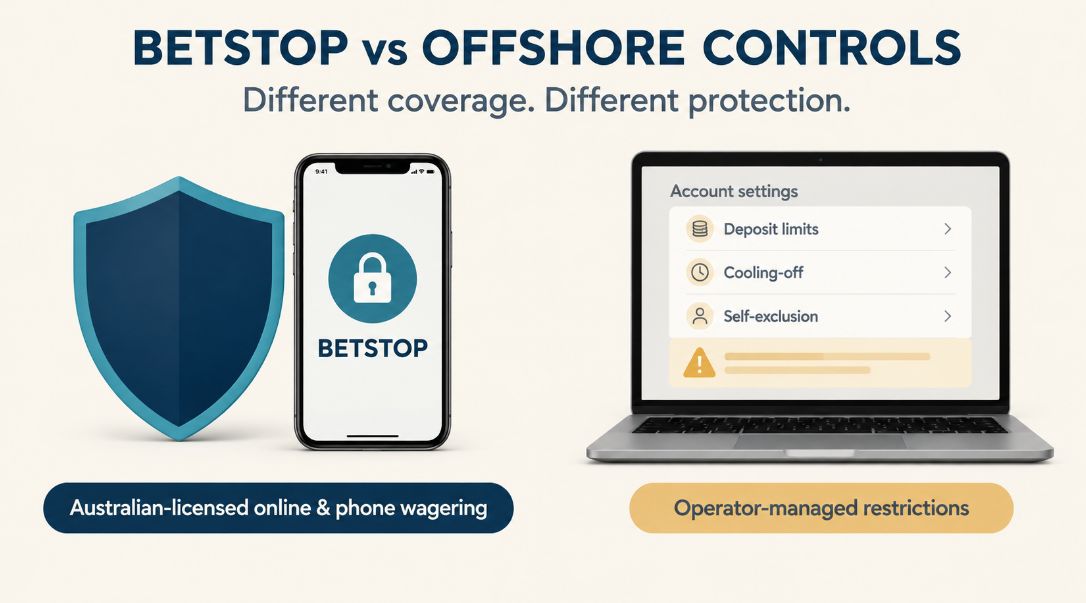
- BetStop covers Australian-licensed online and telephone wagering providers—not offshore casinos, illegal overseas betting sites or physical gambling venues.
- Offshore deposit limits, cooling-off periods and self-exclusion tools depend on the operator’s implementation. They are not equivalent to Australia’s national register.
- A deposit limit restricts incoming money, not necessarily total losses or betting turnover. Check its calculation, reset period and effective date.
- If you want to stop gambling, request explicit self-exclusion—not just routine account closure. Ask for betting and deposits to be blocked, marketing stopped and written confirmation.
- If support ignores you, preserve records and add independent bank and device restrictions. Do not deposit again to test whether the exclusion works.
- Reporting an illegal operator to ACMA does not guarantee account closure or reimbursement. Offshore losses after an exclusion request are not automatically refundable.
- Use layered protection: BetStop, account exclusions, bank controls, blocking tools and support. Free gambling counselling is available on 1800 858 858.
BetStop and Offshore Gambling Sites: Where Self-Exclusion Protection Ends
BetStop and an offshore gambling website’s account controls are not equivalent forms of protection. BetStop is Australia’s national self-exclusion register for Australian-licensed online and telephone wagering providers. Offshore deposit limits, cooling-off tools and account closures depend on the individual operator’s systems, policies and willingness to act.
The distinction matters when someone wants to stop gambling. Registering with BetStop does not automatically block an offshore casino account, stop offshore marketing or prevent payments to an overseas gambling website.
Calling BetStop a register for “locally licensed sportsbooks” is broadly understandable, but incomplete. Its coverage includes Australian-licensed online and phone wagering providers, including relevant racing and sports betting services. It does not cover illegal online casinos or replace separate exclusion arrangements for physical venues.
The central issue is enforceability. A national register creates obligations within Australia’s regulated wagering system. An offshore account setting may offer useful friction, but it should not be treated as equivalent protection.
What BetStop Covers
BetStop is a free Australian Government initiative that allows someone to exclude themselves from covered wagering providers in one registration.
The available exclusion period ranges from three months to a lifetime.
Once registered, covered providers must not allow the person to open a betting account or place bets. They must also stop direct marketing. Existing wagering accounts need to be closed, with remaining credit refunded.
This creates an important advantage over contacting bookmakers individually. The exclusion operates across the covered Australian-licensed sector rather than only at one brand.
BetStop is not simply a reminder to gamble less. It is a self-exclusion mechanism backed by legal obligations.
However, its scope has boundaries. It does not automatically exclude someone from:
-
Offshore online casinos.
-
Overseas wagering services operating illegally in Australia.
-
Physical casino gaming floors.
-
Pokies at clubs and hotels.
-
Every other form of gambling.
Those activities require additional protective measures.
Why Offshore Sites Are Outside BetStop’s Protection
BetStop expressly states that it does not apply to online casino games or other gambling services illegally provided in Australia.
ACMA identifies online pokies, casino-style games and sports betting services without an Australian licence among prohibited online services offered to Australians.
A website can still display Australian dollars, accept Australian registrations or promote itself to Australian customers. None of those features establishes Australian authorisation.
Similarly, a foreign licence is not an Australian wagering licence.
The practical consequence is straightforward: an offshore operator is not brought into BetStop’s covered network merely because an Australian customer registers for exclusion.
If that operator continues accepting deposits, BetStop registration does not itself disable the account. Nor does it provide a universal payment block.
This is a coverage limitation, not evidence that registering is pointless. BetStop remains valuable for shutting off access to the Australian-licensed wagering services it covers.
BetStop and Offshore Controls Compared
| Protection | BetStop | Offshore internal control |
|---|---|---|
| Coverage | Covered Australian-licensed online and phone wagering providers | Usually the particular account or operator’s stated network |
| Activation | One national registration | Account settings or a support request |
| Duration | Three months to a lifetime | Depends on the operator and selected tool |
| Marketing | Covered providers must stop direct marketing | Depends on implementation and applicable obligations |
| Remaining balance | Covered accounts must close and credit be refunded | Withdrawal and verification arrangements vary |
| Enforcement | Australian regulatory oversight | Depends on jurisdiction, licence and practical accessibility |
| Offshore casino access | Not covered | Requires separate action |
| Payment blocking | Not a bank transaction block | Usually not an independent payment block |
Neither column should be read as a guarantee that technical or compliance failures cannot occur.
The difference is the available accountability. A breach by a covered Australian wagering provider can be reported through the Australian regulatory system. An offshore dispute can be much harder to resolve.
Deposit Limits, Cooling-Off and Self-Exclusion Are Different
A responsible gambling page may list several tools together. They do not perform the same job.
Deposit limits
A deposit limit restricts money entering the account during a defined period.
It does not necessarily restrict total betting turnover, time spent gambling or losses from an existing balance.
Loss limits
Where available, a loss limit restricts losses according to the operator’s calculation.
Check whether the calculation uses settled bets, includes bonuses or treats pending bets separately.
Session controls
A session timer or reality check may display an alert rather than end play.
An acknowledgement button is not the same as a mandatory logout.
Cooling-off periods
A cooling-off period temporarily suspends gambling access for a selected duration.
Check exactly what is blocked: betting, deposits, login access or some combination.
Self-exclusion
Self-exclusion is intended to prevent gambling access for the selected exclusion period or indefinitely.
Do not assume an ordinary account closure activates self-exclusion protections.
The right tool depends on the objective. If the objective is to stop gambling, a low deposit cap is not equivalent to exclusion.
How to Set a Deposit Limit on an Existing Offshore Account
There is no universal offshore menu or standard implementation. The following process is a protective checklist, not confirmation that a particular site offers reliable controls.
Do not make a new deposit to activate or test a limit.
1. Find the responsible gambling settings
Look within account settings for labels such as “Responsible Gambling”, “Safer Gambling”, “Limits” or “Account Restrictions”.
If the controls are absent, ask support for the direct account-setting location.
2. Identify the limit period
Check whether the options are daily, weekly, monthly or rolling.
A calendar-month limit resets differently from a rolling 30-day limit. Also confirm the account currency and reset time zone.
3. Read how deposits are counted
Establish whether the cap measures gross deposits or deposits after withdrawals.
A net-deposit calculation can behave differently from a simple cap on incoming funds. Do not assume the displayed amount represents your maximum possible loss.
4. Select and submit the limit
Choose the amount according to the restriction you actually need. If stopping entirely, use self-exclusion rather than relying on a spending allowance.
Check whether zero is an accepted setting.
5. Save confirmation
Record the amount, effective time, period and confirmation message.
A submitted request is not necessarily an active restriction.
6. Check amendment rules
Find out whether reductions apply immediately and whether increases involve a delay. Do not assume offshore controls follow Australian rules.
Why a Deposit Limit Is Not a Spending Guarantee
Consider a hypothetical account with a A$50 weekly deposit limit and A$200 already available.
Unless another restriction applies, the person may still be able to lose the existing A$200. The deposit limit controls new funding, not necessarily the money already inside the account.
Turnover can also exceed deposits because returned winnings may be wagered again.
A A$50 deposit therefore does not imply only A$50 in total bets.
Other uncertainties include multiple accounts, multiple brands and separate wallets. A limit on one account should not be assumed to apply across all related websites.
These limitations do not make deposit controls useless. They explain why the exact definition matters.
For someone experiencing gambling harm, restrictions at the bank, device and account levels can provide stronger protection than relying on one operator-controlled setting.
How to Activate a Cooling-Off Period
A cooling-off tool can create an immediate break if the operator provides and implements it properly.
Before confirming, establish:
-
The exact start and end time.
-
Whether betting and deposits are both disabled.
-
Whether existing sessions are terminated.
-
Whether marketing is suspended.
-
Whether withdrawals remain available.
-
Whether the account reactivates automatically.
Save the confirmation and any terms displayed during activation.
If the tool is unavailable, send a written request through support. State the requested restriction clearly rather than asking vaguely for “a break”.
Do not assume a temporary timeout will remain in place indefinitely. If the objective is lasting exclusion, request self-exclusion instead.
A cooling-off period should not become a countdown to the next gambling session. Use the break to arrange independent barriers and support.
Request Self-Exclusion Clearly
A routine closure request can be ambiguous.
“Please close my account” may be treated as an ordinary customer-service request rather than a gambling-harm exclusion. Explicit wording creates a clearer record.
A suitable message is:
Subject: Immediate self-exclusion request
I am experiencing gambling harm and request immediate self-exclusion from gambling access. Please block betting and deposits, stop promotional contact and apply the longest exclusion available.
Please confirm the effective date, duration and brands covered. Do not treat this as a routine closure or offer bonuses to retain me. Please explain how my remaining withdrawable balance will be returned without reopening gambling access.
My account username is [username], and my registered email address is [email address].
Use the registered email address where possible.
Never include a password, card security code or banking login credentials.
If the operator offers only fixed periods, request written confirmation of the longest available option and the conditions governing any later access.
Account Closure Is Not the Same as Data Deletion
People sometimes request deletion when their immediate need is exclusion.
The two objectives should be separated.
Self-exclusion concerns stopping gambling access. Data deletion concerns the handling of personal information. An operator may retain some information for legal, financial or exclusion-record purposes.
Do not assume deleting an account removes every record. Equally, do not assume a privacy request prevents another account being opened.
Ask for gambling access to be blocked immediately, then address data handling separately.
Where identity checks are requested, verify the communication channel before sending documents. Do not follow unexpected messages asking for sensitive information.
Preserve enough account information to identify the exclusion request and any remaining balance. Losing access to records can make a later complaint harder.
What If Support Ignores the Request?
An unanswered exclusion request is a warning that the operator’s internal controls may not protect you when needed.
Possible failures include delayed responses, repeated requests to contact another department or routine closure without a meaningful exclusion flag.
The immediate priority is not proving that the website will eventually comply. It is reducing further exposure.
Take these steps:
-
Save the original request with its date and time.
-
Send a concise follow-up identifying it as a self-exclusion request.
-
Ask for escalation to the complaints or compliance team.
-
Activate any available account restrictions without depositing.
-
Put independent payment and device barriers in place.
-
Stop promotional contact where possible.
-
Report the illegal service through ACMA’s relevant complaint process.
Do not keep depositing to demonstrate that the restriction has failed. That creates additional loss without guaranteeing a stronger remedy.
Keep Evidence Without Continuing to Gamble
Good records help explain what happened, but evidence collection should not require further gambling.
Preserve:
-
Your account identifier.
-
The website address and trading name.
-
The legal entity shown in the terms.
-
The claimed licence details.
-
Original exclusion messages.
-
Chat transcripts and ticket numbers.
-
Confirmation or rejection notices.
-
Relevant account and transaction history.
-
Marketing received after the request.
Use a simple timeline. Include the time zone, especially where support and account records use overseas times.
Distinguish between when you sent the request, when support acknowledged it and when restrictions actually took effect.
Avoid publishing identity documents, account numbers or other sensitive records publicly.
If gathering information increases the urge to gamble, stop and seek help from someone you trust or a gambling support service.
Escalating a Complaint: What Each Route Can Do
The correct complaint route depends on the operator.
A covered Australian wagering provider
A suspected BetStop breach can be reported through ACMA’s BetStop complaint pathway.
Provide the registration and account information requested by the official process. Do not treat a complaint about an offshore casino as automatically being a BetStop breach.
An illegal offshore gambling service
ACMA accepts reports about prohibited interactive gambling services.
However, reporting a website is not the same as obtaining a refund. ACMA warns that Australian regulators cannot provide the same assistance with poor treatment or withheld winnings at illegal operators.
A claimed overseas licensee
Check the licence independently through the relevant authority’s official records.
If a genuine complaints route exists, follow its eligibility and procedural requirements. A logo on the casino’s footer is not sufficient verification.
A significant financial dispute
Independent legal advice may help clarify options.
Keep expectations realistic. Cross-border disputes can be difficult, expensive and uncertain.
Can Losses After an Exclusion Request Be Refunded?
There is no universal automatic refund rule for offshore self-exclusion disputes.
The outcome can depend on the applicable law, verified licence conditions, operator terms, request wording, timeline and evidence.
An ignored request is serious, but it does not establish that money will be recovered.
Do not accept claims that a particular script, complaint service or legal phrase guarantees repayment.
Likewise, distinguish between dissatisfaction with gambling losses and genuinely unauthorised transactions.
If a payment was unauthorised, report it promptly to the bank and describe the facts accurately. For authorised payments, ask whether any legitimate dispute options exist. Do not relabel a knowingly authorised deposit as fraud.
Never send another deposit to “unlock” a refund or pay an unexpected recovery fee without independent verification.
Use Bank Controls Outside the Casino Account
Bank controls can reduce reliance on the operator responding correctly.
Ask your bank about gambling transaction blocks, card restrictions and support for gambling-related financial difficulty.
Westpac, for example, offers a gambling block for card transactions at merchants classified as betting or casino gambling. Its published information also describes options for adjusting other payment and withdrawal limits.
The classification detail matters. A merchant-category block should not be treated as a universal prohibition on every possible payment route.
Ask the bank what the block covers and what additional restrictions are available. Do not explore alternative payment methods to test or bypass it.
Also consider removing saved payment details and discussing changes to transfer limits.
If essential bills or joint funds are at risk, seek financial counselling and bank support rather than trying to resolve the problem solely through casino settings.
Add Device and Marketing Barriers
Website or app blocking tools can provide another layer between an urge and access.
Their coverage varies, so they should supplement—not replace—BetStop, account exclusion and financial controls.
Review every device used for gambling. A restriction on one phone does not automatically protect a laptop or tablet.
Practical measures include:
-
Removing gambling apps and saved bookmarks.
-
Disabling gambling-related notifications.
-
Blocking promotional senders.
-
Adjusting advertising preferences.
-
Installing suitable gambling-blocking software.
-
Asking a trusted person to help configure controls.
Do not share banking passwords or authentication codes.
Offshore marketing may continue despite an account request. Preserve relevant messages for a complaint, then filter them rather than repeatedly engaging with offers.
The purpose of these barriers is to reduce immediate access, not establish that every gambling website has disappeared.
How to Judge an Offshore “Responsible Gambling” Page
A polished page is not evidence that the controls work.
Useful questions include:
-
Can exclusion be activated without a retention conversation?
-
Are restrictions confirmed in writing?
-
Is the effective time clear?
-
Are covered brands identified?
-
Are withdrawals separated from gambling access?
-
Is there a verifiable complaints route?
-
Does the operator avoid pressuring the customer to remain active?
Warning signs include bonuses offered in response to a harm disclosure, unexplained delays and requests to gamble through a balance before closure.
No checklist makes an illegal offshore casino safe for Australians. It simply helps distinguish a stated policy from an implemented restriction.
The strongest test is not how prominently the site displays “responsible gambling”. It is how reliably it stops access when asked.
A Layered Exit Plan
For someone already using offshore sites, the practical goal is to stop further exposure rather than find a better offshore control panel.
A useful sequence is:
-
Register with BetStop for covered Australian wagering services.
-
Request explicit self-exclusion from existing offshore accounts.
-
Preserve confirmations and essential records.
-
Arrange bank restrictions.
-
Add device and marketing barriers.
-
Seek support for urges, financial pressure or unresolved disputes.
Do not postpone protective action while waiting for account support to reply or a withdrawal dispute to finish.
Gambling Help Online offers support, and free gambling counselling is available on 1800 858 858. For financial difficulty, the National Debt Helpline is available on 1800 007 007.
The honest assessment is that BetStop provides meaningful sector-wide protection within its defined scope. Offshore settings can be inconsistent and difficult to enforce. Independent barriers are essential when the operator cannot be relied upon.
Frequently Asked Questions
Does BetStop block offshore casinos and betting sites?
No. BetStop covers Australian-licensed online and telephone wagering providers. It does not automatically block offshore casinos, illegal overseas betting services or gambling at physical venues. Existing offshore accounts require separate action.
How do I set a deposit limit on an offshore gambling account?
Look under account settings for “Responsible Gambling”, “Safer Gambling” or “Limits”. Select the available restriction, check its calculation and reset period, and save confirmation of when it becomes active. Menus and conditions vary between operators. Do not deposit money to test the restriction.
Is closing my account the same as self-exclusion?
Not necessarily. Routine closure may not activate the operator’s gambling-harm restrictions. Request self-exclusion explicitly, ask for betting and deposits to be blocked, and request written confirmation of the duration and brands covered. Address any remaining withdrawable balance separately.
What should I do if offshore support ignores my self-exclusion request?
Save your request, chat transcripts and ticket numbers, then escalate to the operator’s complaints or compliance team. Put independent bank and device restrictions in place rather than waiting for support. You can report an illegal gambling service to ACMA, but reporting does not guarantee reimbursement.
Can I recover losses incurred after an ignored exclusion request?
There is no automatic refund guarantee for offshore self-exclusion disputes. Any potential remedy depends on the applicable rules, operator, evidence and circumstances. Preserve a clear timeline and describe transactions accurately when seeking help. Never send another deposit to unlock a promised refund.
Sources
- BetStop: Coverage, exclusion periods, account closure and offshore exclusions
- ACMA: BetStop and reporting suspected self-exclusion breaches
- ACMA: Australian restrictions on online casinos and unlicensed wagering services
- ACMA: Offshore gambling risks, recovery limitations and complaint options
- ACMA: Complaint form for prohibited interactive gambling services
- Westpac: Gambling blocks, financial controls and Australian support services
- Gambling Help Online: Online self-exclusion and limitations involving overseas sites
Last Updated on October 27, 2026 by Pokie-Player