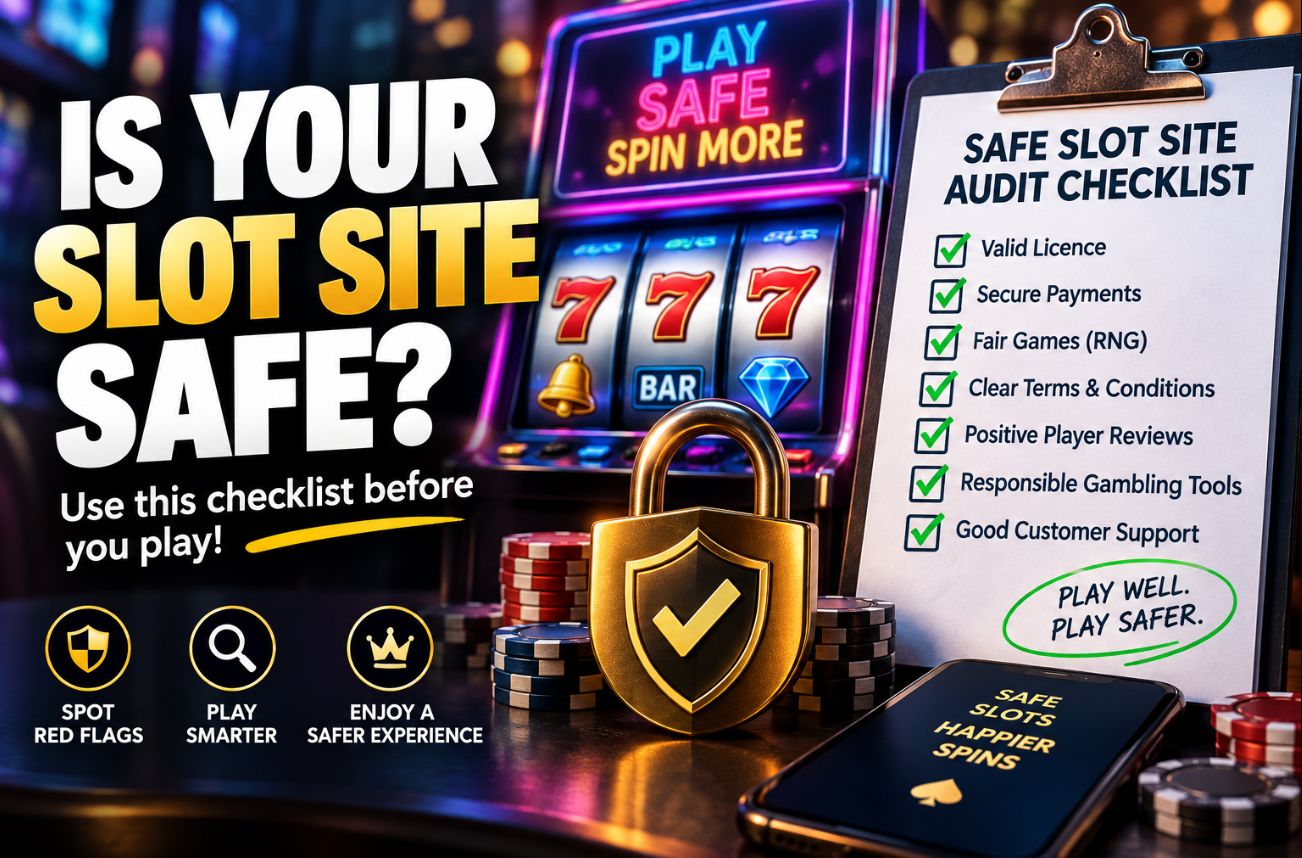
Key Highlights
- Before depositing at any online slot site, complete a three-step safety audit: check local legality, verify the operator’s licence, and review game fairness, banking rules, and player-protection tools.
- A professional website, a huge welcome bonus, popular slot providers, local currency, or a padlock in the browser does not prove that a casino is safe or legally authorised.
- Start with your location. Online casino rules vary by country, province, state, and territory, so a site can be licensed somewhere but still not be authorised to accept players where you live.
- In Ontario, private online casinos must be registered with the Alcohol and Gaming Commission of Ontario and operate under an agreement with iGaming Ontario. Use iGaming Ontario’s official operator directory to check whether the casino and its exact website are regulated.
- In Australia, online casino-style games, including online pokies, slots, roulette, blackjack, and poker, are prohibited when offered to people physically located in Australia. An offshore licence, AUD payments, Australian promotions, or an “Aussie pokies” label does not make a casino lawful for Australian players.infrastructure.
- Never use a VPN, false address, foreign payment account, or another person’s identity to bypass a casino’s country restrictions. It can breach terms, lead to account closure, and prevent withdrawals.
- Verify the casino operator, not only the brand. Find the company’s legal name, licence number, registered address, licence authority, terms and conditions, privacy policy, complaints process, and responsible gambling information.
- Check the licence through the gambling regulator’s own public register. Do not rely on a footer badge, a casino-uploaded certificate, a screenshot, or wording such as “fully licensed worldwide.”
- Confirm that the licence covers the exact domain name you are visiting. Scam sites may copy real brands, licence numbers, audit logos, and page designs while using a slightly different web address.
- Genuine slot games use random number generators, or RNGs. Independent laboratories such as eCOGRA, GLI, and iTech Labs can test RNG systems, game rules, payout calculations, and technical compliance.
- An independent audit confirms that a tested game should operate according to its approved mathematical model. It does not guarantee that a player will win, remove the house edge, make a jackpot due, or predict results in a single session.
- Check that an audit seal is clickable and opens a live verification record on the laboratory’s official website. A static eCOGRA, GLI, or iTech Labs logo in a casino footer can be copied and means nothing on its own.
- Review the game information panel before wagering. Look for the paytable, RTP configuration, volatility, maximum win, bet range, free-spins rules, jackpot details, and the game provider’s name.
- Audit the cashier before depositing. Confirm available deposit and withdrawal methods, minimum cashout amount, processing times, verification requirements, fees, withdrawal limits, and whether funds must return to the original payment method.
- Treat any demand for a “withdrawal release fee,” “verification payment,” “tax payment,” “anti-money-laundering fee,” or extra deposit to unlock winnings as a major scam warning. Never pay more money to release an existing casino balance.
- Read bonus terms before claiming a welcome offer. Key conditions include wagering requirements, maximum bet limits, expiry dates, game-contribution rates, restricted games, and maximum cashout limits.
- Avoid sites with missing legal information, unverifiable licences, guaranteed-win claims, crypto-only payment demands, fake countdown timers, poor translations, Telegram-only support, unsolicited links, or pressure to deposit immediately.
- A safe casino should be transparent before it takes your money. If you cannot independently verify legality, the operator, the licence, the audit scope, and the withdrawal rules, do not deposit.
- Gambling should remain entertainment only. Set a fixed budget, never chase losses, use time-outs or self-exclusion tools when needed, and seek support early if gambling is affecting your finances, wellbeing, work, or relationships.
Is This Online Casino Legit? The Essential Player Safety Checklist
A slot site is only worth considering when its legal status, operating credentials, game testing, banking terms, and player protections can be independently verified. A polished homepage, a large welcome bonus, thousands of pokies, or a familiar game provider do not prove that a casino is safe.
The safest approach is simple: do not deposit until you have completed a three-step audit. First, verify whether the casino is legal for your location. Second, confirm that the licence belongs to the real operator behind the website. Third, check that the games, payments, and player-protection systems can be verified through independent sources.
This guide explains how to audit an online casino before depositing, with special attention to players in Canada and Australia. It also explains how independent testing labs assess slot games, what scam sites commonly do, and when the safest choice is to leave a site without creating an account.
The Three-Step Safety Audit
Before depositing at any slot site, complete these three checks:
- Check whether the site is legal where you live
- Verify the licence and the operator
- Confirm game fairness, banking rules, and player protections
If a casino fails one of these checks, do not deposit. There are many legitimate-looking gambling websites online, but a professional design can be copied. Licensing statements can be misleading. Audit logos can be fake. Payment pages can look secure while withdrawal rules are unfair or impossible to meet.
A safe casino should make the key information easy to find. The legal company name, licence details, terms and conditions, payment rules, responsible gambling tools, privacy policy, and support contacts should be visible without needing to register.
A casino that hides basic information behind a login screen, gives vague answers about its licence, or pressures players to deposit quickly should be treated as high risk.
Step 1: Check Local Legality
The first safety question is not “Does this casino accept my card?” It is “Is this site authorised to offer online casino games where I live?”
Online gambling law is not the same in every country, province, state, or territory. A casino may hold a licence in one jurisdiction but still be unable to legally provide its services in another. Players should never assume that a site is safe merely because it accepts their currency, displays a local flag, advertises a local bonus, or has an Australian or Canadian version of its homepage.
Canada: Gambling Rules Are Provincial
Canada does not have one nationwide online casino licence. Gambling regulation is largely managed at the provincial level, which means the legal and regulated options can differ depending on where the player lives.
Ontario has a competitive regulated online gambling market. Private operators can offer online casino games to Ontario residents only when they are registered with the Alcohol and Gaming Commission of Ontario and have an agreement with iGaming Ontario. Ontario players should use the official iGaming Ontario operator directory to check whether a casino is approved for the province.
A regulated Ontario casino should clearly show that it operates under the provincial framework. It should also provide age and identity verification, responsible gambling tools, transparent game information, secure payments, and customer support.
Other Canadian provinces generally use provincial lottery corporation platforms rather than a wide open market of private casino operators. For example, players may encounter provincially operated online gambling services associated with local lottery organisations. The exact options depend on the province or territory.
This creates a clear rule for Canadian players: verify the casino against the correct provincial authority before depositing. A casino that is legal and regulated in Ontario is not automatically authorised in every other province. A site that advertises “Canada friendly” or “Canadian players welcome” is not necessarily locally licensed.
Ontario’s model is especially useful as a benchmark because approved private operators are publicly listed through the iGaming Ontario directory. If a website claims to be regulated in Ontario but cannot be found in the official directory, do not assume it is legitimate.
Australia: Online Casino Games Are Restricted
Australia has strict laws governing interactive gambling. Online casino games, online pokies, and similar prohibited interactive gambling services cannot legally be provided to people in Australia, even when the website is operated offshore.
This is one of the most important facts for Australian players. An offshore casino can display Australian dollars, advertise Australian bonuses, mention Aussie pokies, offer local payment methods, and provide Australian customer support. None of these features make it legally authorised to offer online casino games in Australia.
The Australian Communications and Media Authority monitors and investigates illegal online gambling services. It can request that illegal gambling websites be blocked and can take action against operators that breach Australian rules.
A casino site may be regulated in another country, but that does not mean it is a lawful online casino option for Australians. Licensing in Curaçao, Malta, Gibraltar, the Isle of Man, or another jurisdiction does not override Australian restrictions on online casino games and online slots.
For Australian residents, the safest legal choice is not to use offshore online casino or online pokies sites. Do not use a VPN, false address, foreign payment account, or another person’s details to get around a casino’s location restrictions. This can breach site terms, create identity-verification issues, and make withdrawals difficult or impossible.
Australian players who want help managing online or phone wagering can use BetStop, the National Self-Exclusion Register. It allows people to self-exclude from licensed Australian online and phone wagering providers through one registration. However, it does not cover unlicensed offshore online casino sites, which is another reason those sites carry additional risk.
A Location-First Checklist
Before registering, answer these questions:
- What country, province, state, or territory am I physically located in?
- Is online casino play legal in that location?
- Is the casino authorised by the regulator that applies to my location?
- Does the casino explicitly accept players from my location?
- Is the website using local branding to imply legitimacy without listing a local licence?
- Does the casino require accurate identity and location verification?
- Am I being asked to bypass a geo-block, use a VPN, or provide inaccurate details?
If the answer to the final question is yes, stop. A legitimate casino should not ask players to hide their true location or use false information.
Step 2: Verify the Licence and Operator
A licence badge is not proof by itself. The next step is to identify the legal company that operates the website and verify its licence through the regulator’s own register.
This is the most important difference between a real casino licence and a copied logo in the website footer.
Find the Real Operator Name
Scroll to the bottom of the casino homepage. Look for the legal company name, registered address, licence number, licensing authority, company registration details, and links to the terms and conditions.
A legitimate operator should state something similar to:
- The full legal company name
- The trading name of the casino brand
- The licence number
- The licensing authority
- A registered office address
- The jurisdiction governing the terms
- A contact email or support channel
- Responsible gambling links
- Privacy and data-handling information
Do not rely on the casino’s brand name alone. The brand may be different from the company that holds the licence. One company can operate multiple casino brands, and scam sites sometimes imitate established brands by using similar names, copied colours, or small spelling changes.
For example, a fraudulent site may use a brand name that differs from a legitimate casino by one letter, a hyphen, a country-code domain, or an extra word such as “official,” “VIP,” “casino,” or “play.”
Check the Regulator’s Register
After finding the licence number and company name, leave the casino website and visit the regulator’s official public register. Search for the legal company name and licence number there.
A valid match should confirm:
- The operator’s legal name
- The licence status
- The licence number
- The jurisdiction
- The authorised gambling activities
- Any restrictions or conditions
- The current status of the licence
Do not treat a screenshot, a PDF uploaded by the casino, or a seal in the footer as enough proof. The information needs to be confirmed independently.
For Ontario, use the official iGaming Ontario directory and the Alcohol and Gaming Commission of Ontario information. The directory exists specifically to show the iGaming sites offered by registered and approved operators.
For other regulated jurisdictions, use the relevant regulator’s own register. A real regulator usually maintains a searchable licence database or a list of authorised operators.
Check the Domain Name
Even if the licence is valid, confirm that it covers the exact website domain you are visiting.
This matters because scammers may copy the legal company name and licence number of a genuine operator. They may then use a different web address, a lookalike logo, and a similar homepage to trick players into depositing.
Compare the domain carefully:
- Check spelling letter by letter.
- Look for extra words or unusual hyphens.
- Check whether the site uses a strange country-code extension.
- Be cautious with domains that include random numbers.
- Check whether the regulator’s register lists the same domain.
- Avoid links from unsolicited emails, social-media messages, pop-ups, or Telegram groups.
- Type the official address manually or use a trusted regulator directory.
A secure padlock icon in the browser only means that the connection between the browser and the website is encrypted. It does not prove that the casino is licensed, fair, or trustworthy.
Licensing Red Flags
Leave the site if you see any of these warning signs:
- No legal company name in the footer
- No licence number
- A licence number that cannot be found in an official register
- A licence that belongs to another company
- A licence that does not cover the casino domain
- Claims of being “internationally licensed” without naming a regulator
- Vague language such as “fully certified” or “100% legal everywhere”
- No terms and conditions page
- Terms that list no legal jurisdiction
- No clear complaints process
- A request to use a VPN or change your country
- A site that accepts deposits but gives no clear withdrawal policy
- Unsolicited bonus offers from messaging apps or social media
A legitimate casino does not need to hide basic legal information. If the facts are difficult to verify, treat that difficulty as a warning.
Step 3: Audit the Games, Banking and Protection Tools
A licence confirms who is operating the casino. It does not automatically tell you whether the games are properly tested, whether the bonus terms are reasonable, or whether withdrawals are handled fairly.
The third audit step examines the actual player experience: game fairness, payment transparency, withdrawal rules, identity verification, customer support, and responsible gambling protections.
How Independent Labs Audit Slot Games
Online slots use random number generators, often called RNGs. An RNG is software that produces random outcomes for each spin. The purpose is to ensure that a game result is not determined by previous wins, previous losses, account balance, deposit size, or a player’s belief that a jackpot is “due.”
Independent testing laboratories assess RNGs, games, and casino systems. Well-known testing organisations include:
- eCOGRA
- Gaming Laboratories International, or GLI
- iTech Labs
- BMM Testlabs
These labs can test whether game outcomes are random within the game’s mathematical design. Their work may include examining RNG behaviour, reviewing game rules, checking payout calculations, assessing RTP settings, reviewing technical controls, and confirming that the version released to players matches the version that was tested.
An independent audit does not mean that players will win. It does not remove the house edge, guarantee a fair result in one session, or mean a bonus will pay out. It means the tested game should operate according to its approved mathematical rules.
For slot players, the key terms are:
- RNG: The system used to determine each game outcome randomly.
- RTP: Return to Player, a theoretical long-term percentage based on a very large number of rounds.
- Volatility: How uneven a game’s payout pattern can be.
- Hit frequency: How often a slot may produce any winning result, not how large that result will be.
- Maximum win: The largest advertised multiplier or prize potential under the game’s rules.
A 96% RTP does not mean every player receives 96 dollars back from every 100 dollars wagered. It is a long-run mathematical expectation, and real short-term results can be far above or below it.
How to Verify an Audit Seal
A real audit seal should be clickable and should take you to a live certificate, verification page, or operator listing on the independent laboratory’s own website.
Do not trust a seal simply because it is visible in the footer. A scam site can copy an image of an eCOGRA, GLI, or iTech Labs logo in seconds.
Use this quick process:
- Click the seal.
- Check that it opens the auditor’s official domain, not another page on the casino site.
- Confirm that the certificate names the casino operator or the game supplier.
- Check the scope of the certificate.
- Check the certification date and whether it remains current.
- Confirm that the casino domain or product covered matches the site you are using.
- Check the game information panel to see whether RTP and rules are clearly displayed.
A proper certificate should identify what was tested. It may cover the platform, a software supplier, an RNG, selected games, or an operational standard. Do not assume that a certificate for one software provider automatically proves that every game or every part of the casino has been audited.
Check the Game Provider
A trustworthy casino should state which studios provide its games. Recognised suppliers normally have official websites and clear product pages.
Popular provider names alone are not sufficient proof. Some fraudulent websites display game thumbnails and provider logos without having a genuine commercial relationship with those studios.
Open a few games and check:
- Does the game load through a recognised provider interface?
- Is there a visible information or paytable button?
- Are the RTP, game rules, and maximum win clearly shown?
- Does the game look technically consistent and professionally translated?
- Does the provider list the casino as a partner, where such information is available?
- Do the game rules match the provider’s official game description?
Poor-quality copies may have spelling errors, broken game controls, inconsistent stake values, missing paytables, or suspiciously simple “guaranteed win” claims. These are strong reasons not to deposit.
Audit the Cashier Before Depositing
A safe casino should explain deposits and withdrawals clearly before taking money.
Open the banking page and check:
- Available deposit methods
- Available withdrawal methods
- Minimum and maximum deposits
- Minimum and maximum withdrawals
- Withdrawal processing times
- Identity-verification requirements
- Fees
- Daily, weekly, and monthly withdrawal limits
- Whether the casino returns funds to the original deposit method
- Whether different rules apply to cryptocurrency
- Whether bonus funds affect withdrawal eligibility
A legitimate casino may need to verify identity before allowing a withdrawal. This is a normal anti-fraud and regulatory process. However, the site should explain this requirement clearly rather than inventing new document demands only after the player wins.
Be cautious if a casino:
- Promises instant withdrawals with no verification
- Refuses to show withdrawal terms before deposit
- Requires extra deposits to “unlock” an existing withdrawal
- Demands a fee before releasing winnings
- Requests payment through cryptocurrency only
- Asks for banking passwords, wallet recovery phrases, or remote access to a device
- Uses only anonymous messaging apps for payment support
- Changes the withdrawal rules after a player submits a request
Never pay a separate “release fee,” “tax,” “verification charge,” “anti-money-laundering fee,” or “wallet activation fee” to obtain a withdrawal. These demands are common scam tactics. If a casino requires a deposit to release an existing balance, stop communicating and seek advice from your bank, payment provider, or consumer-protection service.
Read Bonus Terms Like a Contract
A large casino welcome bonus is not automatically valuable. It can contain conditions that make it difficult to withdraw winnings.
Before accepting any bonus, check:
- The wagering requirement
- The time limit
- The maximum bet permitted with bonus funds
- The contribution rate by game type
- Restricted games
- The maximum withdrawal from bonus winnings
- Whether free spins expire
- Whether the bonus is opt-in
- Whether a promo code is required
- Whether the offer applies to your payment method
- Whether the casino can cancel the bonus for a specific reason
For example, a 100% match bonus with a 40x wagering requirement may require a significant amount of gameplay before any bonus-related balance becomes withdrawable. A bonus can be suitable for some players, but it should never be accepted without understanding the rules.
If the bonus terms are vague, contradictory, unavailable, or written in poor-quality language, do not deposit.
How to Spot a Scam Slot Site
Scam sites use urgency, false social proof, oversized bonuses, and copied branding to make players deposit before checking the details.
The most common scam pattern is simple: the site makes depositing easy and withdrawing difficult. It may show fake winner notifications, false countdown timers, made-up “licence” badges, or claims that a jackpot is guaranteed.
Common Scam Signals
Be highly cautious when a casino has several of these signs:
- A bonus that is unrealistically large or guaranteed
- “Guaranteed jackpot” or “guaranteed win” wording
- No licence verification link
- No legal company name
- No terms page or a copied, generic terms page
- Only cryptocurrency deposits
- Requests for a payment to release winnings
- Customer support available only through Telegram, WhatsApp, or social media
- Poor grammar, broken pages, and inconsistent currencies
- Fake celebrity endorsements
- A download file instead of a browser casino
- Unsolicited links sent by text message, email, or direct message
- A requirement to recruit friends before withdrawal
- A sudden account freeze after a winning session
- Requests for sensitive financial details beyond normal verification documents
- Pressure to deposit immediately because an offer is “ending in minutes”
A legitimate casino can still have a large bonus or use promotional countdowns, but a safe operator will also provide clear rules, proper support channels, legal details, and independently verifiable credentials.
Do Not Trust Reviews Alone
Review sites can be useful for comparing casino features, but they are not a substitute for a personal audit. Some reviews are outdated, affiliate-driven, copied, or written before a casino changed ownership, payment rules, or availability.
Use reviews to find questions to ask, not as the final answer.
A good review should tell you where the casino is licensed, what country restrictions apply, what the withdrawal limits are, how the bonus works, and what responsible gambling tools exist. It should also make clear when a site is not legally available to certain players.
The safest evidence always comes from official regulator registers, official operator terms, recognised audit laboratories, and trustworthy government sources.
The Safe Deposit Checklist
Use this checklist before every first deposit at a new casino:
Legal Status
- I have confirmed that online casino play is legal where I live.
- I have checked whether the casino is authorised for my province, state, or country.
- I am not using a VPN, false address, or false identity.
- I understand that accepting my currency does not prove local legality.
Licence and Operator
- I know the casino’s legal company name.
- I have found the current licence number.
- I have checked that licence in the regulator’s official register.
- The licence belongs to the company named in the casino terms.
- The licence or regulator record covers the exact casino website domain.
- The casino provides clear terms, privacy rules, and customer support details.
Game Fairness
- The casino identifies its game providers.
- The games have visible rules and paytables.
- The games show RTP or other relevant game information where required.
- Any audit seal links to the testing laboratory’s official site.
- The certificate is current and covers the relevant operator, product, or game supplier.
- I understand that audited RNG games are still games of chance.
Banking and Withdrawals
- I have checked deposit and withdrawal methods before depositing.
- I know the minimum withdrawal amount.
- I know whether there are daily, weekly, or monthly cashout limits.
- I understand the verification requirements.
- I have read the bonus terms.
- I will never pay a fee to release a withdrawal.
- I will only use a payment method in my own name.
Responsible Gambling
- I am old enough to gamble legally in my location.
- I have set a spending limit I can afford to lose.
- I am not gambling to solve debt, stress, or financial problems.
- I know how to use deposit limits, time-outs, and self-exclusion tools.
- I will stop if gambling stops being entertaining.
Final Verdict
A safe slot site is not identified by its colours, welcome bonus, influencer promotion, or game count. It is identified by information that can be verified independently.
The three-step audit is the most practical protection available to players. First, confirm whether the casino is legal where you live. Second, verify the operator and licence through the regulator’s own register. Third, check whether the games, audit certificates, payments, withdrawals, bonus terms, and responsible gambling tools are transparent and credible.
For Canadian players, gambling legality and licensing depend heavily on the province. Ontario players should confirm operators through the iGaming Ontario directory, while players elsewhere should use their applicable provincial gambling authority or government-operated platform.
For Australian players, offshore online casino and online pokies sites are not lawful options. A site displaying AUD, Australian promotions, or local payment methods does not change this. Do not bypass restrictions, and do not treat an offshore licence as Australian authorisation.
If a casino cannot pass the audit, do not deposit. Leaving a suspicious site is not missing an opportunity. It is avoiding an unnecessary financial and identity risk.
Frequently Asked Questions
How can I tell whether an online slot site is safe?
Use a three-step check before depositing: confirm that online casino play is legal where you are located, verify the casino’s operator and licence through the relevant regulator’s official register, and review its game testing, payment terms, withdrawal rules, and responsible gambling tools. A safe-looking website, local currency, a bonus banner, or a browser padlock does not prove that a casino is legitimate.
How do I verify an online casino licence?
Find the legal company name, licence number, licensing authority, and registered address in the casino footer or terms and conditions page. Then leave the casino website and search for those details in the regulator’s official public register. The legal entity, licence status, licence number, and authorised domain should match exactly. If the licence cannot be found, belongs to another company, is inactive, or does not cover the website you are visiting, do not deposit.
Are online casinos legal in Canada?
Online casino rules in Canada vary by province and territory. In Ontario, private online casino operators must be registered with the Alcohol and Gaming Commission of Ontario and operate under an agreement with iGaming Ontario. Ontario players should use iGaming Ontario’s official operator directory to confirm that a casino is authorised before creating an account or depositing. Other provinces may use different provincial lottery or gambling frameworks.
Can Australians legally play at offshore online pokies sites?
Online casino-style gambling services, including online pokies, slots, roulette, blackjack, and poker, are prohibited when offered to people physically located in Australia. A casino accepting Australian dollars, promoting “Aussie pokies,” or holding an offshore licence does not make it lawful or locally authorised. Australians should not use a VPN, false address, or another person’s account to bypass country restrictions.
What does an RNG audit prove?
An RNG, or random number generator, is the system that determines game outcomes in online slots and other casino games. Independent laboratories such as eCOGRA, GLI, and iTech Labs can test whether the RNG and game software operate according to their approved technical and mathematical rules. An audit does not guarantee that a player will win, predict the next spin, remove the house edge, or make a jackpot due. It confirms that the tested product should produce random outcomes within its declared game model.
How can I check whether an audit seal is genuine?
Click the audit seal and make sure it opens a live verification page on the testing laboratory’s official website, rather than another page on the casino site. The record should identify the casino operator, game supplier, relevant product or system, certificate scope, and status. A static logo in a website footer is not proof because scam sites can copy eCOGRA, GLI, and iTech Labs images without permission. eCOGRA’s eGAP framework is designed around operational standards and player-protection requirements, including responsible gambling information.
What are the biggest signs of a scam casino site?
Leave immediately if a site has no verifiable operator or licence, claims guaranteed wins or jackpots, hides its withdrawal rules, requires a fee to release winnings, demands another deposit to unlock a cashout, asks for passwords or crypto wallet recovery phrases, or relies only on Telegram, WhatsApp, or social-media support. Other warning signs include fake celebrity endorsements, broken pages, poor translations, unexplained account freezes, crypto-only deposits, unrealistic bonuses, and pressure to deposit before an offer “expires.” A legitimate casino should be transparent about its legal identity, licence, banking process, verification requirements, and responsible gambling tools before it accepts a deposit.
Sources
- iGaming Ontario: Approved operator directory
- Alcohol and Gaming Commission of Ontario: Internet gaming overview
- Australian Communications and Media Authority: Interactive gambling information
- Australian Communications and Media Authority: Online gambling investigations
- BetStop: Australia’s National Self-Exclusion Register
- eCOGRA: eGAP and Safe and Fair certification
- Gaming Laboratories International: RNG testing and certification
- iTech Labs: RNG and game certification
Last Updated on September 17, 2026 by Pokie-Player