Return to Player (RTP) is one of the few hard numbers that Aussie players can use to judge whether an offshore casino is offering decent value or quietly shaving extra profit off every spin. When you play at overseas sites, you lose the safety net of Australian venue regulation, so understanding RTP—and how to check it – matters more than ever.



What RTP Actually Means for Aussies at Offshore Casinos
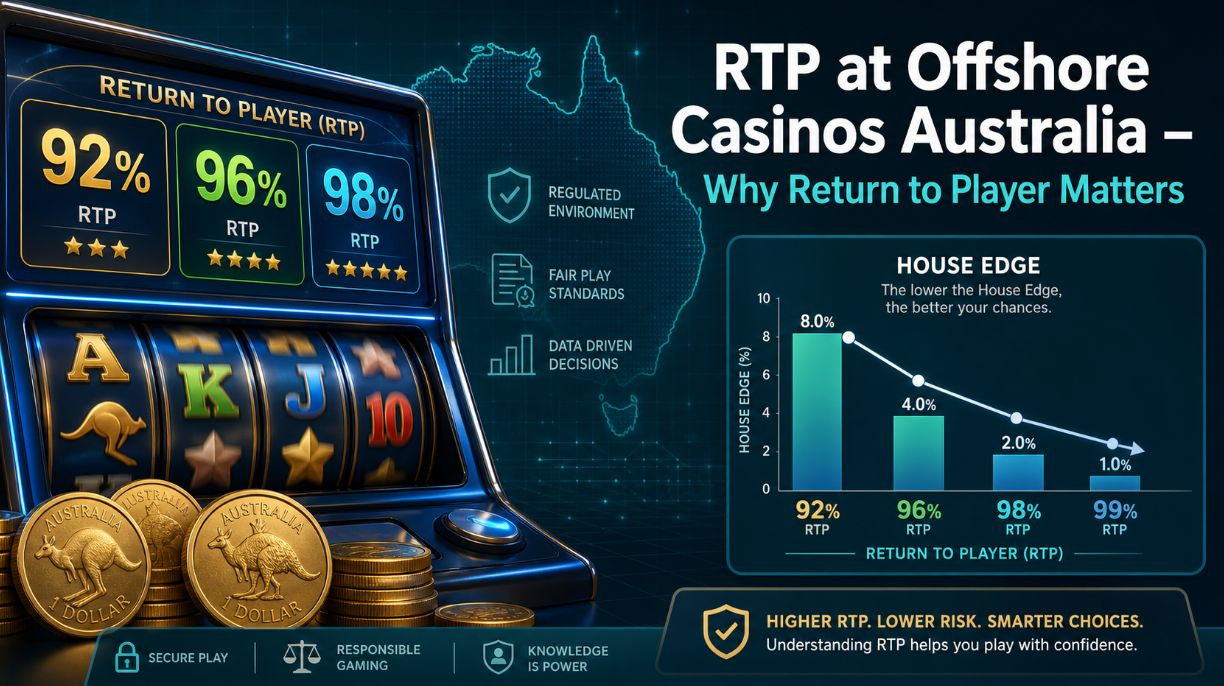
RTP is the percentage of total bets that a game is programmed to return to players over a very long period. For example, a pokie with 96% RTP will, on average, give back 96 AUD for every 100 AUD wagered when you look at millions of spins, leaving 4 AUD as the house edge.
Important points:
-
RTP is long‑term math, not a prediction for tonight’s session.
-
Individual sessions can swing wildly above or below the theoretical percentage.
-
Offshore casinos can offer games with different RTP versions, especially popular slots that exist in multiple configurations.payoutverdict+2
In Australian pubs and clubs, regulators enforce minimum RTPs—often around 85% or higher depending on the state. Offshore sites don’t follow those local thresholds, so the same branded pokie can be set at 96% on one site and 92% on another. That spread is where RTP starts to seriously impact your bankroll.
Why RTP Matters More at Offshore Casinos
When you play at offshore casinos, your main protection is choosing games and sites with favourable math rather than relying on local regulation. RTP is a key part of that.
1. It Defines the House Edge You’re Accepting
The house edge is simply 100%−RTP100\% – RTP. If you play a 94% RTP pokie, the house edge is 6%; at 92% RTP, it jumps to 8%. Over time, that difference compounds:
-
At 94% RTP, a 1,000 AUD total wager carries an expectation of losing around 60 AUD.
-
At 92% RTP, the same volume of play raises the expected loss to around 80 AUD.
For Aussies spinning regularly offshore, that extra 2–4% is the difference between a manageable entertainment expense and a sharply steeper long‑term loss curve.
2. Offshore Casinos Can Quietly Use Lower RTP Versions
Popular online slots often ship with multiple RTP configurations, such as 96.5%, 94% and 92%. Reputable casinos tend to use the highest or mid‑tier settings, but less scrupulous operators may choose lower variants because they increase profit while most players never notice.payoutverdict+1
If you don’t check the RTP version, you might assume you’re playing the same game as at another casino when in reality the math has been tilted further in the house’s favour.
3. Bonus Terms Are Built Around RTP
Welcome bonuses and free spins are always priced against game RTP and volatility. Offshore casinos know exactly how much they expect to recover from wagering requirements across their selected slot list. If they push you toward lower‑RTP games for clearing a bonus, the offer may look generous but effectively locks you into worse mathematical odds.
Understanding RTP allows you to spot when a bonus is genuinely friendly versus structurally tilted against you.
RTP vs Volatility: Why the Numbers Need Each Other
RTP is only part of the story; volatility (or variance) describes how uneven the payouts are.
-
Low volatility pokies pay smaller wins more frequently, sticking closer to the RTP in shorter sessions.
-
High volatility pokies deliver fewer but larger hits, making short‑term results swing more wildly.
A 97% RTP game with extreme volatility can feel brutal during a brief session, while a 94% RTP low‑variance game may feel “luckier” because it pays regularly. Offshore casinos often highlight volatility in their game info or reviews, but you should interpret it alongside RTP:
-
High RTP + high volatility: mathematically strong long‑term value but rough short‑term swings.
-
Mid RTP + low volatility: gentler experience but a larger embedded house edge.
Knowing this helps Aussie players choose offshore pokies that fit their risk appetite instead of just chasing high RTP figures blindly.
How Offshore RTP Compares to Australian Venue Standards
Australian land‑based venues must abide by state‑mandated minimum RTPs, often around 85% or above, with many machines clustering in the mid‑90s range. Offshore casinos, by contrast:
-
Are free to offer games ranging from low‑90s up to around 98–99%.
-
May feature “high‑RTP pokies” that exceed typical pub and club settings, especially value‑focused classics.
-
Can also deploy aggressively marketed games with relatively poor RTP where the theme and bonus hype distract from the underlying math.
This makes offshore play a double‑edged sword. If you choose high‑RTP titles from reputable providers, you can sometimes get better theoretical value than at a local venue. If you ignore RTP entirely, you may end up playing flashy, low‑RTP slots that quietly cost more than their land‑based equivalents.
Practical Example: High‑RTP vs Low‑RTP Offshore Pokies
Guides on high‑RTP pokies for Aussies show concrete spreads between games. For instance:
-
Some classic 3‑reel or simple video slots sit around 97–98% RTP, offering more predictable long‑term returns.
-
Branded or heavily marketed games can drop to 92–94% RTP, particularly when featuring complex bonus mechanics and large headline max wins.
If you play 10,000 AUD in total stakes over months of offshore spins:
-
At 97% RTP, the expected long‑term loss is around 300 AUD.
-
At 92% RTP, the expected loss around 800 AUD.
The difference of 500 AUD isn’t theoretical—it reflects how much extra you may effectively pay for the same amount of entertainment if you pick lower‑RTP games.
How Aussies Can Check RTP at Offshore Casinos
Most reputable offshore casinos list RTP data either inside the game info screen or in separate documentation. A practical routine for Australians is:
-
Open the game’s information or help section
-
Look for a line specifying “RTP,” “return to player” or “payout percentage.”
-
-
Cross‑check with independent sources
-
Use trusted databases, guides and provider documentation to confirm that the casino’s stated RTP matches known versions of the game.
-
-
Watch for multiple RTP versions
-
If a slot is known to have 96% and 92% variants, ensure your chosen casino lists the higher figure; if it doesn’t, assume the lower setting and reconsider.
-
-
Treat missing RTP as a red flag
-
If the casino or game provider fails to display RTP at all, independent experts advise assuming the worst and avoiding that title.
-
This process takes only a minute but can significantly improve the long‑term sustainability of your offshore play.
RTP and Table Games at Offshore Casinos
RTP isn’t just for pokies; it applies to table games too. Offshore casinos typically offer:
-
Blackjack variants with RTPs above 99% when played with optimal basic strategy.
-
European or French roulette with RTP around 97.3%, better than double‑zero versions.
-
Video poker titles where certain paytables deliver RTPs in the 98–99% range.
By comparing RTP and rules across different versions of blackjack, roulette or video poker, Aussies can choose the tables that minimise house edge even at offshore sites.
RTP, Bonuses and Wagering at Offshore Casinos
Bonuses at offshore casinos are always tuned around game RTP. Common patterns include:
-
Higher wagering requirements on bonuses that can be used on high‑RTP games.
-
Restrictions that push bonus play onto lower‑RTP titles, such as excluding high‑value classics or limiting contributions from them.
-
Terms that reduce effective RTP—like maximum bet limits or time‑limited free spins – if not understood properly.
For Australian players, reading bonus terms through the lens of RTP helps you spot when an offer is genuinely player‑friendly versus a mathematical trap designed to recover the bonus amount with a tidy profit.
Responsible Gambling: RTP Is a Tool, Not a Shortcut
RTP is a vital tool, but it doesn’t turn offshore casinos into investment platforms. Pokies and casino games remain chance‑based; even with good RTP, your bankroll’s path is unpredictable in the short term. Responsible gambling guidelines for Aussies emphasise:
-
Using RTP to choose less damaging games, not to guarantee profit.
-
Setting clear limits on deposits and session time.
-
Accepting that even high‑RTP games can produce long losing streaks, especially at high volatility.
-
Seeking support if gambling begins to impact finances, relationships or mental health.
In other words, RTP helps you understand the price of entertainment at offshore casinos. It doesn’t change the fundamental fact that the house retains an edge.
Key Takeaways: RTP at Offshore Casinos Australia
For Australian players using offshore casinos, RTP is one of the few transparent metrics that can meaningfully influence your outcomes over time.
-
A higher RTP reduces long‑term loss expectation but still leaves the house with a slice of every stake.
-
Offshore sites can choose lower RTP versions of popular games; checking RTP prevents you from unknowingly playing the worst configurations.
-
Volatility shapes how that RTP feels in practice, with high‑variance games making short‑term experience far more swingy.
-
Bonuses and wagering conditions are calibrated around RTP, so understanding it helps you judge whether a promotion is worth chasing.
If you’re going to spin at offshore casinos, treat RTP as your first line of defence. Combine it with solid bankroll management, cautious bonus use and strict personal limits, and you’ll have a clearer, more informed view of what each session is likely to cost in the long run—without losing sight of the fact that pokies and casino games should always remain entertainment.
FAQs: RTP at Offshore Casinos for Aussie Players
What is RTP in online casinos?
RTP, or Return to Player, is the percentage of total bets that a game is mathematically designed to pay back to players over the long term. For example, a pokie with 96% RTP will, on average across millions of spins, return 96% of all wagered money and keep 4% as the house edge.
Why does RTP matter more at offshore casinos for Australians?
At offshore casinos, you don’t have Australian regulators enforcing minimum payout levels, so the operator can choose different RTP versions of the same game. Knowing the RTP helps you avoid low‑paying versions and pick pokies and table games that give you better long‑term value.
Is a higher RTP always better?
Generally yes, because a higher RTP means a lower built‑in house edge. Over many sessions, games with 96–98% RTP will usually cost less than games set at 92–94%. However, volatility also matters; a high‑RTP game can still feel rough in the short term if it’s very volatile.
What’s the difference between RTP and volatility?
RTP describes the long‑term average return, while volatility describes how that return is distributed. Low‑volatility pokies pay small wins more often, sticking closer to the RTP in shorter sessions. High‑volatility pokies pay less frequently but can produce large spikes, making results swing more wildly around the same RTP.
Can the same pokie have different RTP at different offshore casinos?
Yes. Many modern slots are released with multiple RTP settings, and casinos choose which version to use. One site might offer a game at 96% RTP while another runs the same title at 94% or lower. That’s why checking the game info or documentation before you play is important.
How can I find the RTP of a game at an offshore casino?
Usually you can open the game’s help or information section and look for “RTP” or “return to player.” Some casinos also list RTP values on dedicated pages or in their game catalogue. If you can’t find any RTP information at all, it’s sensible to treat that as a warning sign.
Does RTP apply only to pokies or also to table games?
RTP applies to both. Blackjack, roulette, video poker and other table games all have mathematical payout percentages based on their rules and paytables. Choosing versions of these games with better RTP—such as single‑zero roulette or full‑pay video poker—can reduce the house edge.
How does RTP affect casino bonuses at offshore sites?
Bonus offers are designed around RTP and wagering requirements. Casinos know how much they expect to recover when you play through a bonus. If the terms push you toward lower‑RTP games or restrict high‑RTP titles, the bonus may look generous but will be harder to turn into withdrawable profit.
Can a game with high RTP still be risky?
Yes. A high RTP game with high volatility can produce long losing streaks and occasional big wins. The maths is better over huge numbers of spins, but your short‑term experience may be very swingy. That’s why you should consider both RTP and volatility, and never gamble more than you can afford to lose.
Are offshore casinos required to follow Australian RTP rules?
No. Offshore casinos follow the rules of the jurisdiction where they are licensed, not Australian venue regulations. This means they are free to offer games with lower or higher RTP than typical Aussie pubs and clubs, so players need to check RTP themselves rather than assuming local standards apply.
What’s the best way for Australians to use RTP when playing offshore?
Use RTP to filter out poor‑value games, favour titles with solid percentages, and combine that with sensible stakes and session limits. RTP should guide you toward less costly entertainment, not encourage you to chase profit. Keeping play within strict personal limits and focusing on fun is still the most important part.
Sources
- Return to Player (RTP) in Australian Pokies Explained
- RTP Pokies Australia – How Percentages Shape Losses
- Complete Guide to RTP and Paylines in Online Pokies
- What RTP Means and Why It Matters for Aussie Players
- Gambling Help Online – Australia
Last Updated on August 4, 2026 by Pokie-Player