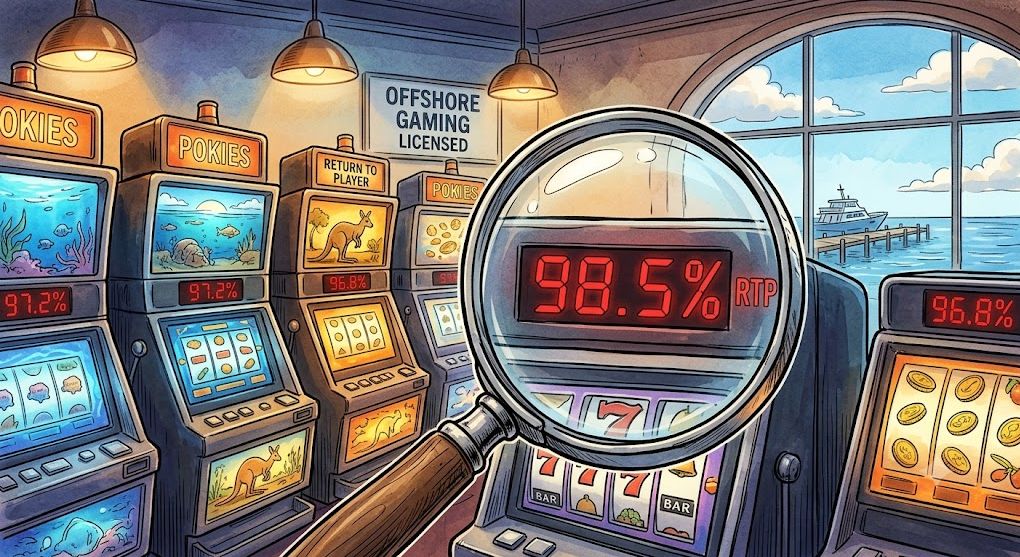
Offshore casinos serving Australian players can, in some cases, run lower RTP (Return to Player) versions of popular pokies, but the key is that the game providers themselves usually offer multiple RTP configurations and the casino chooses which one to deploy. The smartest way to protect yourself is not to guess, but to learn how to check the actual game information screens and, where possible, external RTP databases to see whether you are playing the standard 96% version of a pokie like Gates of Olympus or a downgraded 94% or even 88% build.



This guide walks through what RTP really is, how multi-RTP game versions work, why offshore casinos sometimes choose lower settings, and step-by-step methods Australians can use to verify the RTP configuration of their favourite pokies directly from game files, info panels and independent resources.
What RTP Means for Australian Pokie Players
RTP is the long-term percentage of total bets that a pokie is mathematically designed to return to players. If a game lists a 96% RTP, it is expected to pay back about 96 dollars for every 100 dollars wagered over a very large number of spins.gamblingcommission.
This does not mean you will personally get 96% of your money back in a single session; variance, volatility and hit frequency still apply. RTP is a design parameter that shapes the average performance of the game over time. For Australian players comparing pokies across different casinos, RTP is one of the most important technical metrics to check before deciding where to play.
Multi-RTP Configurations: Same Pokie, Different Returns
Modern slot providers often ship their games in several RTP variants to meet different regulatory and business needs. A single title can have multiple official versions, such as:
-
96.5% (full, standard RTP)
-
95% or 94% (mid-range RTP options)
-
92% or 88% (lower RTP versions for specific markets or business strategies)
The provider chooses these variants and documents them; casinos then decide which configuration to install on their platform. A pokie like Gates of Olympus is widely known at around 96.5% RTP in its standard build, but its developer can also offer lower-RTP configurations that some casinos use. As a result, playing the same game at two different offshore casinos may not give you the same expected return.
Can Offshore Casinos Change RTP Themselves?
In properly regulated environments, casinos are not allowed to silently change RTP values inside game code. Independent labs and regulators audit games to confirm that the actual RTP matches the approved design, and many licensed casinos publish certification reports.gamblingcommission.
However, offshore, unlicensed or weakly regulated casinos can choose lower-RTP variants offered by providers and may avoid prominently displaying the RTP. Some may use opaque practices that make it hard for players to know which version they are playing. The risk is less about a casino secretly rewriting the game and more about it deliberately picking the lowest-RTP configuration it can legally deploy, then hiding the details.
Why RTP Visibility Matters for Australians
For Australian players who mostly access offshore sites, RTP visibility is crucial:
-
It allows you to compare pokies objectively instead of relying only on themes or bonus features.
-
It helps you avoid platforms that hide RTP, which may be a sign of reduced integrity or weaker oversight.
-
It lets you identify casinos that proudly publish high-RTP selections and use that as a trust signal.
When a casino or game hub shows RTP values clearly on thumbnails or in info panels, you can make data-driven decisions rather than guessing whether you are playing a 96% or an 88% version of the same title.
How to Check RTP Inside the Game Client
The most direct way to see which RTP version you are playing is to open the game’s internal information screens. Most modern pokies include a detailed help section accessed via icons such as:
-
“i” button (information)
-
“?” icon (help)
-
“menu” or “settings” icon
Once inside, look for sections like “Game Rules”, “Paytable”, “Information”, or “Return to Player”. Technical RTP data is often near the end of the rules document or under a dedicated heading.
Typical phrasing includes:
-
“The theoretical return to player (RTP) is 96.5%.”
-
“Expected RTP: 94.0%.”
-
“This game has a theoretical RTP between 88% and 96%, depending on configuration.”
If the game clearly states a single percentage, that is the exact RTP for the instance you are playing at that casino. If it offers a range or vague wording, you may need to cross-check with external information.
Example: Checking RTP on Gates of Olympus
Gates of Olympus is a high-profile pokie, widely discussed in RTP and volatility guides for Australian players. Independent reviews and game-focused resources normally list a standard RTP around 96.5%, along with high volatility.
To check your specific casino’s version:
-
Open Gates of Olympus at your chosen casino.
-
Click the “i” or “menu” button, usually in the corner of the screen.
-
Navigate to the “Game Rules” or “Information” section.
-
Scroll until you find a line stating “Return to Player” or “RTP”.
-
Note the exact percentage shown—this reveals whether the casino is running the full 96.5% version or a lower variant.
If you see a value like 94% or 88%, you are not playing the standard configuration; that casino has opted for a reduced RTP build, which directly lowers your long-term expected returns.
Cross-Checking RTP With External Databases
In addition to in-game info screens, you can consult RTP databases and comparison tools that aggregate data across multiple casinos and game providers. These platforms allow players to:
-
Search for a specific pokie by name.
-
See documented RTP ranges for that title.
-
Compare how different casinos configure the same game.
If a database shows that a pokie officially supports RTP variants from 96.2% to 94.5%, and your casino’s info screen lists 94.5%, you can confirm that they have chosen the lower end of the range. This is valuable evidence when deciding whether that casino deserves your play.
Verifying RTP Against Regulatory or Audit Reports
Licensed casinos and providers often undergo independent testing by labs such as eCOGRA, iTech Labs or GLI, and publish summary reports confirming that actual RTP aligns with stated design.gamblingcommission.
As an Australian player, you can:
-
Look for a “Fair Play”, “Certificates” or “Testing” section on the casino site.
-
Open PDF or web reports showing game samples and their verified RTP values.
-
Check whether these match the numbers shown in each pokie’s info screen.
While offshore casinos targeting Australians may not always publish such detailed reports, those that do provide a stronger integrity signal. A mismatch between stated RTP in the game and audited RTP in reports would be a serious red flag.
Calculating Realised RTP Over Time (Advanced)
For highly technical players, it is also possible to estimate the actual realised RTP over a large session, although this is more of a diagnostic tool than a precise test. Regulatory guidance explains that you can calculate realised RTP by:
-
Tracking total turnover (amount wagered).
-
Tracking total wins (payouts received).
-
Dividing total wins by total turnover.
For example, if a game with a designed RTP of 91.68% produces 1,200,000 units of turnover and 1,085,000 units of wins over a month, the realised RTP is 1,085,000 / 1,200,000 ≈ 90.42%, which is below the design. Some technically minded players have performed large sample tests on titles like Gates of Olympus and observed realised RTP values below 96% in limited data sets, though variance makes short-term measurements noisy.gamblingcommission.
This approach is demanding and not necessary for casual players, but it can help confirm whether a casino’s implementation appears to align broadly with expectations over many spins.
Offshore Casinos, RTP Opacity and Risk
Independent fairness reviews emphasise that properly licensed casinos are required to publish RTP and undergo regular testing, whereas offshore sites often operate with looser oversight.
Common issues with unlicensed or lightly regulated offshore casinos include:
-
Lack of clear RTP data in game info or on site pages.
-
Use of lower-RTP configurations without disclosure.
-
Absence of independent RNG and RTP audits.
-
Difficult or delayed withdrawals, reinforcing distrust.
For Australians, this does not mean every offshore casino is dishonest, but it does mean you should treat missing or vague RTP information as a warning sign. A casino that takes pride in publishing detailed RTP values and audit reports is generally a better choice than one that hides them.
Practical Workflow: How Aussies Can Check RTP Before Playing
A robust step-by-step process for Australian pokie players could look like this:
-
Choose a pokie you like – for example, Gates of Olympus or another popular title.
-
Open the game at each casino you are considering.
-
Access the info or rules screen via the “i”, “?” or menu icon.
-
Scroll to the RTP section and write down the exact percentage shown.
-
Compare RTP values across casinos and avoid those offering significantly lower versions.
-
Optionally cross-check with an external RTP database or review site to confirm official ranges for that game.
If one casino runs Gates of Olympus at 96.5% and another at 94%, the first offers a mathematically better long-term expected return, all else being equal.
High-RTP Pokies and Casinos That Promote Them
Some Australian-facing guides now highlight casinos that prominently display RTP values and focus on high-RTP pokie selections, giving players upfront access to return data. These sites showcase titles with RTP figures often between 96% and 98%, plus clear volatility information.
A casino that:
-
Shows RTP on game thumbnails or in an easily accessible info section.
-
Publishes a list of high-RTP pokies.
-
Provides audit references or certificates.
is typically more transparent than a platform that only advertises bonuses and jackpots without any mention of RTP at all.
Responsible Gambling Context: RTP Is Not a Guarantee
Even with precise RTP data, pokie play remains a game of chance. Regulators and educational content emphasise that:
-
RTP describes long-term averages, not individual outcomes.
-
Volatility significantly affects how often you see wins and how large they are.
-
No strategy can “beat” RTP; the house edge remains.
For Australian players, RTP checking is about making informed decisions and avoiding needlessly bad deals, not about eliminating risk. It should be combined with bankroll management, limits, and awareness of when to stop.
What a Technically Strong and Unbiased RTP Guide Should Do
A high-quality, technically focused RTP guide for Australian players should:
-
Explain RTP, variance and RNG in clear but accurate language.
-
Show exactly how to access RTP info in-game for popular pokies.
-
Use examples like Gates of Olympus to demonstrate multi-RTP variants.
-
Encourage cross-checking with independent RTP databases and audit reports.
-
Warn about offshore opacity and lower-RTP configurations without sensationalism.
-
Emphasise responsible gambling and realistic expectations.
By combining these elements, such a guide positions itself as a trustworthy expert resource rather than a promotional hype piece.
Final Thoughts: Do Offshore Casinos Lower RTP for Aussies?
In summary, offshore casinos do not typically rewrite pokie code themselves, but they can and do choose lower RTP configurations offered by providers, especially in environments with weaker oversight. For Australian players, the safest approach is to assume nothing and verify everything: open the game’s information screens, read the RTP percentage, cross-check with external databases or audit summaries, and favour casinos that clearly display high-RTP versions of your favourite pokies.findmyrtp+2
This technical, fact-based method turns RTP checking into a standard part of your pre-spin routine. Instead of wondering whether an offshore casino is quietly running an 88% version of a pokie that should be 96%, you will know—and you can take your action to more transparent platforms that respect both your bankroll and your intelligence.
Frequently Asked Questions – Offshore Casinos and Pokie RTP for Aussies
Do offshore casinos lower the RTP on pokies for Australian players?
Some offshore casinos choose lower-RTP versions of popular pokies when the game provider offers multiple configurations. They generally do this through legitimate settings options provided by the developer, not by secretly rewriting the game code.
Can a casino change the RTP of a pokie on its own?
In properly regulated environments, casinos cannot arbitrarily alter RTP; they must use officially certified game builds. Offshore sites with weaker oversight can still select lower-RTP variants that the provider supplies, which is why checking the actual RTP for each game is so important.
What does RTP actually mean?
RTP (Return to Player) is the theoretical percentage of total bets that a game is designed to return to players over a long period. For example, a 96% RTP pokie is mathematically expected to return about 96 units for every 100 units wagered across a very large number of spins.
Why can the same pokie have different RTP values?
Many modern providers release games with multiple RTP configurations (for example, 96%, 94% or 88%) to fit different markets and business models. Casinos then decide which version to run, so the same title can behave quite differently depending on the platform.
How can I see the RTP of a pokie like Gates of Olympus?
Open the game, tap the “i”, “?” or menu icon, and go to the rules or information section. Scroll until you find a line mentioning “Return to Player” or “RTP” and note the exact percentage displayed. That figure represents the RTP of the version you are playing at that casino.
What if the game shows a range instead of a single RTP number?
If the info screen says something like “RTP between 88% and 96%,” it means the provider offers several configurations. In that case, you may need to check the casino’s documentation or use external RTP resources and reviews to confirm which specific variant the platform has enabled.
Is a 94% RTP pokie much worse than a 96% RTP version?
Over thousands of spins, even a 2% difference in RTP adds up. A 96% build theoretically returns more of your wagers than a 94% one, and an 88% version is significantly harsher. Choosing higher-RTP versions helps reduce the house edge you face in the long run.
How do I compare RTP across different casinos?
Pick a game you know, open it at each casino, and check the RTP in the info screen. Write the numbers down and compare them. If one site consistently runs higher-RTP variants of your favourite pokies, it is mathematically more favourable than a site using lower settings.
Can I calculate the “real” RTP myself?
You can estimate realised RTP by tracking your total bets and total wins over a long session, then dividing wins by bets. However, short-term results are heavily impacted by variance, so this method is more useful for curiosity than as a precise test.
Does lower RTP mean the game is rigged or unfair?
A lower RTP variant is not necessarily rigged; it can still follow proper random number generation. It is simply designed to return less over time. The issue is fairness and transparency: players deserve to know which version they are playing so they can make informed choices.
Are all offshore casinos bad when it comes to RTP?
No. Some offshore casinos run full-RTP builds and publish RTP values clearly. Others hide or minimise this information and may favour lower-RTP configurations. The key is to favour platforms that are transparent, audited, and upfront about return percentages.
What are red flags around RTP I should watch for?
Warning signs include: no RTP listed in the game rules, vague wording with no precise percentage, no mention of testing or certification, and a casino that refuses to answer RTP questions from players. These clues suggest you should proceed cautiously or look elsewhere.
Do higher RTP games guarantee I will win more money?
Higher RTP reduces the average edge against you, but it does not guarantee profit. Individual sessions can still produce big wins or heavy losses due to volatility and randomness. RTP is a long-term expectation, not a promise of specific outcomes.
How should Australian players use RTP information in practice?
Treat RTP as a screening tool. Prefer casinos and pokies that publish clear, higher RTP values, avoid platforms that hide or downgrade versions, and combine RTP awareness with sensible bankroll management and strict limits on your play.
What is the best quick RTP-check routine before I play?
Before spinning, open the game’s information screen, find the RTP line, note the percentage, and compare it to what you know about that title’s standard version. If the number looks significantly lower than expected, it is often better to switch casino or pick a different game.
Sources
- https://findmyrtp.com/
- https://rtptrack.com/
- https://www.gamblingcommission.gov.uk/licensees-and-businesses/guide/page/how-to-calculate-return-to-player-rtp
- https://icdst.org/blog/index.php/2025/04/15/pokie-rtp-secrets-every-aussie-should-know/
- https://safetherapeutics.com/offshore-unlicensed-casino-australia/
- https://www.lance.com.br/sites-de-apostas/cassino/o-que-e-rtp.html
- https://www.youtube.com/watch?v=n7E7H45c-5M
Last Updated on August 4, 2026 by Pokie-Player