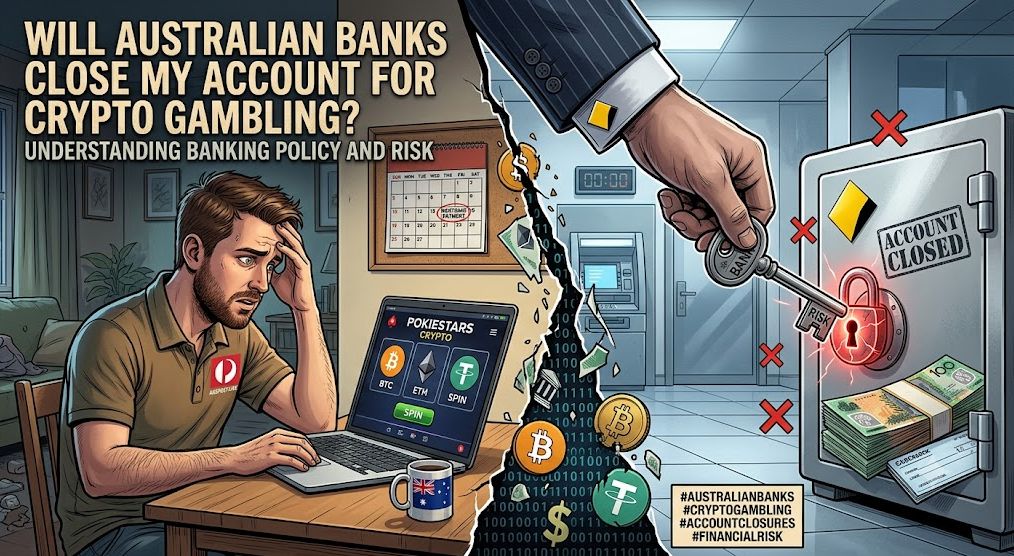
Australian banks are unlikely to close your account purely for buying crypto, but they are increasingly blocking or scrutinising transactions they see as linked to gambling, scams, or “high‑risk” crypto activity – especially at exchanges they don’t like. If you are using crypto specifically to gamble at offshore casinos, your main risks are payment blocks, frozen transfers, or compliance questions, and you need to structure things carefully if you want to stay on the right side of both the bank and the law.



Why Aussie Banks Care About Crypto and Gambling
Australian banks operate under strict anti‑money‑laundering (AML) and counter‑terrorism financing rules enforced by AUSTRAC and other regulators. These frameworks require them to:
-
Monitor transactions for suspicious patterns.
-
Report certain movements of funds involving crypto exchanges and gambling.
-
Block channels that show high levels of fraud, scams or illicit use.austrac.
Crypto and offshore gambling often sit in the same “high‑risk” bucket from a compliance perspective. Industry commentary and recent oversight changes show major banks tightening controls on crypto-related payments, especially where they see links to unregulated exchanges and gambling activity.
What Big Banks Like CommBank and Westpac Are Doing
Public reporting and industry analysis indicate that major Australian banks – including Commonwealth Bank, Westpac, NAB and ANZ – have:
-
Implemented blocks on payments to selected “high‑risk” crypto exchanges.
-
Introduced transaction monitoring rules that flag unusual patterns (rapid transfers in/out, multiple exchanges, repeated decline attempts).
-
Positioned these measures as consumer protection against scams and fraud.
For example:
-
Westpac and other big banks have blocked transfers to certain global exchanges after linking them to scam activity.
-
The Australian Banking Association has supported tighter controls on high‑risk channels, particularly crypto ATMs, because of their association with scams and illicit funds.
This doesn’t mean every crypto purchase is forbidden, but it does mean that banks are increasingly selective and risk‑averse.
Will My Bank Close My Account Just for Buying Crypto?
In general, simply purchasing reasonably sized amounts of crypto through recognised exchanges is unlikely to get your account closed. Banks know that many Australians use crypto for investment or legitimate payments.
However, account closure or serious restrictions become more likely if:
-
You repeatedly attempt payments to blocked or high‑risk exchanges.
-
Your transactions match suspicious patterns (rapid purchase, immediate off‑ramp to unknown wallets, scam‑like flows).
-
The bank believes you are involved in money mule activity or obvious fraud channels.austrac.
Using crypto for gambling is harder to detect at the bank level (they see an exchange or wallet, not the casino), but if your overall activity looks risky, they can still intervene.
How Banks View “Crypto for Gambling”
From a bank’s perspective, they typically see:
-
Payment to a crypto exchange (using BPAY, card, or account transfer).
-
Withdrawal from that exchange to your personal wallet.
-
They do not directly see the gambling site, but they may infer patterns over time.
Regulators and industry guides note that banks aim to limit harm from online gambling and scams, including via cards and direct merchant codes. When crypto is part of that ecosystem, they look for:
-
Transfers to exchanges known to service unregulated gambling platforms.
-
Large or highly frequent payments aligned with gambling behaviour.
-
Use of crypto ATMs or channels strongly associated with scam activity.austrac.
Rather than instantly closing accounts, they more commonly block specific payments, request explanations, or tighten limits.
Common Bank Actions Aussies Are Seeing
Aussie players and crypto users report several typical outcomes:
-
Declined payments to certain exchanges or payment processors, especially international ones flagged as high‑risk.
-
Extra verification (phone calls, questionnaires) when bank systems detect unusual crypto activity.
-
Temporary holds on large transfers while compliance teams review them.
-
Permanent bans on sending money to specific merchants or exchanges, even if the bank keeps your account open.
These measures are part of broader AML and consumer protection efforts, not personal vendettas against gamblers, but they absolutely impact anyone trying to use crypto as a bridge to offshore casinos.
Why Crypto ATMs and Certain Channels Are High‑Risk
Regulatory reports show particular concern around crypto ATMs, where anonymous cash deposits are converted into digital currency. These devices have seen rapid growth in Australia and are heavily linked to:
-
Scam victims being pressured to send money via ATMs.
-
Money mule operations moving illicit proceeds.
-
Extremely high fees with little legitimate use case.
While banks may not directly control crypto ATMs, AUSTRAC and the government are considering powers to limit or ban high‑risk mechanisms. If a bank sees you frequently interacting with such channels, they may treat your activity as riskier than standard exchange use.treasury.
Safest Ways to Buy Crypto If You Still Want to Gamble
If you decide to use crypto to gamble despite the risks, several practices reduce friction with your bank:
-
Use regulated, well‑known exchanges.
Stick to exchanges that comply with AUSTRAC reporting, apply KYC, and are not on any known block lists. Banks are more comfortable with exchanges they recognise and can monitor.austrac. -
Avoid shady processors and direct casino payments.
Don’t try to send funds straight from your bank to unknown payment intermediaries or obvious offshore casinos using questionable merchant codes. Those are far more likely to be blocked. -
Keep transaction sizes realistic and consistent.
Sudden large transfers to crypto or rapid in‑and‑out flows can trigger reviews. Smaller, regular amounts look more like investment behaviour than suspicious movement.austrac. -
Separate your activities.
Consider using one bank or account for general finance and another for higher‑risk activity. While this doesn’t eliminate AML monitoring, it can limit the impact of any restrictions on your main day‑to‑day banking. -
Be ready to explain your crypto activity honestly.
If compliance contacts you, a clear, truthful explanation (for example, long‑term investment, using a licensed exchange) is safer than evasive answers. Misleading responses can increase risk.
Remember: even if the bank doesn’t see the gambling site directly, they still care about the risk profile of your crypto usage.
Using E‑Wallets or “Payment Bridges”
Educational content for Australian casino players often recommends using a “bridge” rather than paying casinos directly from bank cards. The bridge can be:
-
A regulated e‑wallet that supports both bank transfers and casino payments.
-
A reputable crypto exchange and personal wallet, with crypto then sent to the casino.
In this setup:
-
Your bank sees a transfer to a digital asset provider or wallet service, not a gambling merchant code.
-
The casino sees funds arriving from the wallet or crypto address, not directly from your bank.
This can reduce the chance of outright bank declines on gambling deposits. However, it does not remove AML monitoring or the need to stay within legal and regulatory boundaries.
De‑Banking Risk: What the Parliamentary Inquiry Says
Australian parliamentary inquiries and reports have examined the risk of “wholesale de‑banking” of crypto businesses and users. Submissions argue that:aph.
-
Blanket bans on crypto‑related accounts can harm legitimate industry and innovation.
-
Banks should take a case‑by‑case, risk‑based approach rather than shutting down everything.
-
New powers should focus more on high‑risk channels (like crypto ATMs) than on mainstream banks.aph.
As a retail customer, this means banks are under pressure not to randomly close accounts without reason. When they act, they need to justify it in terms of AML risk, scam prevention or regulatory compliance.
Honest Assessment: How Worried Should an Aussie Gambler Be?
If you are:
-
Buying modest amounts of crypto via recognised exchanges, and
-
Not constantly triggering blocks or suspicious activity flags,
your chance of outright account closure appears relatively low based on current public information.
However, if you:
-
Routinely push large sums through high‑risk channels,
-
Use exchanges or ATMs known for scam or mule activity, or
-
Show patterns clearly linked to offshore gambling and rapid cash‑outs,
your bank may restrict specific payments, freeze transfers, or in extreme cases, reassess your relationship.
The paranoia some Australians feel is understandable – controls are tighter than they used to be – but the real risk is more about blocked transactions than mass closure of ordinary accounts.
Responsible Gambling and Crypto
Crypto adds extra layers of risk to gambling:
-
Price volatility can amplify wins or losses.
-
Irreversible transfers mean mistakes or scams are harder to fix.
-
Combining offshore casinos and crypto can complicate dispute resolution and consumer protection.
Responsible gambling messages emphasise treating both gambling and crypto as high‑risk activities. Using crypto to gamble should be approached with strict limits, an acceptance that funds may be lost, and clear boundaries on how much of your savings you expose.
Practical Guidelines for Aussie Players
If you are an Australian player considering crypto for gambling, a realistic, safety‑focused approach might look like this:
-
Start with a clear budget for both gambling and crypto – money you can afford to lose.
-
Choose a reputable, AUSTRAC‑compliant exchange for purchases, avoiding ATMs and unknown platforms.austrac.
-
Use a personal wallet as an intermediary, not direct bank‑to‑casino card payments.
-
Avoid repeated attempts to push payments through blocked channels; if your bank declines, forcing the issue can raise flags.
-
Keep track of your activity and review whether the risk and complexity are worth it compared to more straightforward, locally permitted options.
This doesn’t eliminate the underlying regulatory tension between offshore gambling and Australian law, but it reduces unnecessary friction with your bank.
Final Thoughts: Will Australian Banks Close My Account for Buying Crypto to Gamble?
Buying crypto in Australia, in itself, is not outlawed and is widely done for legitimate reasons. Banks like CommBank and Westpac are not on a mission to close every account that touches crypto – but they are actively monitoring and sometimes blocking transactions they see as high‑risk, including flows linked to unregulated exchanges, ATMs and potentially offshore gambling.
If you use crypto as a quiet bridge to gamble, the most likely outcomes are blocked payments, extra questions and tighter limits – not immediate account termination. Still, the safer path is to keep your crypto activity clean, use regulated channels, respect AML rules, and treat both gambling and crypto as volatile, high‑risk domains where you never put essential funds on the line.
Frequently Asked Questions – Australian Banks, Crypto and Gambling
Will my Australian bank close my account for buying crypto?
In most cases, no. Buying reasonable amounts of crypto through recognised exchanges is common and usually treated as normal high‑risk financial activity, not an automatic reason to close your account.
Can banks see that I’m using crypto to gamble at offshore casinos?
Your bank sees transfers to exchanges and sometimes withdrawals back, not the casino itself. They can infer risk from patterns (large, fast in‑and‑out movements or known high‑risk channels), but they don’t see individual spins or bets on pokies.
Do CommBank or Westpac block crypto payments?
Major banks can block or restrict payments to specific exchanges or processors they consider high‑risk. You might see declines or extra verification for certain merchants, even if other, more established platforms work smoothly.
Is it illegal to buy crypto in Australia if I then gamble with it?
Buying crypto is legal, and using offshore casinos sits in a regulatory grey area. The bigger issue is whether your behaviour triggers anti‑money‑laundering or scam concerns, leading the bank to challenge or restrict your transactions.
Can the bank shut my account just because I use crypto regularly?
Occasional, well‑documented crypto activity is unlikely to cause closure. Problems are more likely if your account shows repeated payments to blocked exchanges, suspicious patterns or clear links to scam‑like behaviour.
Why are banks suddenly stricter about crypto and gambling?
Banks are under growing pressure from regulators to reduce money laundering, fraud and harm from online gambling. Crypto is often involved in scams and unregulated casinos, so banks err on the side of caution when they see risky patterns.
Will the bank ask why I’m sending money to a crypto exchange?
They might. For larger or unusual transactions, you can be asked to confirm the purpose and source of funds. Clear, honest answers—such as long‑term investment or general trading—are safer than vague or inconsistent explanations.
Is using a crypto ATM riskier than a normal exchange?
Yes, typically. Crypto ATMs are closely associated with scams and anonymous cash transfers. Heavy use of ATMs looks far more suspicious than transfers to a mainstream, AU‑regulated exchange.
What’s the safest way to buy crypto if I plan to gamble with it?
Stick to reputable, KYC‑compliant exchanges; avoid unknown processors; keep amounts moderate; and don’t hammer blocked merchants with repeated attempts. This reduces flags, even though it doesn’t remove the underlying risk of gambling.
Should I use a separate bank account for my crypto and gambling activity?
Using a secondary account can limit the impact if your higher‑risk activity triggers restrictions. It doesn’t remove monitoring, but it helps keep your main everyday banking insulated from potential issues.
Can banks stop me from sending money back from the exchange to my account?
They can delay or question inbound transfers, especially large ones, to verify source of funds. Provided you used a legitimate exchange and can document your activity, most banks will eventually process the payment.
Are prepaid cards or alternative fintechs safer for crypto gambling?
Some people use fintech accounts or prepaid cards to create a “buffer” between their main bank and crypto/gambling. This can reduce friction with big banks, but those services have their own risk and compliance controls too.
Will my bank lower my credit score because I buy crypto?
Banks usually don’t adjust credit scores simply because you buy crypto. However, chronic overdrafts, missed repayments or risky behaviour affecting your overall financial health can indirectly impact how lenders view you.
Is it better to be upfront with my bank about my crypto use?
If questioned, it is generally better to give consistent, truthful explanations about your crypto activity than to be evasive. Transparency helps show you’re not hiding fraud, even if you prefer not to discuss gambling explicitly.
What’s the bottom line risk for an Aussie using crypto to gamble?
The typical risk is not instant account closure, but blocked payments, extra scrutiny and occasional delays. Treat both crypto and gambling as high‑risk, use only money you can afford to lose, and expect that your bank may tighten controls over time.
Sources
https://www.austrac.gov.au/sites/default/files/2022-04/AUSTRAC_FCG_PreventingCriminalAbuseOfDigitalCurrencies_FINAL.pdf
https://treasury.gov.au/sites/default/files/2022-12/c2022-259046-austrac.pdf
https://www.ausbanking.org.au/credit-cards-online-gambling/
https://www.linkedin.com/pulse/australias-big-banks-tighten-reins-crypto-industry-d-menifee-esq-
https://zerohedge.com/crypto/australian-financial-watchdogs-back-new-powers-curb-money-laundering-crypto
https://palmerstongpsuperclinic.com/guides/crypto-gambling-australia/
https://lensautara.id/cryptocurrencies-for-beginner-gamblers-in-australia-a-practical-guide-for-aussie-punters/
https://www.youtube.com/watch?v=YdgBHY-Zvbs
Last Updated on September 11, 2026 by Pokie-Player